
Thoughts on war: The British soldier and war poet Siegfried Sassoon and his 1917 statement “Finished with the War: A Soldier’s Declaration” (Published on 07/09/2026)
This blog has repeatedly featured anti-war poems by British poets from the First World War era that describe various aspects of the war in timeless words, for example, those by MacLeish, McCrae, Binyon, Brooke or Flint.
The story of the British soldier and war poet Siegfried Sassoon is particularly extraordinary, which is why it will be recounted in greater detail here.
I. Volunteer Service During World War I
Siegfried Loraine Sassoon, born on September 8, 1886, in Matfield, Kent, and died on September 1, 1967, in Heytesbury, Wiltshire, was a British poet and officer who became best known for his radically pacifist and anti-militarist poems about World War I.
Sassoon came from a wealthy family and studied history at Cambridge between 1905 and 1907, though he did not earn a degree. He initially spent his time hunting, playing cricket, and writing privately published poems. In early August 1914, he volunteered for service in World War I, where he initially served with the Sussex Yeomanry Regiment. Starting in May 1915, he served as an officer with the Royal Welch Fusiliers, with whom he was deployed to the Western Front in France beginning in November 1915. There he experienced the brutality of trench warfare, which fundamentally changed the tone of his poetry. Whereas his poems had initially been somewhat romantically idealized, they now increasingly aimed to convey the ugly truths of the trenches to an audience that had previously been lulled by patriotic propaganda.
Initially quite patriotic, he gained public attention through his daring military exploits. Wounded several times, awarded the Military Cross for bravery, and even nominated for the Victoria Cross – Britain’s highest military decoration – he refused to return to the front in July 1917 after a stay in a military hospital in England, issuing the statement “Finished with the War: A Soldier’s Declaration,” a public declaration against the war.
II. “Finished with the War: A Soldier’s Declaration”
His declaration was worded as follows:
“I am making this statement as an act of wilful defiance of military authority because I believe that the war is being deliberately prolonged by those who have the power to end it. I am a soldier, convinced that I am acting on behalf of soldiers. I believe that the war upon which I entered as a war of defence and liberation has now become a war of agression and conquest. I believe that the purposes for which I and my fellow soldiers entered upon this war should have been so clearly stated as to have made it impossible to change them and that had this been done the objects which actuated us would now be attainable by negotiation.
I have seen and endured the sufferings of the troops and I can no longer be a party to prolong these sufferings for ends which I believe to be evil and unjust. I am not protesting against the conduct of the war, but against the political errors and insincerities for which the fighting men are being sacrificed.
On behalf of those who are suffering now, I make this protest against the deception which is being practised upon them; also I believe it may help to destroy the callous complacency with which the majority of those at home regard the continuance of agonies which they do not share and which they have not enough imagination to realise.”
The British War Office did not punish him, but instead transferred him – as “no longer fit for military service” – to a military hospital for traumatized officers, the Craiglockhart War Hospital near Edinburgh, where he was officially treated for “shell shock”.
III. Meeting Wilfred Owen
There he met Wilfred Owen, who was still unknown at the time but would later become world-renowned as a critical war poet; Sassoon, who had already made a name for himself as a war poet, encouraged and supported Owen’s writing. Under Sassoon’s influence, Owen wrote some of his most famous works, including “Dulce et Decorum Est” and “Anthem for Doomed Youth”. Both men later returned to active duty in France, where Owen was killed on November 4, 1918, one week before the armistice. Sassoon later became an important custodian of Owen’s literary legacy and helped bring his poems to a wider audience.
IV. Leaving the Army and Views on World War II
Siegfried Sassoon was wounded once again in July 1918. He survived the war but left the army in 1919 for health reasons.
His experiences in World War I turned him into a staunch opponent of war in the form he had witnessed there, but not into an absolute pacifist. At the outbreak of World War II, he supported the fight against Hitler and National Socialism in principle, even though he no longer took part in the war himself due to his age.
V. Final Years of Life
After the end of World War II, Sassoon became increasingly religious and lived a secluded life at his country estate in Wiltshire, where he continued to devote himself to writing.
He died in 1967, a few days before his 81st birthday.
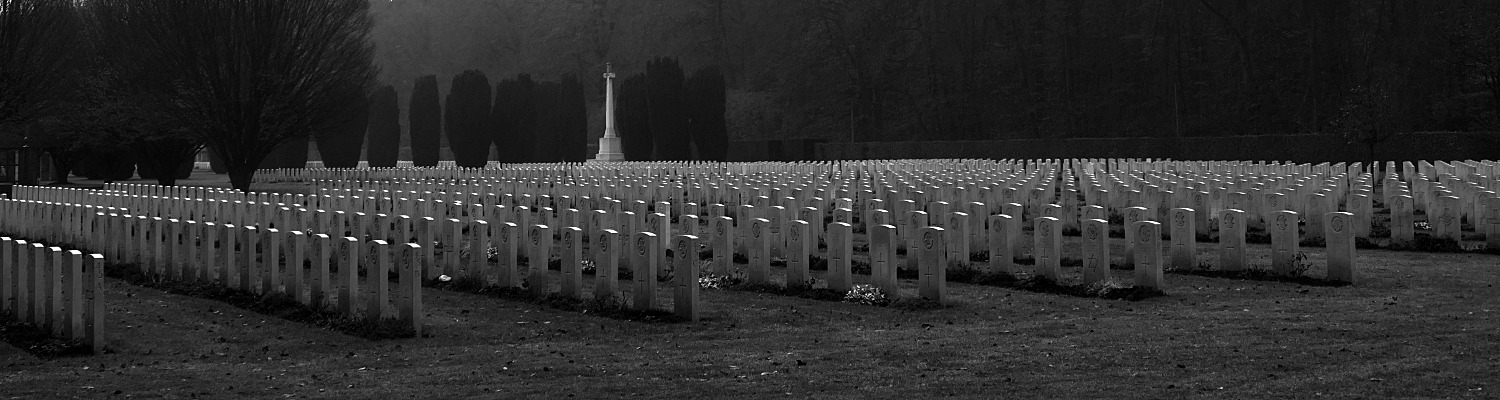
(Head picture: Gravestones at the British military cemetery Reichswald
near Kleve/Germany, November 2025)
If you wish to support my work, you can do so here. Many thanks!