
Thoughts on war: Laurence Binyon – For the Fallen (1914) (Published on 09/05/2025, latest update on 19/06/2026)
For the Fallen
by Laurence Binyon
With proud thanksgiving, a mother for her children,
England mourns for her dead across the sea.
Flesh of her flesh they were, spirit of her spirit,
Fallen in the cause of the free.
Solemn the drums thrill; Death august and royal
Sings sorrow up into immortal spheres,
There is music in the midst of desolation
And a glory that shines upon our tears.
They went with songs to the battle, they were young,
Straight of limb, true of eye, steady and aglow.
They were staunch to the end against odds uncounted;
They fell with their faces to the foe.
They shall grow not old, as we that are left grow old:
Age shall not weary them, nor the years condemn.
At the going down of the sun and in the morning
We will remember them.
They mingle not with their laughing comrades again;
They sit no more at familiar tables of home;
They have no lot in our labour of the day-time;
They sleep beyond England’s foam.
But where our desires are and our hopes profound,
Felt as a well-spring that is hidden from sight,
To the innermost heart of their own land they are known
As the stars are known to the night;
As the stars that shall be bright when we are dust,
Moving in marches upon the heavenly plain;
As the stars that are starry in the time of our darkness,
To the end, to the end, they remain.
(source: Binyon, The Winnowing Fan: Poems On The Great War (1914), p. 28 f.)
Robert Laurence Binyon, born on 10/08/1869 in Lancaster; died on 10/03/1943 in Reading, was an English poet, dramatist and art scholar. He served as a volunteer with the Red Cross during World War I, assisting wounded soldiers. Moved by the losses suffered by the British Expeditionary Force deployed in France and Belgium during the Battle of Mons, he wrote his popular poem “For the Fallen”, which was first published in The Times on 21/09/1914, and remains an integral part of war remembrance in the United Kingdom and Commonwealth countries to this day. Over time, the third and fourth stanzas of the poem – usually now just the fourth – have been claimed as a tribute to all casualties of war, regardless of their nationality.
There is a wealth of poetry, especially from British participants in World War I, on various aspects of war. Although originally written from a British perspective, a number of their thoughts are almost universally applicable more than a century later, for instance the works of MacLeish, McCrae, Brooke or Flint.
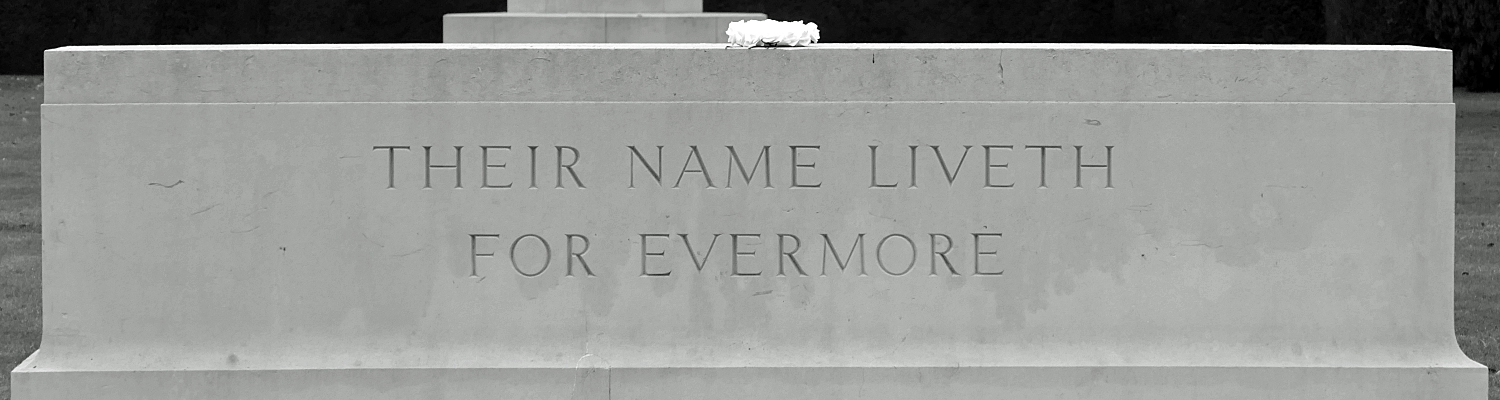
(Head picture: Memorial stone at the British military cemetery Reichswald
near Kleve/Germany, November 2025)
If you wish to support my work, you can do so here. Many thanks!