
Thoughts on war: Archibald MacLeish – The Young Dead Soldiers Do Not Speak (Published on 05/06/2026, latest update on 19/06/2026)
The Young Dead Soldiers Do Not Speak
by Archibald MacLeish
The young dead soldiers do not speak.
Nevertheless, they are heard in the still houses:
who has not heard them?
They have a silence that speaks for them at night
and when the clock counts.
They say: We were young. We have died.
Remember us.
They say: We have done what we could
but until it is finished it is not done.
They say: We have given our lives but until it is finished
no one can know what our lives gave.
They say: Our deaths are not ours: they are yours,
they will mean what you make them.
They say: Whether our lives and our deaths were for
peace and a new hope or for nothing we cannot say,
it is you who must say this.
We leave you our deaths. Give them their meaning.
We were young, they say. We have died; remember us.
The poem “The Young Dead Soldiers Do Not Speak” by Archibald MacLeish (born 07/05/1892 in Glencoe, Illinois, USA; died 20/04/1982 in Boston, Massachusetts, USA, buried at Pine Grove Cemetery in Conway) dates from 1943; the author wrote it against the backdrop of his own participation in World War I and the loss of his brother Kenneth there. It is frequently recited, particularly in the United States, on commemorative days such as Memorial Day or Veterans Day. The poem gives the fallen soldiers a fictional silent voice through which they hold the living accountable for the meaning of their deaths and call on them to create a world that justifies their sacrifice.
There is a wealth of poetry, in particular by British participants in World War I, on various aspects of war; although originally written from a British perspective, much of it can be described as almost universally applicable more than a century later, for instance the works of McCrae, Binyon, Brooke or Flint.
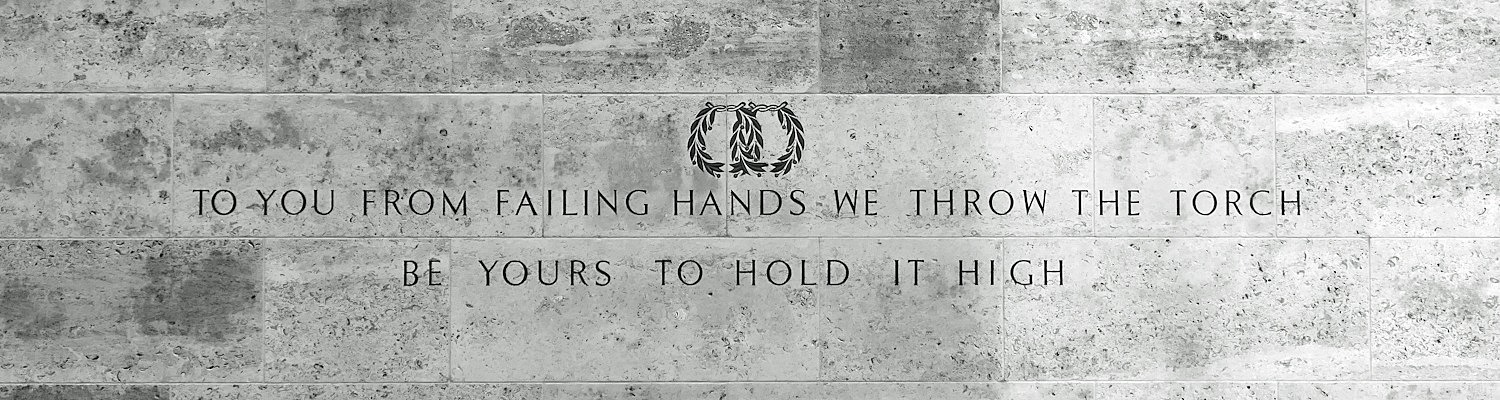
(Head picture: Inscription at the U.S. Military Cemetery Margraten/Netherlands
“To you from failing hands we throw the torch; be yours to hold it high”
from the poem “In Flanders Fields” by John McCrae, November 2025)
If you wish to support my work on Julius Erasmus, you can do so here. Many thanks!