
Mail Correspondence with Soldiers at War (“Feldpostbriefe”): Letter of German soldier Kurt Habernoll, February 1944 (Published on 28/06/2022, latest revision on 30/03/2026)
I. The Purpose of War
Even among Wehrmacht soldiers, there were critical voices that fundamentally questioned the purpose of the war. Some of these remain, to this day, both powerful and timeless testaments to humanity and a critique of power.
II. From a letter written by German soldier Kurt Habernoll in February 1944
One of these documents was written by the German journalist, critic, and author Kurt Habernoll, born in 1922, who was particularly active in the 1960s and 1970s and had a major influence on film criticism during that period. In spring of 1944, he wrote to an unknown recipient (source: Lilli Vetter, Briefe aus jener Zeit (1948), p. 115 ff. [translation from German language]):
“… and as far as the bombing of the cities is concerned, the general public and just as little the leadership are entitled to get into a fright, horror psychosis! What do you mean by ‘innocent people’? Doesn’t it always hit the ‘innocent people’? Is the soldier more ‘guilty’ of this war, which falls to millions on all sides of the battlefields? Who is entitled to whine and rant about the destruction of the Cologne Cathedral, for example? Nobody! Because who of these people has ever prayed fervently to God in this church? Nobody!
What are cultural monuments worth if they do not inspire us to do what they stand for as monuments and more? — What are people worth better than annihilation, who have seen culture preservation and life amenities as no more than their ‘rightful everyday dress’? Who now whine because they seem physically naked and are mentally naked?! … What is the talk of the politicians and political fanatics here and there; it is only about power and possession for them! The old primal evil of mankind, wanting to command others (mostly those who could not even obey their own soul and who are looking for ‘substitutes’ for it) — the addiction for possession without entitlement! Oh, it is idle to talk about it. There are also, God knows, more important things. We have to create something that cannot be destroyed by bombs! — The reconstruction of the new world will not be guaranteed by any of the ‘leaders of the nations’, still less by the more or less prominent market criers who run after these leaders. No, only the strength of a living cultural will of the peoples — of mankind — can achieve this and will achieve it! — The spirit that animates the people is decisive for their living and dying. But not the bombs, not the proclamations and not the programs of the victors.
In the end, the quantity of ammunition, machines or money can never be decisive, but only the number of people with a genuine inner right to live.
And this is also the deeper meaning of the war, which, however, was not intended by its originators; it more or less forcibly strips people of their cursed shells and masks. Only those will live afterwards, i.e. really and justifiably live!, only those whose aims in life go far, very far beyond the ‘daily bread’ and the dwelling with ‘running water’.
Immortal alone is the spirit that always creates new and always something new — a bomb cannot hit Beethoven’s symphonies and Goethe’s verses — and one thing grows (especially for the young generation) duty and responsibility before the future! And that is what fills me beyond sadness and pain, very deeply — the belief that I will belong to this coming generation that will build the new world one day! — As long as the buds break open every spring, we too, who are only a small part of this nature — have to live, have to seek to to live and have to work on our right to live, have to suffer and fight.
Hopefully Klaus will have a chance to get in touch soon — but one thing I know, I feel sure, is that he is alive and will be reunited with us one day!
Warm greetings to all of you!
Kurt”
III. Biographical data
Kurt Habernoll survived the war. As an actor he took part in the German anti-war film “Die Brücke” (“The Bridge”) by Berhard Wicki in 1959.
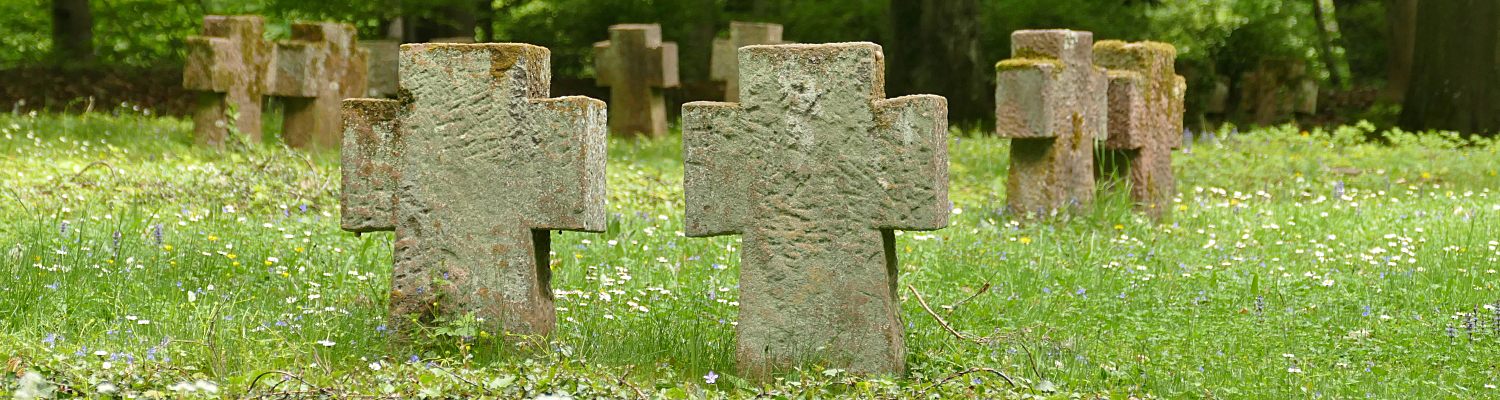
(Head picture: Ehrenfriedhof Heidelberg, April 2022)
If you wish to support my work, you can do so here. Many thanks!