
Mail Correspondence with Soldiers at War (“Feldpostbriefe”): Letter of German soldier Friedrich Geiger from Russia, August 1944 (Published on 21/06/2022, latest revision on 30/03/2026)
I. The collapse of the German front in Belarus in summer of 1944
As a result of Operation Bagration, named after the Russian General Pyotr Ivanovich Bagration, the German front in Belarus collapsed in the summer of 1944 over a width of approximately 400 kilometers following the annihilation of large parts of the 4th and 9th Armies as well as the 3rd Panzer Army. The Red Army advanced into the resulting gaps and pushed the remnants of the German forces westward toward Lithuania and East Prussia. The operation resulted in the loss of 28 Wehrmacht divisions and is considered the most severe and costly defeat in German military history.
II. Penultimate Feldpostbrief of Friedrich Geiger to his wife
It appears that the German teacher Friedrich Geiger also fought in this operation. While this cannot be confirmed with certainty, the timing of his death and his burial site would suggest as much. On August 11, 1944, he wrote his penultimate field post letter to his wife Luise, in which he describes the situation there (source: Volksbund Deutsche Kriegsgräberfürsorge, Letzte Lebenszeichen II – Briefe aus dem Krieg, p. 54 ff. [translation from German language]):
„My dear Lies!
I am sitting at my hole in the trench and would like to write you a few lines today, after a letter to Eva went off the day before yesterday. Yesterday it rained for the first time in a long time. Now the oppressive heat is gone, but there is a lot of smear in the trench. The clothes and boots are full of dirt. But that doesn’t embarrass me. The main thing is that it’s not cold and wet, but still warm. You also get used to not taking off your boots for 8 days day and night and still sleep wonderfully. The front is relatively quiet. The artillery, of course, sends its greetings back and forth every day. How glad we were when some batteries came and fired in opposite our trench at the Ivan. This gave quite a bit of respect. When I walk through the trench, in some places where it is not deep enough for my height, I always have to walk bent over so that the small of my back hurts. Because if you stick your head out, it whistles right around your ears.
(…)
You ask if being MIA [missing in action] is worse than death. I say no. Most missing persons, as far as they get into captivity, are certainly not treated as badly as one often imagines. They have to work, of course, and probably get a meager meal, but still within the bounds of what is bearable. Of course, there are also worse cases, for example, when we were on the Memel. Here the Russian had formed a small bridgehead, which was hard pressed by us. With the help of paratroopers, the Russian managed to capture 22 men of my former 2nd Company there. Since the enemy had to retreat again temporarily, he could not take the prisoners and shot them all down. I saw the poor men lying in the cornfield afterwards. But these are exceptions, as the vicissitudes of battle bring.
I would also like to comment on the ‘home shot’ issue. In the severity of battle, most probably wish for a lighter wound that would temporarily get them out of the ‘shit’. But one should always suppress such impulses. They spring from a base selfishness that wants to save one’s own skin even if one’s comrades continue to lie in the mud. For this reason, the desire for a home shot is fundamentally reprehensible. It is also a blasphemy against the Creator, to whom we must be grateful as long as we have our healthy bones. I feel the same way towards those who are always allowed to be at home and do not have to go to the front. Grant it to them! Most of those at the front would also like to be at home if they could do it. So they are not better, but are just envious. Moreover, as a rule, usually a man cannot influence whether he stays at home or goes to the front. It is doubly reprehensible, of course, if he tries to keep his position in the homeland by smearing, but most reprehensible of all for the one who lets himself be smeared.
For God’s sake, let us not follow the bad examples, but trust in divine providence, as it also intends to do with us. This is also how I view the general military situation. As black as it sometimes looks, we must not despair. Somehow the misery will come to an end. And the best thing we can ask the Lord God for is the strength to bear all that may come with poise. That is worth more than all other earthly stuff. With this attitude, all our joy and courage in life will never dry up. Gratefully we greet the sun in the morning, we look at the landscape. With inner happiness one remembers the loved ones at home, with whom one feels intimately connected and who make life worth living. And such happiness also radiates to others. I have often walked through the entire front trench of our section, and warm words of encouragement often work wonders. Many people have known only work, food and drink in their lives and are now too poor inside to survive the loneliness of life in the trenches. How many times naive people have asked: Why do we need poets, thinkers, artists, etc., we can’t eat from them. These people have forgotten that man does not live on bread alone, that the spiritual food that comes from great men helps us to overcome difficult situations more easily.
(…)
So let us continue to live, hope and do our duty.
With heartfelt greetings also to all loved ones
Your Friedrich“
III. Biographical data
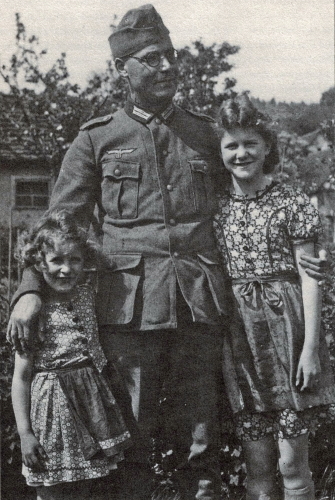
Friedrich Geiger, born on 11/05/1902 in Lorch, was killed on 15/08/1944. He was buried in the cemetery in Šakiai/Lithuania.
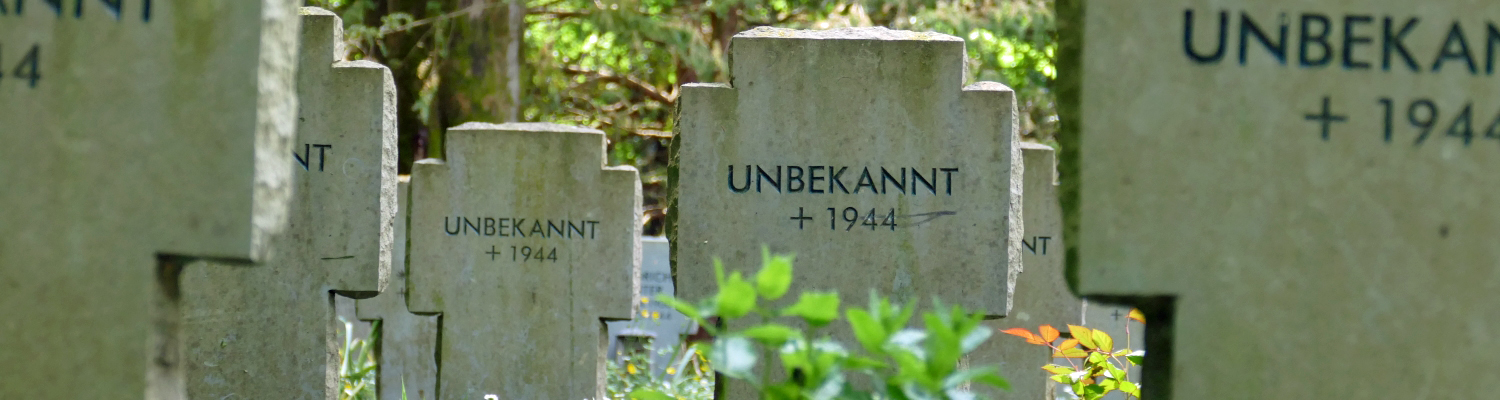
(Head picture: Forest Cemetery Aachen, May 2022)
If you wish to support my work, you can do so here. Many thanks!