
The German essence: Count Schwerin von Krosigk’s Address on Germany’s Surrender in World War II and Its Significance Today (Published on 02/05/2026)
I. A Look Back at Germany’s Unconditional Surrender in 1945
In these times of renewed militarization in Germany, when defense spending is reaching new record highs and calls for the reinstatement of conscription are made almost daily, it is worth looking back at the end of World War II on May 8, 1945. After nearly six years, the loss of millions of lives, and the devastation of countless regions, hostilities in Europe ended on this day with Germany’s unconditional surrender. On the night of May 7, 1945, Colonel General Alfred Jodl, Chief of the Wehrmacht High Command, signed a declaration on behalf of the German delegation at the headquarters of the Western Allied forces (Supreme Headquarters Allied Expeditionary Force, short “SHAEF”) in Reims, a declaration of the unconditional surrender of all German troops, which took effect for all fronts on May 8, 1945, at 11:01 p.m. and brought World War II in Europe to an end.
II. The radio address by Reich Minister Count Schwerin von Krosigk on the Reich Radio Station in Flensburg
On May 7, 1945, at 12:45 p.m., the Reich Minister of Finance, Johann Ludwig Graf Schwerin von Krosigk – who, following Hitler’s death, had been appointed by his successor Karl Dönitz as “Leitender Minister” (head of government) and foreign minister in Dönitz’s preliminary government – addressed the German people.
In a radio address broadcast on the Reich Radio Station Flensburg, he informed the public of Germany’s surrender and called on them to return to the values of unity, justice, and freedom, describing these as the three core elements of the “true German essence”. This address remains as relevant as ever, particularly in light of the situation in 2026 – especially Germany’s renewed militarization – and is well worth listening to and reading.
Count Schwerin von Krosigk said (translation from German language):
“Men and women of Germany!
The High Command of the German Wehrmacht has today, at the behest of Grand Admiral Dönitz, declared the unconditional surrender of all troops. As the leading minister of the Reich Government, which the Grand Admiral has appointed to handle the tasks arising from the war, I address the German people at this tragic moment in our history.
After nearly six years of heroic struggle of unforgettable severity, Germany’s strength has succumbed to the overwhelming power of our enemies. Continuing the war would have meant nothing but senseless bloodshed and needless destruction. A government that feels a sense of responsibility for the future of our people had to draw the conclusion from the collapse of all physical and material forces and request that the enemy cease hostilities.
The primary objective of the Grand Admiral and the government supporting him was to preserve the lives of as many German people as possible during the war’s final phase, following the terrible sacrifices the war had exacted. The fact that the war was not ended immediately, nor simultaneously in the West and the East, can be explained solely by this objective. In this most difficult hour for the German people and their Reich, we bow our heads in reverence before the dead of this war, whose sacrifice is our highest duty. Our sympathy and concern go above all to the wounded, the bereaved, and all those whom this struggle has scarred.
No one should delude themselves about the severity of the conditions our enemies will impose on the German people. We must face them clearly and soberly, without resorting to empty rhetoric. No one can be in any doubt that the coming times will be hard for each and every one of us and will demand sacrifices from us in all areas of life. We must accept these sacrifices and remain loyal to the obligations we have undertaken. But we must not despair or succumb to silent resignation. We must let our path through the darkness of the future be illuminated and guided by three stars that have always been the hallmarks of the true German essence: unity, justice, and freedom.
From the collapse of the past, there is one thing we wish to preserve and safeguard: unity, the idea of a national community, which found its most beautiful expression during the war years in the camaraderie of the front lines abroad and in the mutual willingness to help one another in times of need at home. We will need this camaraderie and willingness to help just as much in the coming hardships of hunger and poverty as we did in the days of battles and air raids. Only if we preserve this unity and do not fall apart again into warring classes and groups can we survive the hard times ahead.
We must make the rule of law the foundation of our national life. Among our people, justice must be the supreme law and the highest guiding principle. We must also recognize and respect the rule of law as the foundation of relations between nations out of inner conviction. Respect for concluded treaties shall be as sacred to us as the sense of our people’s belonging to the European family of nations, as a member of which we wish to mobilize all our human, moral, and material resources to heal the terrible wounds inflicted by the war.
Then we can hope that the atmosphere of hatred that surrounds Germany in the world today will give way to a spirit of reconciliation among nations – without which the world’s recovery is impossible – and that freedom will once again beckon to us, without which no nation can lead a tolerable and dignified existence.
We wish to see the future of our people in the rediscovery of the deepest and finest qualities of the German essence, which have given the world enduring works and values. We will combine our pride in our people’s heroic struggle with the determination, as a member of Christian-Western culture, to make a contribution through honest efforts for peace that is in keeping with the finest traditions of our people.
May God not forsake us in our time of trouble and bless our difficult work!”
III. Between 1945 and 2026: From dictatorship to “unity, justice, and freedom” – and back again?
While some parts of Count Schwerin von Krosigk’s speech may seem questionable from today’s perspective, one must bear in mind the prevailing spirit in Germany at that time, which was addressed.
In the context of this blog, we should above all recall the oft-invoked “reverence for the dead of this war, to whose memory we owe the highest duty”, as well as the compassion and concern for “the wounded, the bereaved, and all those whom this struggle has scarred.” When, for example, sometimes the placing of flowers or candles in military cemeteries is now prohibited and so-called “Dance Theater” is performed directly above the graves of war dead, this clearly demonstrates the doubtful intellectual and moral path this country has taken once again.
When the Federal Republic of Germany was founded, unity, justice, and freedom were defined as the cornerstones of the new state and, as such, were also emphasized in the new German national anthem. The anthem describes the realization of these values as “the pledge of happiness”, in whose “glory” the “German fatherland” is to flourish again.
What is the current state of unity, justice, and freedom in Germany?
Perhaps at no time since the end of World War II has the German society ever been so fragmented and divided as today, with people turning against one another over the most trivial matters, sometimes to the point of open violence. The realization of law and justice is increasingly being relativized and made contingent on whether it aligns with the now prevailing political and ideological climate of the day. Not everyone who is in the right according to law and justice is granted that right by the courts. The so-called “allgemeine Handlungsfreiheit” (“general freedom of action”) enshrined in Article 2, Section 1 of the German Grundgesetz – the constitutional foundation of the liberal state – is increasingly being called into question, and with it, individual freedom. Said “flower ban” at the German military cemeteries in Hürtgen and Vossenack, which has so far been ruled lawful by all courts, is just one example of a state that is becoming increasingly intrusive.
While, in his address to the German people in May 1945, Count Schwerin von Krosigk called on them to muster all their moral and material strength to heal the terrible wounds inflicted by the war, German society is now being prepared day by day for the infliction of new wounds and seems to be coming to terms with this.
While in the speech of May 7, 1945 the future of the German people was seen in drawing upon the “deepest and finest qualities of the German essence” and, in doing so, “making a contribution through honest efforts for peace that is in keeping with the finest traditions of our people” – a vision that was also lived out for decades by the vast majority of those who had experienced war and its consequences firsthand – one cannot help but rub one’s eyes in astonishment in light of the new German enthusiasm for rearmament and military adventures. The so-called “war generation”, now almost completely extinct, is sorely missed as a cautionary force, and the increasing acceptance of war and the military in the country, which correlates with their passing, is hardly a coincidence.
Once again, the fatal German tendency toward unconditional obedience to supposed authorities – a tendency once thought to have been overcome – is coming to the fore, accompanied by a sometimes grotesque overestimation of one’s own capabilities, a tendency that has repeatedly brought death and destruction to the country and the world. The world will not be healed by the German essence, not this time either. There is still hope for reflection and a change of course, but given Germany’s history and its new amnesia regarding the past, doubts are certainly warranted.
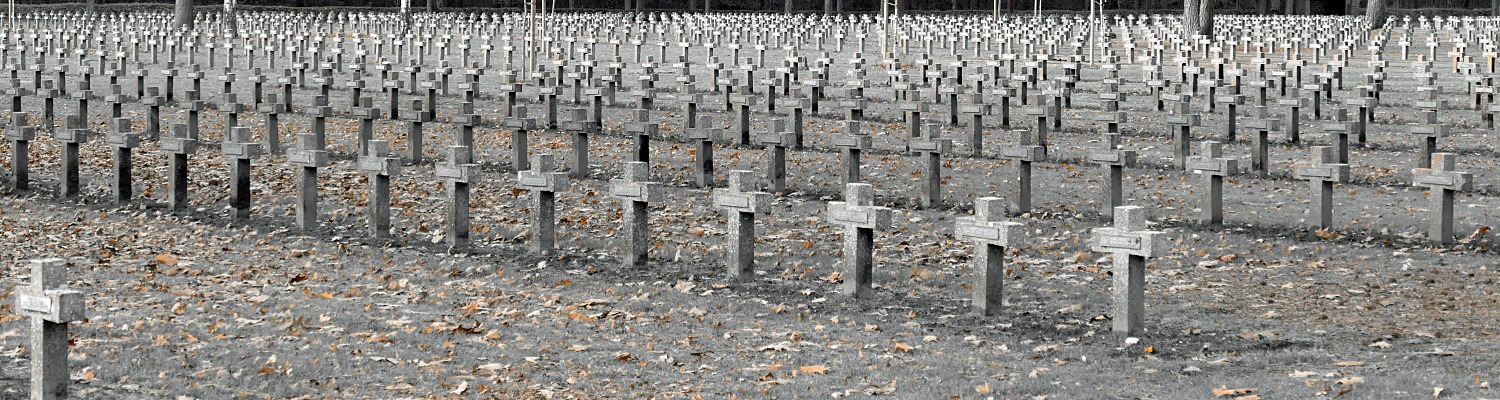
(Head picture: Grave crosses at the German military cemetery in Lommel/Belgium,
November 2025)
If you wish to support my work, you can do so here. Many thanks!