
Episodes of War: An eye for an eye in Schmidt in November 1944 (Published on 17/04/2023, latest update on 19/04/2026)
I. The 28th U.S. Infantry Division in the Battle of Hürtgen Forest
During the approximately six months that the Battle of Hürtgen Forest lasted, both sides committed numerous infantry divisions to the fighting; due to heavy casualties, these divisions soon had to be replenished or replaced. Armored units could only be deployed to a limited extent in the dense forest terrain.
One of the U.S. divisions that was deployed not only in the Hürtgen Forest but frequently at flashpoints along the Western Front was the 28th Infantry Division (“Bloody Bucket”) with its 109th, 110th, and 112th Regiments. Deployed in the Hürtgen Forest starting on October 28, 1944, the division saw action particularly in the “All Souls’ Day Battle” and suffered heavy losses. It was relieved toward the end of November 1944.
II. Death on the Cross
The 110th U.S. Infantry Regiment was primarily tasked with securing the southern flank of the main assault on Schmidt, led by the 112th U.S. Infantry Regiment, and was engaged in heavy fighting around the Siegfried Line bunkers in the Raffelsbrand and Simonskall areas (source: Chernitsky, Voices from the Foxholes – Men of the 110th Infantry relate personal accounts of what they experienced during World War II, p. 62 f.):
“After the Hedgerows of France, the 28th Division was the first division to enter Germany. On Nov. 2nd the Division was ordered to secure the Hurtgen Forest. The Hurtgen Forest was the worst ordeal I had in the service. The amount of men lost is unbelievable. My checking of the foxholes each morning increased the casualty list that kept piling up. The cold weather and snow were no help, as you checked the hole some of the men were stiff from the cold, others were dead. The constant firing of shells making tree bursts surely made our lives very uneasy. I remember one night, we received two new lieutenants as replacements. The C.P. sent them to me and I was elated, for the first time in months I had dreams of getting some rest and sleep. I told them they would be up and awake all night. I sent them back to the Mess tent for some refreshments (food and drink). It was about fifteen minutes later a shell burst over the Mess tent. I couldn’t believe it. Both lieutenants were hit, one wounded in the shoulder, the other in the forearm. Of course they were immediately sent back and there went my night of rest.
As you probably know, the towns in this sector of Germany are very religious (mostly Catholic) and in the center of the towns one would find the Crucifixion and several statues with the crosses. Our patrol duty was the town of Schmidt, daily we would check the houses, etc. in the daytime. We also knew that the Germans patrolled the same town at night. One morning our patrol came into town and found a G.I. hung on the Crucifixion Cross (we cut it down). We stayed in town and hid in a few houses waiting for the Germans. The German patrol came in, we had a gunfight, they were caught by surprise. A few of the patrol got away but we took three Germans and hung them on the three crosses. That ended that little fanfare for both sides in this town.”
The act vividly illustrates the perversions unleashed by war. As is well known, in the Christian faith the depiction of Jesus nailed to the cross symbolizes the sacrifice Jesus Christ made for the salvation of humanity. To demonstratively hang people on such a cross says everything about the nature of war and the brutalization of those involved in it.
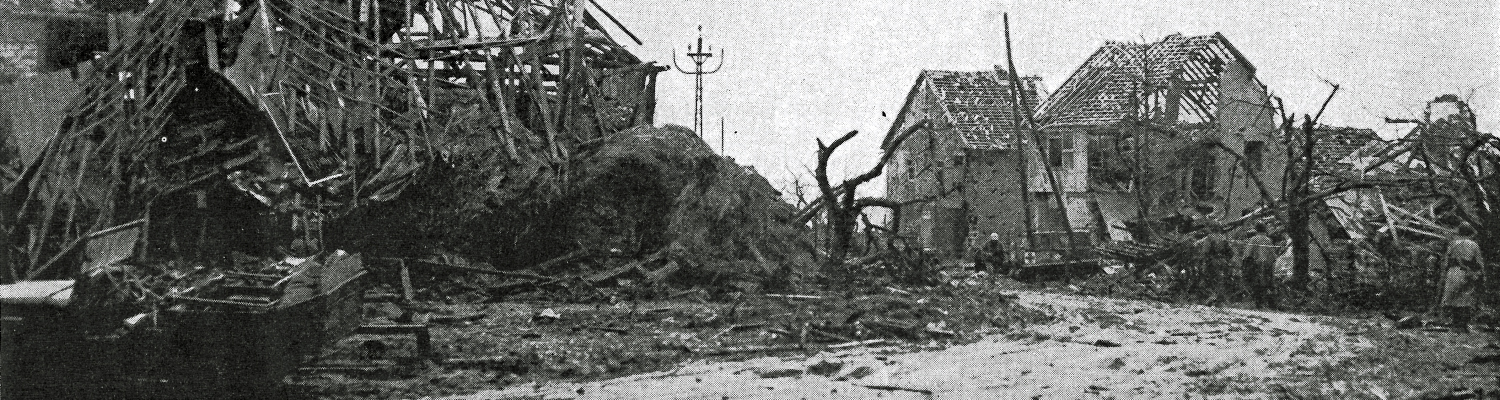
(Head picture: Destroyed Schmidt,
from: Lightning – The History of the 78th Infantry Division, p. 108)
If you wish to support my work on Julius Erasmus, you can do so here. Many thanks!