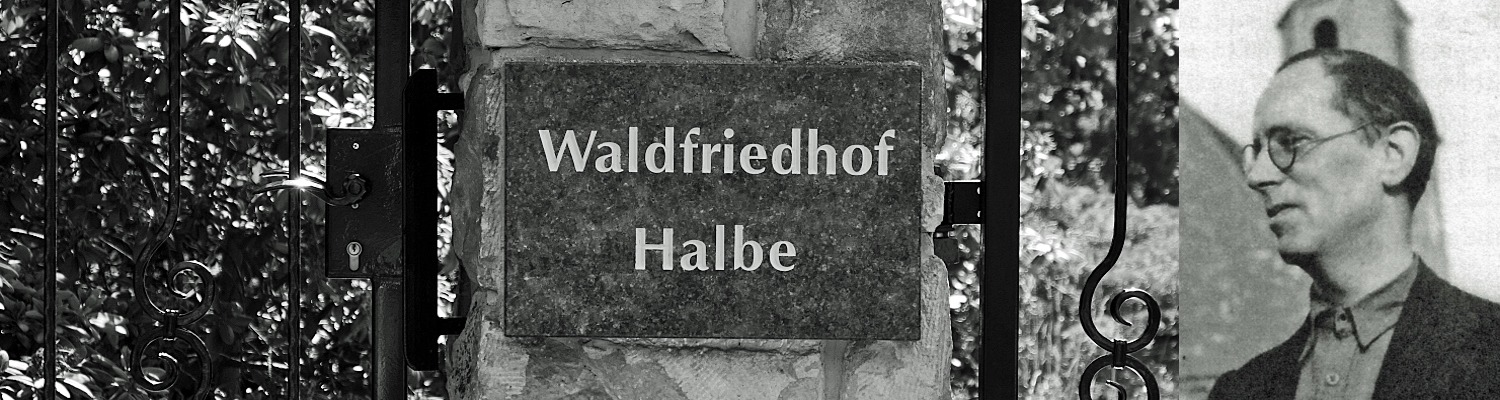

In Memoriam: Recovery of World War II Dead in the Halbe Region by Pastor Ernst Teichmann (Published on 06/07/2026)
I. Caring for the dead
This blog is also intends to honor those who, like Julius Erasmus, dedicated themselves to the recovery, identification, and burial of people killed in war, and who sought to restore these victims’ names and create a place of mourning for their relatives.
This series has already featured Gerda Dreiser from Bitburg, Toni Latschrauner from Merano, Lodewijk Johannes Timmermans from Ysselsteyn, and Nikolai Orlov from Novgorod.
II. The Battle of the Halbe Pocket in April 1945
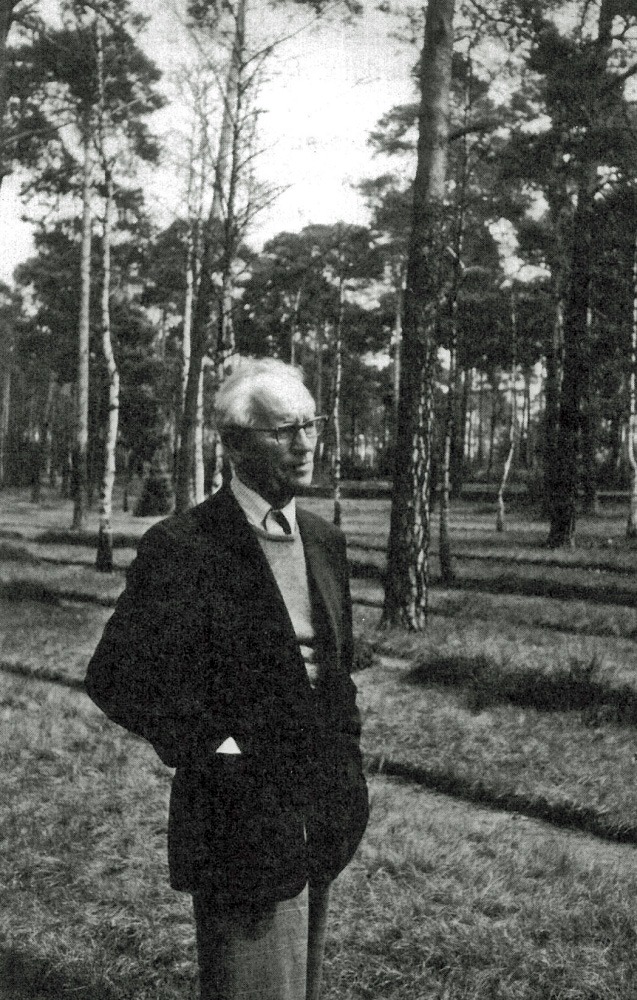
To this day, one of the best-known figures of war graves care in Germany is the Protestant pastor Ernst Teichmann, who, undeterred by government restrictions in the former GDR, devoted himself to caring for the war dead and their families in the Halbe area.
The area around Halbe, about 60 km southeast of Berlin, was the scene of the so-called Battle of Halbe in late April 1945, when Soviet troops encircled the German 9th Army and civilians fleeing westward in the forests between Storkow, Märkisch Buchholz, and Halbe. On the night of April 28–29, 1945, German troops broke out of the encirclement, suffering heavy losses. An estimated 30,000 German soldiers, 10,000 German civilians, and many Soviet forced laborers are believed to have lost their lives in the Halbe Pocket; 120,000 German soldiers were taken prisoner by the Soviets. The Red Army suffered approximately 20,000 casualties.
III. The Dead from the Battle of the Halbe Pocket
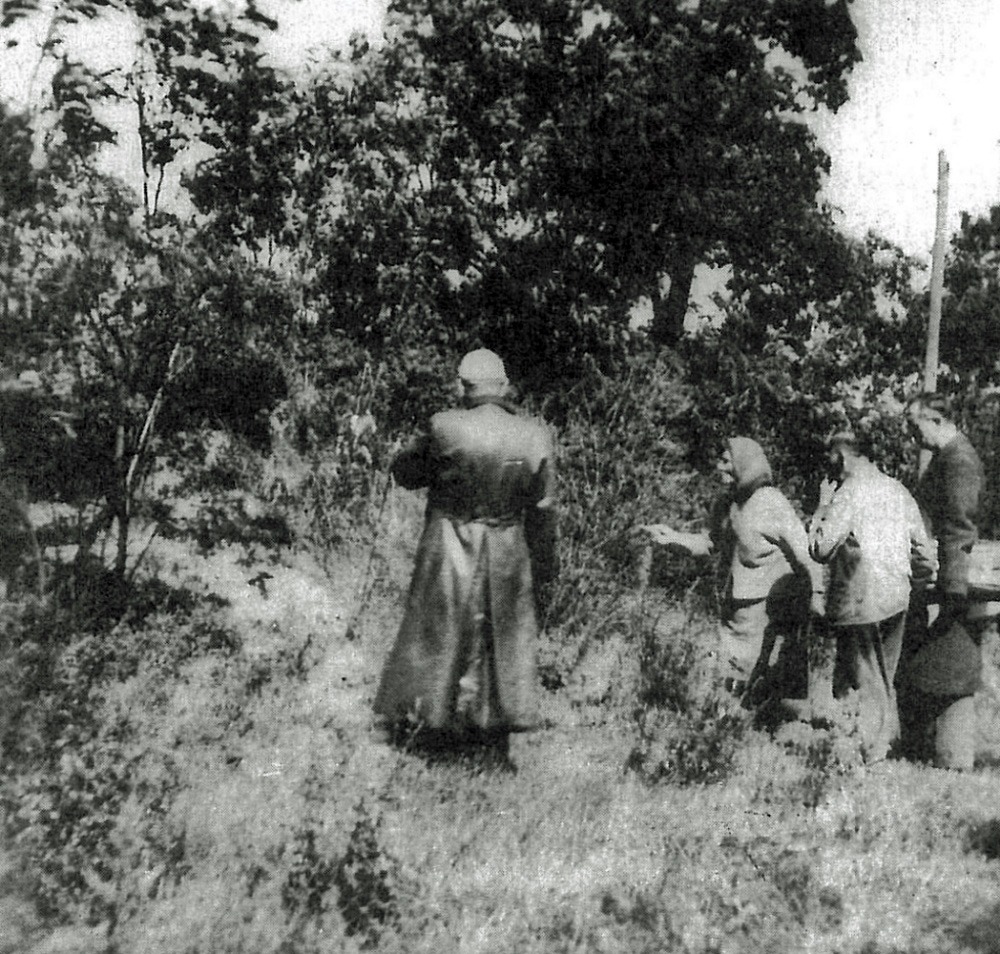
After the fighting had ended, the Red Army commanders ordered the local population – consisting essentially only of women, children, and the elderly – and prisoners of war to provide a makeshift burial for the numerous German dead scattered throughout Halbe and the surrounding fields and forests, mostly in mass graves on the spot. The exceptionally hot temperatures in May and June 1945 made a swift burial all the more urgent and further complicated the work. Names were often not recorded, and information that could have been used for identification – such as dog tags or pay books – was left unsecured, frequently at the instigation of Russian troops (see Mückler/Hinderlich, Halbe – Bericht über einen Friedhof, 2nd ed. (1997), p. 20).
The following account of the situation on the ground comes from Hans Jabschinsky, a 15-year-old member of the German Volkssturm who participated in the rescue efforts (see Mückler/Hinderlich, op. cit., pp. 20-21 [this and all subsequent citations translated from German language]):
“Back then, you couldn’t open a single window in or around Halbe – if there was even one left. So we dragged the dead – often mutilated, including many women and children – into holes, hauled them into ditches, basically wherever we could get rid of them the fastest. If there was a hollow nearby, the dead would end up lying haphazardly on top of one another; then we’d just throw a layer of sand on top and move on to the next bodies. No markers were set up, and nothing was recorded. The Russians were especially vigilant in ensuring that no one took identification tags or pay books. The rescue of the tank crews was a whole other story. If a terrible stench wafted from destroyed tanks and assault guns, we knew – the crew was still inside! But we couldn’t see anything because of the swarms of carrion flies. If you lifted an access hatch, clouds of blowflies would pour out toward you. Warm summer weather prevailed during those days in May and June of 1945.
But we were supposed to get them out – the ones still crouching in their seats, hanging over ammunition crates, and clinging in pieces to the tank’s hull. We didn’t see them at first, but we could smell them all the more clearly from their steel coffins. Climbing inside was out of the question. For this particular task, we’d armed ourselves with shovels. For the old soldier I was assigned to, that wasn’t a problem. He pulled the pin on an egg-shaped hand grenade – those things were still lying around everywhere – threw it through a hatch, and the problem of them flying around was blown away. Now we hacked away from the outside with our shovels at the bodies, which were faintly visible, and began to pull – to pull slowly. Oh my God! The slimy, sticky mass of flesh began to stretch like chewing gum; intestines bulged out, and often the chest cavity would tear open as well. So we had to keep at it until we’d managed to haul the first one through the hatch amid a cloud of mist. Once, twice – for hours on end, days on end – and you’re supposed to remain a decent human being through it all?”
While German field graves were ubiquitous in the Halbe region in the summer of 1947, the Soviet dead had for the most part already been buried in their own cemeteries, such as the Soviet Cemetery of Honor in Baruth.
IV. Pastor Ernst Teichmann is coming to Halbe
It was in this situation that Ernst Teichmann first came to Halbe.
1. The Road to Halbe
Born on August 11, 1906 in Jever, he spent his youth as an orphan with foster parents near Berlin. He first completed a banking apprenticeship and then, after being laid off due to rampant inflation, studied theology in Berlin from 1932 to 1937 and was ordained as a pastor in 1940. Drafted into the Wehrmacht in October 1939, he served as a soldier throughout World War II and was taken prisoner of war after the war ended; however, he was able to return to his family as early as June 1945, by which time they were living in Wernigerode. In 1948, he became the regular pastor in the Schierke district of Wernigerode. From aunts and cousins, who had escaped from the Halbe encirclement as German Red Cross nurses, he learned of the events that had taken place there in April 1945 (see Mückler/Hinderlich, op. cit., p. 24).
2. The Search for and Documentation of the Graves
In the summer of 1947, Pastor Teichmann visited Halbe for the first time – a place still ravaged by the war, with its numerous field graves, often marked only provisionally, which no one had attended to until then. He also traveled there during the summer months in the years leading up to 1950 and, with the help of locals, worked to locate and systematically document the graves.
The following appeal he made to the local population in 1950 has been preserved (see Potratz/Stark, Ernst Teichmann – Pfarrer vom Waldfriedhof Halbe (2007), p. 15 ff.):
“A heartfelt request to all residents of Halbe and the surrounding area! Having been able to carry out preparatory work for the reburial of the deceased here in Halbe and the surrounding area – as planned by the state government – with the kind support of the authorities and the local community, I would like to conclude today by expressing my gratitude to everyone who helped me with love and understanding, and at the same time ask for everyone’s cooperation:
Above all, I ask that you perform this act of love – which should go without saying – for the families of the deceased with special care and a willing heart! (Since the information we provide can help many who are waiting in vain for their loved ones to return home, and can at least relieve them of their agonizing uncertainty!)
Above all, I ask for information:
Where in the Halbe district are there still graves that do not have a numbered plaque?
Does anyone still know the names of the deceased or their relatives from among the graves located here? (Answering this question is particularly important because, otherwise, during the reburial process, there is a possibility that a previously identified deceased person – if not reported as such to the reburial team – might suddenly be buried as an unidentified person. To prevent this, I ask everyone who still remembers any names or knows of graves that are not marked as such to come forward!)
Where are any dog tags, service records, rings, or other identifying items (notebooks, etc.) that have been found or confiscated currently located? (If possible, please include details on where they were found or confiscated!)
All items must be turned in at the mayor’s office in exchange for a receipt, along with a detailed description of the items or a label. Numbered signs are still being installed in the Forst [name of a wooded area], but I ask all residents to take care to ensure that as few graves as possible are lost. (Once the numbered signs have been installed as widely as possible, we intend to reconvene the burial teams to determine who can still recall any unrecorded grave sites.)
Dear people of Halbe! Please help in any way you can so that the traces of war – which are so painful for all of us – in our gardens, forests, meadows, and fields do not remain as they are. The goal is not merely to create a cemetery through our own labor, but to establish a resting place for the many dead in and around Halbe – a place where truly all the residents of Halbe and the surrounding area have contributed with love and thoughts of peace. With this in mind, let us serve the spirit of a new humanity, so that we (each in our own way and to the best of our ability!) may quietly share in the guilt and suffering of others, so that the world, as far as we are able, may be freed from hatred and the clamor of war.
Halbe, 31/10/1950
Ernst Teichmann”
By 1950, Pastor Teichmann and his assistants had recorded so many burial sites that they would eventually form the foundation of the Halbe Forest Cemetery (see Potratz/Stark, op. cit., p. 9).
3. A Place for the Dead
As early as July 1948, the Teltow district – which had jurisdiction over Halbe – had issued an administrative directive to the municipalities to inter the remains of fallen soldiers and civilians from field graves in the municipal cemeteries and to forward all identifying information to the German Red Cross (DRK). Since this directive could not be implemented – not only in the area around Halbe but elsewhere as well – due to the effort required to process the thousands of graves, it was repeated in 1950.
Ernst Teichmann, however, had entirely different ideas about the burial of the dead. He wanted to transfer all the deceased to a new cemetery to be established, and found an influential supporter of this proposal in Dr Otto Dibelius, the regional bishop of the Evangelical Church of Berlin-Brandenburg. While the Brandenburg state government was initially open to the establishment of such a central cemetery under church administration – and various plans had already been drawn up – it subsequently changed its stance and refused to grant its approval. The state then decided to take charge of building such a cemetery itself and passed a resolution to that effect in 1951 (see Mückler/Hinderlich, op. cit., p. 28 ff.).
It was also decided to reestablish a single-pastor parish in Halbe, which was filled by Pastor Teichmann – a pivotal decision that made the specific form of his subsequent work on the ground possible in the first place. The Teichmann family – consisting of the pastor, his wife Ilse, and their three children, Christine, Jens, and Friedegard – moved into the parsonage in the summer of 1951, which was still damaged from the fighting in April 1945 (see Potratz/Stark, op. cit., p. 9).
V. The Construction of the Halbe Forest Cemetery
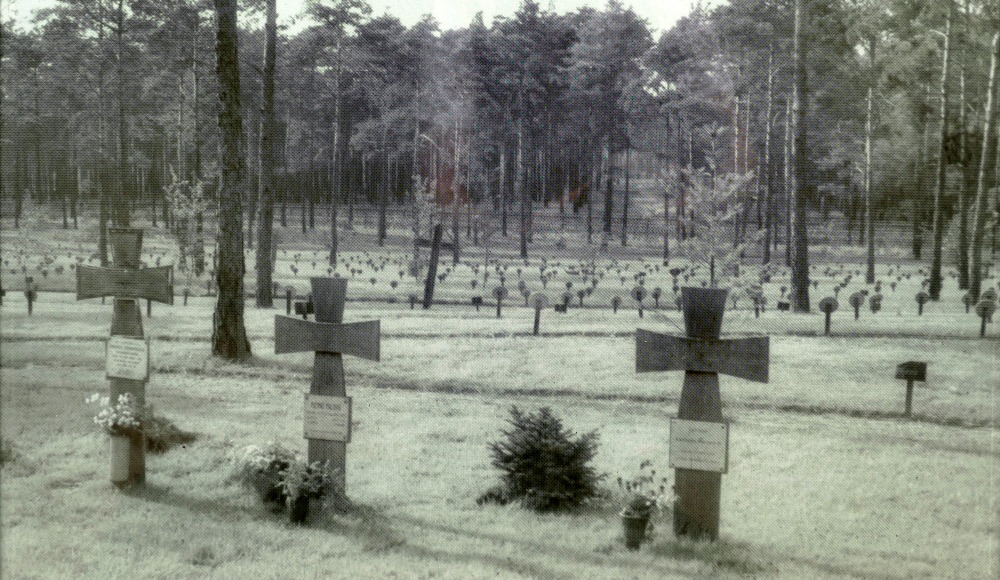
Work on the cemetery began in the fall of 1951. The first reburials there took place starting in October 1951, and – surprisingly – it was expected that the work would be completed by the end of the year (see Mückler/Hinderlich, op. cit., p. 37).
For a long time, the Forest Cemetery was known as the “Central Cemetery”, because, in addition to the dead from Halbe, many other war dead from all over Brandenburg and other regions of the GDR – such as the lignite mining areas – were buried here. Fifty-seven soldiers sentenced to death and executed by the Wehrmacht’s military courts, Soviet forced laborers and their children, as well as approximately 4,500 victims of the Soviet internment camp in Ketschendorf, also found their final resting place there (see Potratz/Stark, op. cit., p. 10 and Mückler/Hinderlich, op. cit., p. 49 ff.).
Within the first three months after work began, 6,803 deceased had already been buried there. Although the reburials were initially considered complete in 1954, the discovery of new graves on an ongoing basis necessitated the continuation of the work; the cemetery’s area even had to be expanded to accommodate the deceased. As of December 31, 1958, the cemetery contained 19,178 graves; by the end of 1989, this number had grown to 20,222 (see Mückler/Hinderlich, op. cit., pp. 37, 40, 47).
To this day, war dead are still being found and buried at the Forest Cemetery. For unknown reasons, the number of those buried there varies between “around 24,000” and “over 28,000”; in any case, it is one of the largest military cemeteries in Germany.
VI. Pastor Teichmann’s dedication to the war dead and their families
From the very beginning, Pastor Teichmann devoted special attention to the war dead and their families, and saw his pastoral care of the grief-stricken bereaved as his particular duty as a local clergyman. He worked with great perseverance and meticulousness on the recovery and reburial of the dead. He worked – often against the will of the GDR bureaucracy – to identify the dead and notify their families; he conscientiously secured evidence that might enable the identification of a deceased person at a later date.
1. Humanistic motivation drawn from his own wartime experiences
According to his own account, he drew his motivation from his six years as a Wehrmacht soldier, during which he had been in immediate danger of death on numerous occasions but nevertheless managed to return safely to his family (see Potratz/Stark, op. cit., p. 84). Pastor Teichmann’s humanistic motivation is expressed in a letter to the Minister President of the State of Brandenburg, Rudolf Jahn, from 1951, as are the obstacles that the state increasingly placed in his path (see Potratz/Stark, op. cit., p. 28 ff.):
“Pastor Ernst Teichmann
Halbe, Teltow District, 6/10/51
Dear Mr. Minister President,
Dear Mr. Nuschke,
Since District Administrator Siebenpfeiffer from the Teltow District was also here – and while he took a personal interest in the reburial efforts, he likely will not, or cannot, bring about any significant changes – I am turning to you once again, and I believe that by doing so (since this is the final step for me), I have fulfilled my duty to the government.
I must say quite frankly that I have the impression the government’s heart is still missing from this whole matter, and that is why I am writing to you today – because I believe I have found a piece of the government’s heart in you. In what follows, I am not speaking of abstract theories, but of practical matters and real-life experiences. As I write to you now, I can still see the two women and mothers who sat before me here in the rectory yesterday, so full of sorrow, and who drove home once again, having been comforted, and I know (without being presumptuous, for what is happening here is far too distressing for that!) where a mother’s heart turns to distress and despair.
After his visit, I sent the District Administrator a letter telling him that I would not have my father or my own children reburied the way it is being done here, and that we, after all, hold the same office on behalf of those who are suffering. Even today, I would say that if there’s no other way to do it, I’d rather things stay as they are! For the sake of the cause itself, I object to turning a task that is so serious for our people into piecework – at the expense of care and attention!
Above all, I miss having a conscientious minute-taker on every reburial detail who is always present and takes notes immediately. It is unacceptable that Mr. Löffler, the reburial supervisor, does this himself on the side whenever he has the chance – probably to save on manpower and thereby earn a little more. That would also not be in keeping with the nature of the government. I personally believe that such a record-keeper should err on the side of being overly meticulous rather than careless. Why aren’t engravings on tablespoons recorded, since they could still – perhaps even after 2–3 years – be important for investigations? Why not collect well-preserved samples of clothing and the like from civilians, who are already harder to identify? I am repeatedly shocked by the self-assurance of those in charge, who think so superficially about these very matters and make judgments without having gathered the necessary experience!
Above all, I object to the fact that the dead are not, as a rule, completely excavated, but are instead literally hacked and torn apart piece by piece – often even arbitrarily – with spades and potato hoes (!). This is so disrespectful, even when you consider that some things simply cannot be done more carefully! For the sake of the cause, I’d like to show the head of the reburial operation and the government how it can and must be done more carefully if one wants to do it properly.
There’s one final question that keeps coming up for me – and all of this with an eye toward the people, for whom the government is, after all, there: What is the government doing to thoroughly search the area (we’re still finding dead bodies lying out in the open!) and continue to register the graves? I even believe – if anything is to be done at all – that while orders can be issued and superficially carried out, that’s not enough; we must also awaken people’s compassion and understanding and make them realize that their own fathers, children, or wives might be lying there. Then, unless they’ve become completely callous, they would search – and find – with a little more compassion and zeal.
Furthermore, I believe that this Central Cemetery, which is intended to serve as the final resting place for the victims of the largest battle in Germany, is not just a matter for the state government of Brandenburg, but for the GDR – it is a matter for all of Germany.
I won’t deny that there is concern that no accusations should be made; on the other hand, however, we ourselves are giving cause for them; and I would be sorry – for the sake of the cause and for our own sake – if not only accusations were made, but if these hasty and therefore so irreverent methods were to add new suffering to the long-standing heartache of the many who are already suffering. Here in Halbe and throughout the surrounding area, many Christians – Protestants and Catholics – as well as non-Christians lie side by side: men, women, children, and even the unborn. As human beings in general or as conscious Christians, we can pass by this site and have many thoughts of our own about God, the world, and politics, but there is one thing we should all agree on (which is precisely why the state government’s behavior is so incomprehensible to me!).
We should have learned from the hardships of the past and the present to see the spirit of humanity in a greater and more comprehensive way – and to feel it within ourselves! And that is why it seems almost unbelievable to me – if I hadn’t experienced it myself – that a pastor, who otherwise has so much to do with the dead and those who suffer, should suddenly be excluded here against all reason and love, and not even be allowed to participate by offering help and advice – especially in work that he himself has carried out for years on his own, without any external publicity, almost alone, and in which I have, unfortunately, also observed many evil things – even fraud – that could have been avoided with just a little more interest on the part of the authorities!
Dear Mr. Minister President! It took me three years just to repeatedly get the various agencies in charge interested in this matter; for three years, I used every spare moment to make preparations for the state government’s work as, as I was told at the time, an »honorary staff member of the state government« – and now the state government wants to complete this still-incomplete work in three – not even three full months!!!!
For three years, I was allowed to handle the preparations for these reburials. Now, strangely enough, they’re telling the person who knows a little more about these matters and has a better overview: »The pastor has absolutely no business being here!« Quite aside from the fact that this is wrong, I’m sorry that I’m not allowed to help! I also think it’s very unwise, even though it might be more convenient at the moment. I also don’t understand why they’re talking about finding a man to clean the dog tags and turn them in to the tracing service on Kanonierstraße, yet won’t even allow me – who knows how things work and is humbly offering my services – to perform even this smallest of duties among brothers.
Dear Mr. Minister President! There is so much I simply cannot understand anymore! It doesn’t matter to me whether I do this or that specifically, but rather that someone does it at all – with love, diligence, and care. I don’t understand why they would choose someone who does it primarily for the money and reject the one who is fully committed – and has always been so! Has a pastor already been so degraded in the eyes of the authorities? And isn’t there at least some awareness even in these circles that a pastor is also a human being – and certainly not a malicious one? If I were allowed to do any work at all – because I am fully committed to it with all my love – I would not shy away from an inspection; on the contrary, it could only serve to confirm my work. I myself, however, am currently not in a position to confirm the reburial work here, and I would be sad if even this endeavor – which should and must be a work of love and a work of peace – were to bring about new suffering and strife, in which right and wrong, along with spiteful exaggerations, always lie so close together. My greatest concern, however, is that traces might be obliterated here under certain circumstances – traces that we may never find again! Since I, the pastor of Halbe, am rejected as the advocate for the many unknown victims, I now, in my personal distress, place this office in your hands and in your heart, Mr. Minister President!
I send you my regards, Esteemed Minister President,
with the utmost respect,
Yours,
Your most devoted
Pastor Ernst Teichmann
P.S. The cemetery itself is beautiful, and I like it.”
2. Pastoral Care for the Bereaved
Although viewed with skepticism by the political authorities, Pastor Teichmann also offered his help with work on the graves and, together with his family, assisted in cleaning the headstones. Pastor Teichmann did not limit himself to his pastoral duties, however; he also played an active role in the cemetery’s design, as well as in reburials and identifications, and worked diligently to maintain a meticulous registry of the fallen. As a local voice of conscience, he became an institution and increasingly a thorn in the side of the GDR’s state institutions (see Mückler/Hinderlich, op. cit., p. 51).
Pastor Teichmann did not let this unsettle him. He continued his efforts undeterred and helped countless family members navigate the GDR’s bureaucratic red tape – visiting war graves within the GDR was often made difficult or even impossible for family members from the FRG through bureaucratic means – until they could finally stand at the grave of their deceased loved one in Halbe. The Teichmann family accommodated many of these visitors in their parsonage during their stay; by the mid-1950s, their number had reached 200 to 300 per year (see Mückler/Hinderlich, op. cit., pp. 57, 61). Pastor Teichmann also maintained an extensive and compassionate correspondence with the relatives; for the year 1979 alone, 1,117 such letters are documented (see Potratz/Stark, op. cit., p. 12).
3. Remembering the War Dead as a Call for Peace
Pastor Teichmann never tired of emphasizing the importance of identifying and preserving the identities of those who died in the war and notifying their families. In a 1971 work report, for example, he described the case of 400 soldiers’ graves from Klein Köris, of which 380 were originally known by name but all became unknown as a result of their inadequate reburial in Halbe (see Potratz/Stark, op. cit., p. 65 ff.):
“On June 4, 1968 – more than two years ago – I gave a detailed presentation to the cemetery commission, drawing attention to many problems at the cemetery and urging that the remaining issues be addressed, because I believe it is finally time to do so if we do not want our fellow citizens who are affected by these issues to pass away without seeing them resolved. For example, it is high time to finally compile an accurate record of the deceased from Klein Köris buried in the Halbe cemetery. Despite a list of names that has existed from the very beginning, most of them have remained unidentified.
If the reburial of identified deceased individuals results in them becoming and remaining unidentified, that strikes me as callous and also irresponsible. That is why I have repeatedly advocated for their registration, but have found little support for this cause, because no one felt truly responsible for all these issues anymore. For me, it has remained a pastoral concern, because I also think of the surviving relatives in this context. In the meantime, I had created an »individual grave index« and a »mass grave index«, the more complete version of which is located in the office of the municipal council and which I used, in coordination with the then-representative of the local authority, Mr. Wölki, to verify the grave numbers. Incorrect names, gravestones with incorrect inscriptions – some of which appeared twice and, in a few cases, even three times with the same names in different locations – incorrect labeling (unknown instead of known), even though precise records were available, and the omission of first names and dates of birth (even today!) made this work difficult and caused sadness among relatives who visited the graves.
Since all my suggestions and proposals to try to reach the relatives of every known deceased person were unsuccessful – perhaps because this involves an immense amount of painstaking work – and since a meeting with Mr. Götting, which I had been requesting for a long time, has still not taken place to this day, and since discussions with Mr. Ehlers, later with Mr. Kind, and on several occasions with the president of the German Red Cross, Prof. Dr. Ludwig, all of which ultimately proved unsuccessful, this once again presented me with a pastoral dilemma that finally led me to attempt to reach out to the relatives – who apparently were still in a state of uncertainty – through the Protestant and Catholic parishes, both in the GDR and in the FRG, because I wanted, as far as possible, to relieve all relatives of the fallen from this agonizing uncertainty. For they are often listed as missing, yet have long been buried as confirmed deceased at our Forest Cemetery. Further shortcomings are outlined in the attached report, which I presented to the cemetery commission.”
Pastor Teichmann also advocated for a fitting memorial to the German soldiers buried at the Forst Cemetery who had been sentenced to death and executed by the Wehrmacht judiciary (see Potratz/Stark, op. cit., p. 66 ff.):
“(…) Since about 57 – though it should actually be 67! – former German Wehrmacht people who were shot have also found their final resting place in our cemetery, I mentioned this case as well. However, people merely took note of it without giving it any further thought.
For here lie young people who, as early as 1942, had the courage to stop fighting. As far as I can recall, they were not even mentioned by the speakers during the commemorative services at the Forest Cemetery. Here, too, the simplest and most obvious duty was neglected: to at least try to reach out to their relatives to tell them that their loved ones, who had been buried in unmarked graves, now rest in a dignified and well-maintained cemetery. I, too, only attempted this myself – with some success – after no one among those responsible for the cemetery had shown any interest in the matter. That was in 1966.
A mother then wrote to me: »I received your letter dated February 14, 1966, on Thursday through the Protestant parish office. Thank you very much for the letter. It concerns my son Kurt, who was killed in action. Unfortunately, we have not yet known where my son is buried. (…) My son was shot in Berlin for desertion; we did receive word that he was shot in Berlin, but not where he is buried.« Another letter states: »(…) at least to know where our dear son and brother Karl has found his final resting place. I am now 83 years old and live with my daughter; I have been through a great deal, since Karl deserted from the anti-aircraft unit in Berlin and was shot in Berlin-Tegel on September 24, 1942. He was a devout Catholic, but he could not come to terms with the regime of that time, and that was his fate. Of course, I can no longer manage such a journey myself, but I would nevertheless like to ask you, dear Pastor, if you happen to visit the grave again, to kindly lay down a bouquet of flowers from us there for Easter. The picture you sent us will be very dear to our hearts.«
In doing this work – which no one else has been willing to do to this day, and which, whether out of Christian compassion or humanistic principles and humanity, simply had to be done – I’ve always found myself wondering: If my wife were in the same situation, wouldn’t she spend her entire life tormented by the question, »Where did they bury my husband?« – Their families, like everyone else’s, have the right to be notified. I’m a bit shocked by how few people consider that, when things get difficult, the first challenge is simply finding the relatives at all. (…)”
VII. Death and Legacy
Ernst Teichmann served as the parish pastor in Halbe until 1978, but continued his efforts on behalf of the war dead and their families even after that, despite increasing health problems. He passed away two days after his 77th birthday, on August 13, 1983, and was buried in the Halbe parish cemetery, in the immediate vicinity of the Forest Cemetery. His grave can be easily visited from there through a small gate.
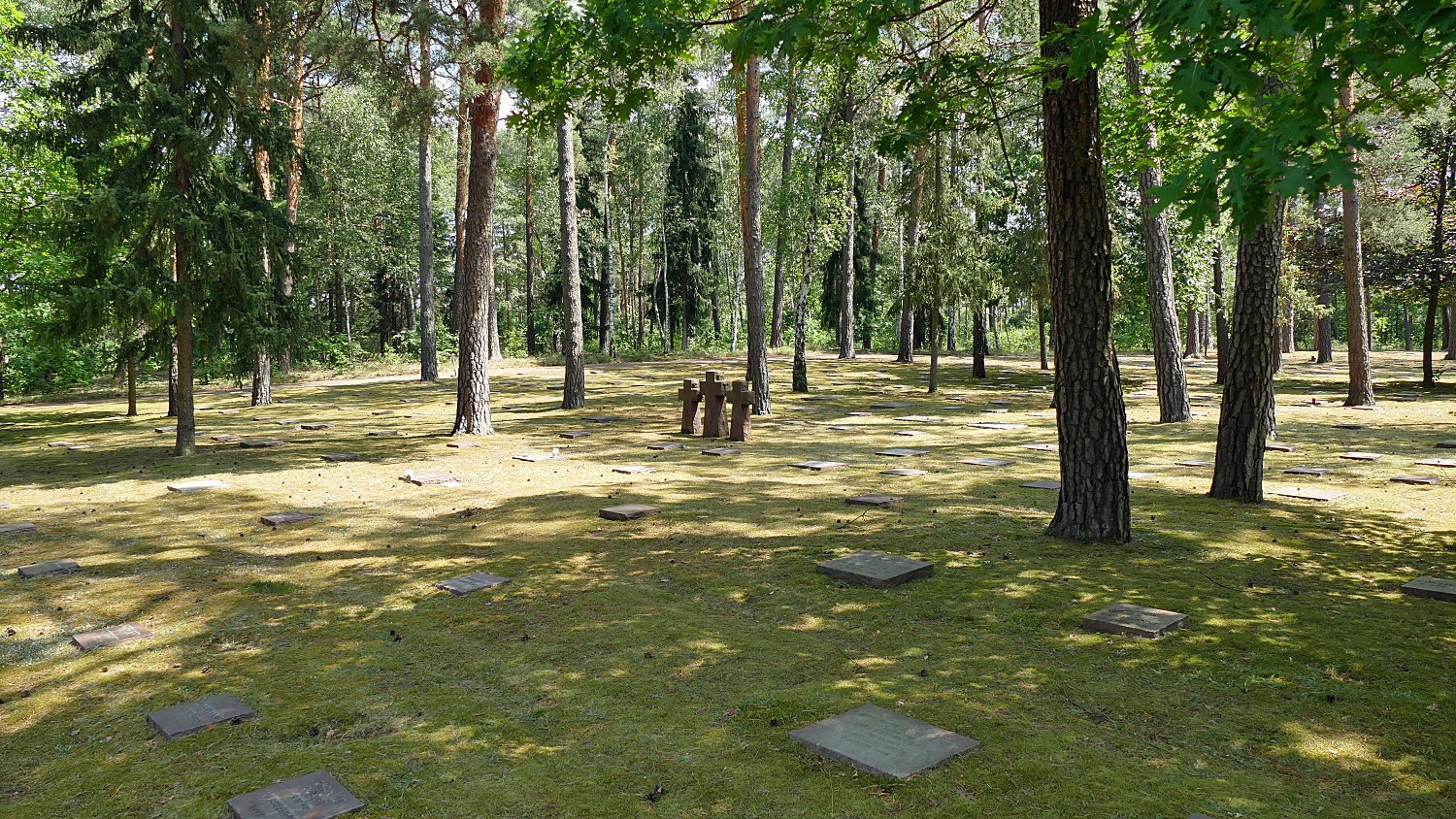
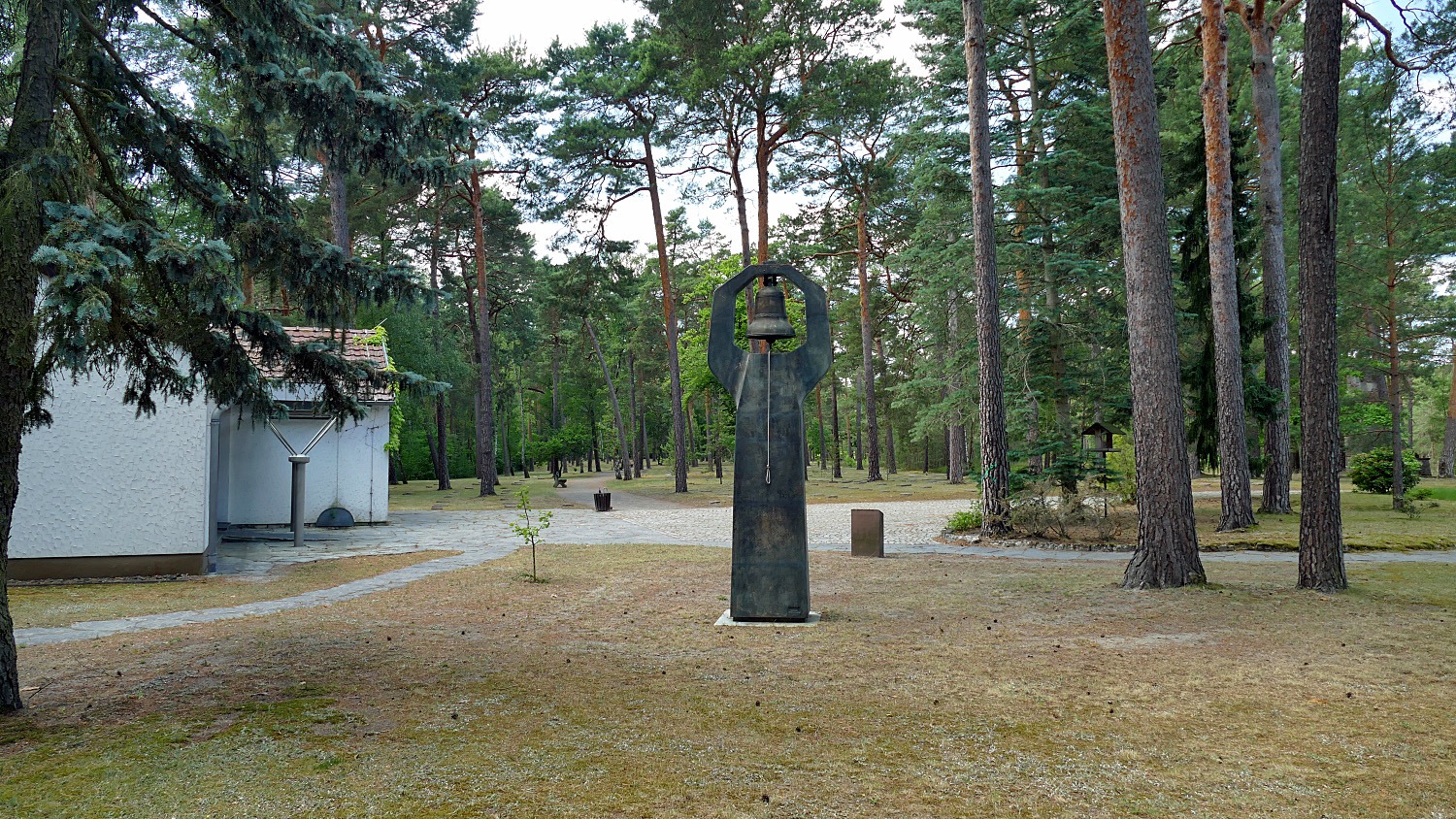
Although the administration denied his request to erect a tall cross at the Forest Cemetery during his lifetime, his wish was ultimately granted after the political upheaval and the reunification of the two German states in 1990.
In a letter to the GDR political leadership dated April 1983, in which he once again underscored the importance of caring for war graves and the bereaved families of the deceased (see Potratz/Stark, op. cit., p. 132), Pastor Teichmann emphasized the motto
“If YOU want there to be peace,
YOU yourself must be a person of peace!”
– a motto he himself exemplified every day by leading by example.
In recognition of his work, the road leading to the Halbe Forest Cemetery bears his name today.
For further details on the life of Pastor Ernst Teichmann and his work on behalf of those buried at the Halbe Forest Cemetery and their families, please refer to the two books mentioned above; the book by Potratz and Stark is also available as a free PDF version.
(Head picture: Entrance gate to the Forest Cemetery Halbe, June 2026;
photo insert: Ernst Teichmann, circa 1950 [source: Potratz/Stark, op. cit., p. 22])
If you wish to support my work on Julius Erasmus, you can do so here. Many thanks!