
War diaries: Marianne Dohm-Franke’s recollections of her encounter with a blind elderly woman in a dark basement in Chemnitz in March 1945 (Published on 10/04/2026)
I. Air raids on Chemnitz during World War II
From the very beginning, aerial warfare during World War II targeted the civilian populations living in cities on both sides. While individual German cities had already become targets of Allied bombing as early as September 1939, the Allied advance on the different fronts of World War II from 1943 onward was accompanied by a massive intensification of bombing raids on German cities, which were also aimed at undermining the civilian population’s will to endure.
One of the cities hardest hit was Chemnitz. Between 06/02/ and 11/04/1945, units of the Royal Air Force and the U.S. Air Force carried out a total of ten air raids on the Saxon industrial city, causing severe damage. The heaviest bombing of the city took place on 05/03/1945, and almost completely destroyed the historic center. According to official figures, 2,105 people died there that night alone, and 75% of the city’s area was destroyed. The Allies declared Chemnitz a “dead city” the following day.
II. March 1945: The blind elderly woman waiting for the war to end in a dark cellar
The German actress Marianne Dohm-Franke, born in Chemnitz in 1912, was on the scene in March 1945 and took part in the cleanup efforts and the search for survivors; she recorded her experiences in a diary. In it, she recounts finding an almost blind elderly woman who had taken refuge alone in a dark cellar and remained there. She describes this encounter as follows (source: Dollinger „Kain, wo ist Dein Bruder? Was der Mensch im Zweiten Weltkrieg erleiden musste – dokumentiert in Tagebüchern und Briefen“ (1983), p. 338 f. [translation from German language]):
“Accompanied by Georg, I go back to the school building the next morning, but the situation hasn’t changed. No help has arrived yet to rescue those buried under the rubble. Georg wants to walk around the building one more time, while I enter the school alone through the left side entrance. Carefully, I descend the steps leading to the underground rooms. Total darkness surrounds me. Step by step, I feel my way along the wall, timidly calling out »Hello«, calling again… »Yeees.« I freeze. My God, someone is still alive down there. I hastily feel my way back, run across the schoolyard, and fall, pale as death, into Georg’s arms. Together we go back down into the basement hallway. Georg lights a match and calls out loudly, »Is anyone here?« – »Yes, here«, comes the reply, like an echo.
By the faint light of a match, we see an old woman. She sits motionless in the hallway alcove on a narrow bench, her hands folded. »What are you doing down here?« I ask her anxiously. »I’m waiting here until the war is over«, she replies in a voice so unearthly gentle, as if it came straight from the afterlife. »But you can’t stay down here that long… don’t you have anyone we could take you to, no children or relatives?« – »No, I have no one.” Silence. »Besides, I’m almost blind without my glasses… I forgot them… the bombs came so fast…« After a while, this angelic voice continues slowly and thoughtfully: »I could afford a taxi… I still have three marks in my pocket.« My reply gets stuck in my throat. Then Georg asks: »Do you know if there’s anyone else down here? Maybe injured people or dead bodies?« – »Dead bodies?« the old woman ponders, »Oh no, there are no dead bodies down here.«
In the flickering light of the matches, we look at each other in silence. Even without words, we ask ourselves: what do we want to do, what can we do? Didn’t we come here to search for people buried under the rubble who need our help just as much? For now, we again leave the poor, distraught woman to her fate…
On the third day after the attack… I step into the dark basement hallway for the last time. The elderly woman is still sitting on the bench and thanks me – already half-absent – for the bread I hand her. »We have to do something for that poor woman«, I say urgently to the men of the rescue team. They wave me off with a dismissive gesture: »Oh, her down there! She should just stay where she is. If we bring her up, she’ll just go crazy when she sees the rubble all around her.« Everyone looks out for themselves, and besides, it’s war – how many are perishing there without a trace…”
War leaves little room for humanity and compassion, and it is the most vulnerable who suffer the most.
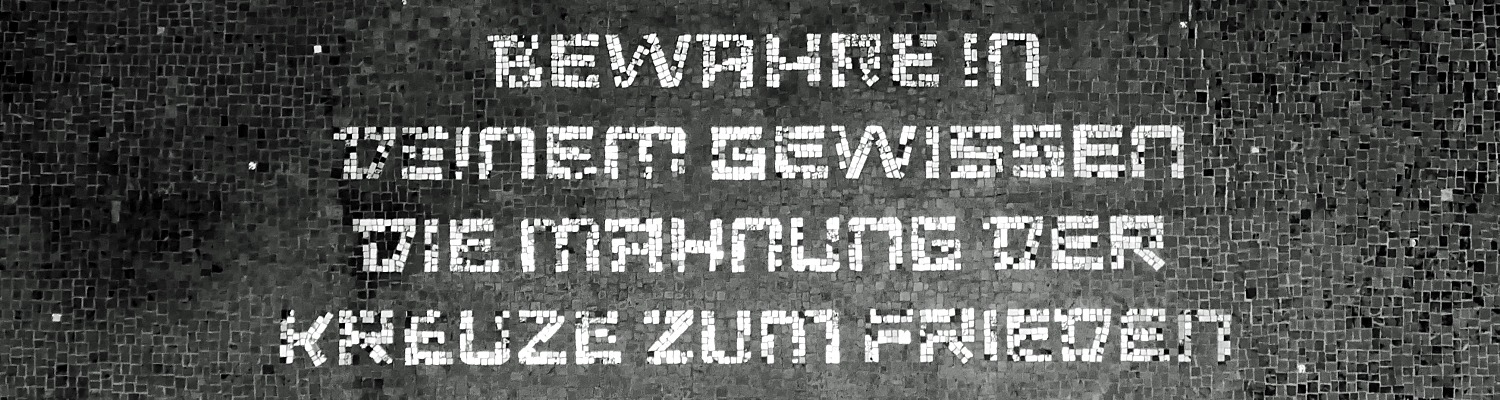
(Head picture: Inscription in the entry hall of the German military cemetery Lommel/Belgium,
stating “Bewahre in Deinem Gewissen die Mahnung der Kreuze zum Frieden”
[“Keep the call of the crosses for peace in your heart”],
December 2025)
If you wish to support my work, you can do so here. Many thanks!