
War Diaries: German soldier Hermann Liebig describes losing his feet in Russia in 1942 (Published on 13/05/2026)
I. The fighting in the northern sector of the Eastern Front in the summer of 1942
In July 1942, the German 8th Jäger Division was stationed in the Army Group North sector south of Lake Ilmen and was engaged in continuous combat. In the marshy and forested areas there, it fought fierce battles to secure the narrow supply corridor – which had been painstakingly cleared – leading to the Demyansk pocket against violent Soviet counterattacks.
II. Hermann Liebig loses his feet
Hermann Liebig fought there as a member of the division. He later recounted those battles, during which he lost both feet on July 20, 1942 (source: Dollinger „Kain, wo ist Dein Bruder? Was der Mensch im Zweiten Weltkrieg erleiden musste – dokumentiert in Tagebüchern und Briefen“ (1983), p. 148 ff. [translated from German language]):
“I am assigned to the headquarters company as an Oberjäger and platoon leader, and to the 5th Company under Second Lieutenant Stark. At 9:25 p.m. – it is still broad daylight thanks to the midnight sun – I am deployed on the right flank of the 38th Jäger Regiment and, during the »night battle«, reach the Bol. Dubowiczy-Wassiljewschtschina road. Mortal fire rains down on us from the T-34 tanks across the road. We remain lying by the road. As a precaution, I order us to »dig in« in the roadside ditch. My medic climbs into a battered assault gun lying in the ditch. I warn him that it’s a sitting duck; but he just laughs.
Around 8:00 a.m., First Lieutenant Stark comes to me and briefs me on the situation and the start of the attack at around 9:00 a.m. At 8:10 a.m., the Stukas are screeching overhead and bombing the T-34s, which are stuck in the swamp 80 meters in front of us, with only their turrets protruding from the ground. Suddenly, a »Rata« appears among the diving Stukas. I watch as the tail gunner fires wildly at the Russian fighter. The »Rata« is right behind him. At an altitude of 200 meters, a plume of black smoke shoots out of the attacker, and at the same moment, a black dot breaks away from the fighter. The parachute opens immediately, and a person is hanging from it. All of this takes place in a matter of seconds right above our heads.
Now the wind is blowing the parachute toward the Russian positions, and I sense something terrible: While the enemy artillery fire had so far been far behind us – since we had advanced to the road here during the night battle, a fact the enemy did not yet know – the pilot who had jumped out had seen from above that all the German assault forces were positioned along the road. No sooner has the Russian landed than the entire road is under artillery fire. A deafening explosion hurls me onto the road. I feel as if I’ve been torn to a thousand pieces! Only one thought is crystal clear in my mind: the tank in front of me! I can already see the barrel swiveling toward me and crawl on all fours into the shell crater, half a meter behind the hole I’d dug – and just then the tank shell crashes into the embankment on the opposite side of the road.
Now I see the full extent of the damage: my right foot has been torn off at the ankle, and my left foot hangs twisted from my leg. My boots are shredded, as are my pants. Pale skin stares back at me up to my knees. I have the feeling: You’re dead! No blood – no pain…
The medic jumps out of his battered assault gun. There’s no time to tend to my wounds. We just have to get out of here! Two men carry me on a tent canvas to the rear, to the regimental command post, which I left 12 hours ago. Before that, I hand over command of the platoon to Oberjäger Krczyz. On our way back, we encounter twenty Russians who came over the right flank during the Stuka attack; all unarmed and completely demoralized. One of them crosses my path, giving me the courage to keep going: his left arm has been torn off at the shoulder joint, completely covered in blood. If he’s still alive and walking around after such a severe wound, then you can make it too!
Everyone at the command post is worried about me, because my youthful appearance made me something of a baby of the group. Even though I don’t smoke, the first lieutenant puts a cigarette in my mouth to calm me down – and it feels good! At the main dressing station, I experience another surprise: The senior physician uses tweezers to grasp the aorta in my torn stump and pulls it out 10 centimeters. Blood spurts out! »That saved your life«, he says. »You have roller shutters that close by rolling up!« Off to the field hospital… I get an Evipan injection in my arm vein and – when I come to, both stumps are the same length…”
Anyone who has spoken personally with German veterans of World War II is familiar with their almost matter-of-fact descriptions of the gory details of even the most serious injuries, such as this one. It was part of their mindset at the time not to show any weakness. What these people were really like behind the heroic facade was often another matter entirely.
III. Biographical data
Nothing else is known about Herrmann Liebig, but he appears to have survived the war.
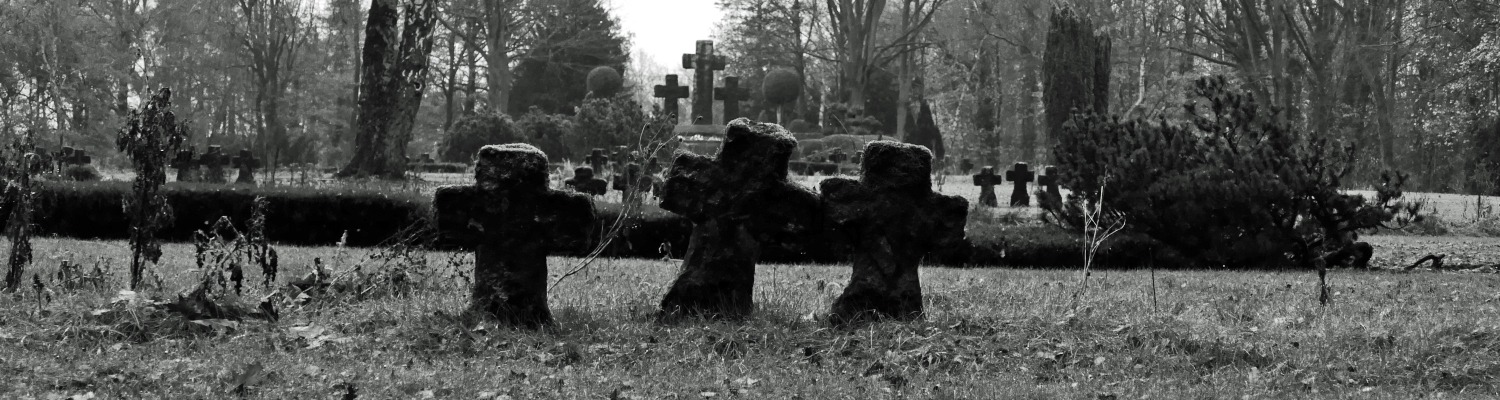
(Head picture: Crosses at the German military cemetery in Weeze,
November 2025)
If you wish to support my work, you can do so here. Many thanks!