
Mail Correspondence with Soldiers at War (“Feldpostbriefe”): Letters from German soldier Harry Mielert from Russia, November 1942 to December 1943 (Published on 09/12/2024, latest update on 19/11/2025)
Source for the following letters: Bähr, Die Stimme des Menschen – Briefe und Aufzeichnungen aus der ganzen Welt 1939 – 1945 (“Man’s Voice – Letters and Notes from Around the World, 1939 – 1945”) (1961), p. 367 ff. (all translated from German language):
Lviv, 14 November 1942
On the train, I read some of Gogol’s »Evenings on a Farm Near Dikanka«. Stories like these, and those by Maxim Gorky, actually bring us closer to the Russian people than Dostoevsky, who was much more of an extraordinary, lonely Russian, while Gogol was at most a lonely Russian. I was particularly moved by the story »Terrible Revenge«, which takes place near Kiev. The quintessence seems to be that it is a punishment for a person to be condemned to do evil to others.
Kharkiv, 17 November 1942
When I went to work this morning, I came to »Red Square«, where there is a monumental Lenin monument; in front of it is a huge paved area, where the mass marches of the proletariat probably took place; on one side is a huge mammoth building housing the party authorities, also somewhat cubist in design. What is peculiar and perhaps typically Russian is that the ground floor of the building is a single, elongated proletarian café. It reminds me of pilgrimage sites, where fairground stalls are set up around the beautiful Baroque church, preferably in front of it, where gingerbread, joke postcards, and jewelry are sold alongside consecrated candles and rosaries; small cafés and ice cream stands can also be seen there. Russians basically have this soul too, and Bolshevism is typically Russian; after the removal of transcendence, Russian piety, which wanders into infinity, has become a worldview that wanders into the endlessness of the earthly (internationalism).
27 November 1942 [On the front line]
The old experience of every serious soldier out here came back to me: how completely alone a man is here on the front line, facing a higher divine power. Here, you can no longer rely on your own strength or the power of weapons. I had to experience it again last night. Suddenly, a man is missing from our combat unit. No one back home will later be able to give the front-line soldier a »reward« for his sacrifice. No one can repay the men for the enormous amount of fear, horror, and other indescribable feelings, and the counterbalance of bravery and perseverance that they have to muster every day and every hour.
Sometimes a prisoner tells us that the Russians also live in rather poor conditions in their holes, just like us, and that the good things always remain behind the front lines. In that respect, we probably have it a little better. But the Russians are also more natural and live much more industriously and habitually in the earth than we do… Everyone has their strengths and weaknesses, and for the soldiers on both sides, the war is less about hatred than a conflict between the highest rulers.
16 February 1943
The Russians broke through our positions with terrible snowstorms. It was impossible to drive them back. Of course, they left many dead behind, but we also have a number of fallen and wounded soldiers. The situation is particularly bad for us; we don’t know how to transport our poor comrades. The scenes are horrific. We only have a few horses left to pull a couple of sleds with the bare essentials of ammunition, weapons, and food. All motorized vehicles, guns, and huge quantities of ammunition that had been stockpiled for trench warfare had to be blown up and burned. Our laundry, coats, and personal belongings, except for the few things that each of us can carry in our bread bags, are also gone. Tanks are operating behind us, and the Russians have already advanced further beside us. We are once again in a real bind. We have retreated to the town of B., which we are now defending in icy storms against the Russians who are attacking fiercely from all sides. These are very fresh Russian troops.
1 March 1943
Some great miracle, incomprehensible to me, saved me yesterday. About 150 meters in front of, or rather behind, our positions, some 800 Mongols suddenly appeared, armed with countless heavy automatic weapons. They had silently crossed the main line of defense at a weak point, overpowered the guards there, and approached our positions from behind. In total, two Russian regiments attacked us in the section of one company. I don’t know how we managed to cope with this. 600 dead lie in front of our positions, in the trenches, in the holes. We lost 30 men, including about 13 dead. One officer fell. I took command of the leaderless company, launched a counterattack behind the fleeing Russians, and occupied another village, where I remained until after midnight. Then we were relieved. What I saw yesterday is the most horrific thing I have ever encountered.
23 March 1943
A few fiery bursts from the Russian machine gun, which is installed over there on the edge of the hollow, race across the bare hilltop. What might Ivan be thinking as he sits there with his rifle, firing? Is he really focused on the task at hand, or is he thinking about other things, about summer in his peaceful homeland, where the steppe grasses bloom silver and the large sunflowers shine in the garden? We all think more about peace, or rather about peacefulness, all with the same longing. May it come soon!
29 March 1943
During the last major mass attack on our position on February 28, a village in front of our main battle line was completely destroyed and all the cellars, in which the Russians were stubbornly defending themselves, were blown up. At that time, there were heavy snowstorms, which quickly covered many of the fallen, so that only now, as the snow melts, are some of them coming to light. Our combat outposts are now stationed in the village in question. Out of curiosity, they are searching through all the ruins and digging in all the houses, because the Russians still have things buried everywhere. In front of the village, the melting snow revealed the entrance to a cellar, and a Landser [German frontline soldier], curious about what might be in the previously unnoticed cellar, cleared the entrance, climbed in, and found four dead Russians inside. As he touched them to move two of them slightly to the side because they were lying on another trapdoor, the two dead men rose and were alive. The soldier was startled and wanted to shoot, but the two dead men laboriously raised their hands, groaning. They were brought into the daylight, where they immediately staggered and fell as if drunk. They were brought to our command post on a sled. We interrogated them after feeding them something, and the following emerged: After the attack, these four hid in the basement. German soldiers threw hand grenades in, and since then they didn’t dare show themselves. They had bread for two days with them, two men were killed by the hand grenades, and these two were wounded. They fed themselves on the potatoes that were lying there by the hundredweight. They endured this for four weeks, together with two corpses and their own excrement, their feet frostbitten to the third degree, yet they still did not dare to come out. One was a Mongolian and one a Siberian. We had them bandaged and carried further back… Can a human being endure this?
Source for the following letters: Bähr/Meyer/Orthbandt, Kriegsbriefe gefallener Studenten 1939 – 1945 (“Letters from fallen students during the war, 1939 – 1945”) (1952), p. 293 ff. (all translated from German language):
In the field, 17 April 1943
Today there is a fierce storm wind, but the sun is shining brightly, with only a few wisps of cloud drifting by now and then. The village where our entourage is staying burned down in a matter of minutes because a spark from an open fire flew into a thatched roof. Oh, you know, my dear, when I stood in front of the last house and looked into the blazing flames, my heart was very sad. This is how human possessions perish; everything transitory flickers for a moment and then turns to ashes. What remains? A life lived, love between people, the sweetness of the heart – we take these things with us into eternity, where we will finally just be. Will beauty go with us? Who knows! But the love of beauty remains, for everything eternal must be the purest beauty.
How the forests in our homeland must be filled with the scent of spring and blossoming like flowers under the sun. The entrance to the valley, an escape to the south – to paradise, to what we long for! It will come, my love! It will be a wonderful, profound love that we will experience there. I can already imagine how we will travel there in later times to enjoy the days of bliss and love that are now still veiled by sorrow and tears.
The evening was wonderful; while strong storm winds had been howling all day, it became completely calm in the evening. The sun sank glowing behind the bare hills, then for a long time the sky remained red up to a cloud that had suddenly stopped as a remnant of the passing storm and now glowed, while above, where the sky itself had already turned yellow and green and almost deep blue, it cast black-violet shadows. There it also had completely frayed edges. Everything was now silent across the wide plateau, and during the silence, night descended, invisible in its approach, and enveloped everything. One instinctively opens one’s eyes once more as the light fades, then it becomes quiet within oneself, and one’s eyes also lower to find the arduous path. Will an irresistible eternal light suddenly break into this darkness? And then the end? Only lovers will exist forever. All others, those who work, fight, and hate, will pass away; only love remains.
26 April 1943
Today was another sunny day, but we still had a hard time. Several comrades fell during the night. During the day, there was another bunker fire, which caused serious injuries. Do you remember the sergeant I told you about last winter? He always took great pride in his handsome face. He was so badly burned that his head resembled a skull more than that of a living person. An officer was also badly burned. These injuries actually look even more frightening than some wounds. These men are married. How will their wives react? And now that their faces are so disfigured, will their hearts remain the same? These are probably the most serious cases that war can cause.
Source for the following letters: Bähr, Stimme des Menschen (ibid.), p. 371 ff.:
26 April 1943
Today I found the first violets, in a barren heathland. It is a strange experience for the eye to suddenly see this completely different color in the ordinary yellow-brown and gray landscape, mixed with at most a little green, this flower, like a small, lovely, graceful revelation: »Words like flowers must arise…« Is there any better way to describe the unique poetic word than this? I did not pick the violet. The moment I saw it, I was overcome with a secret reverence for it, as if it were something sacred.
8 July 1943
It’s a strange situation. Angry artillery battles rage around us in a semicircle, but it’s quiet where we are. We have advanced so far that everything in our area has been destroyed, but all survivors, both friend and foe, are completely exhausted. Ammunition and weapons have suffered, and we have to make do with what little we have.
Since I joined, our battalion has suffered the heaviest losses in the division. Soon, only a few of the men who were there at the beginning will remain. The Russians also fought bravely, especially the commissars. Some stood upright on the edge of the trench and directed the counterattack, which cost us many casualties. These are also men who are determined to go to extremes, and who must be respected. They fall in large numbers in such battles, but they are the backbone of the Russian army. It would be wrong not to acknowledge that… I was not reckless, and my last thought before every new decision was always you. These days have become a new, firm, iron bond of our loyalty. For us, loyalty is not only that we do not go to another, but the intimate awareness of the unbreakable bond of our love in the name of God. It is becoming increasingly clear to me that we must also move beyond the merely moral to the ethical in our thoughts. Only in the ethical lies a deep religious foundation on which we can build something eternal in our hearts. It is clear that we do not base our existence solely on the short span of our lifetime, but on something eternal beyond death.
Source for the following letter: Bähr/Meyer/Orthbandt, Kriegsbriefe (ibid.), p. 295 f.:
20 August 1943
I sit on a pine-covered slope and watch the Russians in their positions without them being able to spot me. Today the sky is overcast and it is very windy again. There is a pleasant, familiar rustling in the pine trees. Only my heart knows that this is not home and never can be, as long as you are not with me. It would be possible for you to be with me if it weren’t for the war.
Then we would be on vacation in Italy or the Balkans. It could also be rustling in the pine trees near Paestum or in the oak trees of Olympia. Athens would certainly disappoint us, at least with its surroundings, which, as I saw in a newspaper, are terribly modern and infected by the West. If it were the Oriental world, lushly overgrown, and if we could find the clear ancient sanctuary hidden within, forgotten, as if created for us lonely, loving, and searching souls – but now there is only the imitation pseudo-civilization in the city, which robs one of beauty. But perhaps, despite all the tourism, it would still be possible for us to take the temples into our reverent hearts and measure our eyes against their real form, unminimized and unadulterated by any image. One would have to see the columns of the Erechtheion standing there in the bright, blazing sun, supporting the roof, and one could touch the living columns with one’s hands, the Doric and the Attic ones… Perhaps then we would also spend a day in the Eleusinian plain. I read that it is light and green, with undulating cornfields and rustling olive groves, and that a rocky hill juts out toward the sea, forming a kind of natural stage in a gentle arc. This was the scene of the mystery plays. Perhaps this was a deep, primordial source of living Greek culture, an elemental creative power that transformed itself in the light of the day into shapes and formations, figures and temples… It would be wonderful if, in these times when everything can only be internal, we could create an »inner Greece« for ourselves.
Source for the following letters: Bähr, Stimme des Menschen (ibid.), p. 372 ff.:
24 August 1943
I can think of nothing but our love. Everything I encounter is quickly swept away by the torrent of my longing for you. It is terribly difficult to submit one’s blood and soul to the laws of fate and allow oneself to be bound like a slave, when it is so certain that freedom, beauty, meaning, and life can only be found in love! To follow this miserable »must« again and again cannot be bearable in the long run. And yet it is the great achievement of all lovers to endure separation and to allow it to form the creative power that compels us back to each other “on wings of dawn.” So long must we wait, always at the mercy of the powers that be and subject to them. Let us celebrate and honor the high power of love, which again and again brings us freedom from this vale of tears of bondage…
20 September 1943
P. is a larger town. The Russians are firing artillery into it, almost all the houses are burning, and in between them large ammunition depots are detonating or buildings and facilities are being blown up by sappers. Everything is roaring, blazing, shaking, cattle are bellowing, soldiers are searching all the buildings, barrels of red wine are being transported away on small flatbed trucks, here and there people are drinking and singing, interspersed with explosions and new fires breaking out. Our men are lying in position, there is some shooting. But the strange thing is the colorful chaos behind the serious, calm battle line… I was interrupted again. Now everything around us is burning again. All bonds are torn. Where is humanity! Anger roars through every crack in the world. There is no end, it is the world itself in its essence. Every »Last Judgment« is the world itself.
Source for the following letters: Bähr/Meyer/Orthbandt, Kriegsbriefe (ibid.), p. 297 ff.:
Gomel bridgehead, 1 October 1943
The worst was four days ago, when I had to defend a place with four men against five approaching tanks with mounted Russian infantry and had orders not to leave this place until an agreed signal. It was cruel. The troops had taken up a new position three kilometers further back. I was at a loss with my few men; the Russians were already advancing on my right and left. We fought the infantry on the fighting vehicles at close range, but the roaring steel colossi roared towards us, rolled through, fired from all barrels and then split up to take us out with a pincer movement.
The following night we broke away from the enemy again, shot down seven tanks with tank guns under cover of darkness and in the forest, some of them from a distance of 20 meters, and had some breathing space the next day. But the Russians had already bypassed us from both sides. We broke through at one point to reach the river behind which Gomel lies, but the Russians had already destroyed all the bridges before us. Now we’re on this side of the river, forming a bridgehead and building a new bridge. This summer’s new lieutenants have almost all dropped out again. I am one of the very few officers in our division who have been with us since the beginning.
1 December 1943
No one but the person involved can understand what is going on here. By that, my dear, I don’t want to exclude you from an »experience«, it’s not an experience, it’s just a terrible fact that has to be endured.
I was hunted as only a very wounded animal can be hunted, sat in the swamp for five hours, in ice-cold water up to my body, under constant fire from tanks that couldn’t follow me and a small group of men there until night fell. We had wanted to rescue comrades who had already perished miserably. We had to cross the swamp during the night, came under German fire in front of our own line and are now back with the old bunch. There’s a bitter struggle going on here that nobody knows anything about.
When my comrades fall like this or are wounded, I always wonder and ask myself: when will I? or what is God keeping me for? I look for the meaning and give it – by being aware of the humanity of this meaning, but also recognizing this humanity as created by God – that I should experience all this and work through it within myself. Later I am to say something about this event, perhaps not about the war, but about the human being that emerges in this war.
6 December 1943
Think of an endless, bare field, frozen hard, covered with light snow, with a terrible wind whistling over it and blowing the thin snow behind the clods, so that the frozen topsoil becomes free. Our men are firmly entrenched in this field. With the small infantry spade they hoe and scrape up the stony earth until they come across unfrozen ground; a small hole is dug into which one or two men can squat. They stand there, one of them awake, the other dozing off. It is freezing cold, only body heat provides warmth. The enemy quickly recognizes the line and shoots at the field with grenade launchers.
The men are alert and shoot at the approaching enemy. When the tanks protect the Russian infantry, the only option is to duck low and finish off the infantrymen in close combat. The scream of a hit man is terrible, without echo in the wasteland, nobody has time to take further notice. Everyone trusts only the weapon and that terrible goddess Fortuna, of whom these men no longer even know the name. – During the night I crawled from hole to hole, the men need strengthening. During the day, 106 of the 220 men in our battalion had lost their lives due to wounds or death. We didn’t talk about the day, but about our loved ones at home and when we would see them again. We didn’t cry, and our outward appearance seemed hard and like a bizarre personification of the purely masculine, cold and warlike. But our hearts are hot and glowing for our loved ones back home.
9 December 1943
[Final letter]
The battlefield always makes me shudder anew. I no longer want to see the dead and the spurting, streaming blood. But I have to stand next to it like someone who has been given this task.
You once said wonderfully that being alone together makes us together again. This is a profound experience, this leaning towards and seeking each other across the distance. The ring is open in two parts, but both halves are so inclined towards each other that it is the distance that separates and closes it. We will close it again when the next testing time has passed over us.
First Lieutenant Harry Mielert, born on 27/12/1912 in Sprottau/Silesia, member of Grenadier Regiment 528, was killed in action on 15/12/1943 northwest of Shlobin/Russia.
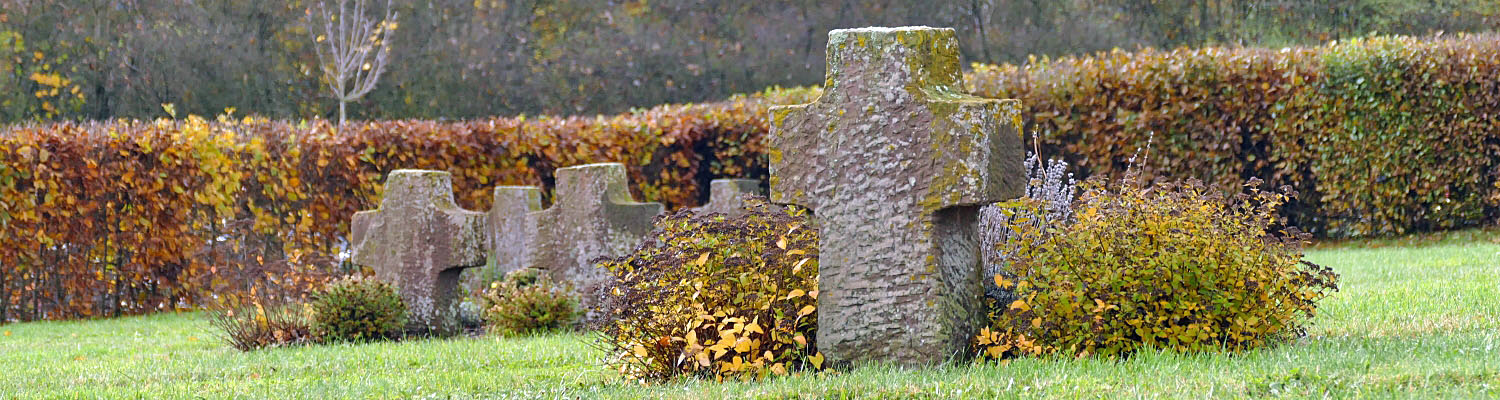
(Head picture: German military cemetery Bleialf,
November 2023)
If you wish to support my work, you can do so here. Many thanks!