
Mail Correspondence with Soldiers at War (“Feldpostbriefe”): Letter from Russian soldier Fyodor Mostovoy on fighting the Germans to the last drop of blood, Stalingrad 1942 (Published on 14/09/2026)
I. “The Russians Are Coming!” – A German Trauma
“The Russians are coming!” Among Germans who experienced World War II firsthand, there was probably no slogan associated with more fear and terror than this one, especially among those who had fled the former German eastern territories. Anyone who lived through this was marked by it for the rest of their lives.
Why the Russians had come, however, was surprisingly often pushed into the background. It was common among Germans – and as a child and teenager, I myself was often a listener to such stories – to hear accounts of hair-raising Russian acts of violence and atrocities that spared neither women, children, nor the elderly; yet there was never any mention of the no less hair-raising acts of violence and atrocities that Germans had previously committed against Russian women, children, and the elderly. Likewise, there were hardly any reports of Russians who had stepped in to protect Germans – though such cases did exist – just as, conversely, there was no mention of Germans who had protected Russians.
The suffering endured by all these tormented people cannot be weighed against one another; the acts of violence and atrocities committed against one group are just as terrible as those committed against another. But we must not forget the historical chain of events that led to the Russians’ arrival at that time – especially when it comes to preventing history from repeating itself.
II. Feldpostbriefe from Russian Soldiers: Fyodor Mostovoy
Against this backdrop, it is worth taking a look at the thoughts and feelings of Russian soldiers who served in World War II – and here, once again, field post letters prove to be very revealing. There are a few German-language collections of Russian field post letters from World War II that make a valuable contribution to our understanding of the events of that time.
Such letters can be found, for example, in the book “Junge deutsche und sowjetische Soldaten in Stalingrad” [“Young German and Soviet Soldiers in Stalingrad”] by Jens Ebert. The book includes the following letter from Red Army soldier Fyodor Mostovoy, written in October 1942 from the Stalingrad area (ibid., p. 194 ff. [translated from German language]):
“18/10/1942
Hello, Comrade Partasewitsch!
Of course, you don’t know me, but please allow me to introduce myself: I am Volodya Yazkevich’s best friend – Fyodor Ye. Mostovoy. I’ve known Volodya Yazkevich since last year – that is, from the moment we left for the front together. We’ve been best friends ever since. But as fate would have it, we were separated this past spring because he was transferred to another unit. When he left, he gave me your address. We met several more times after that, but today I learned that Volodya had been killed. He had asked me to write to you if anything were to happen to him. I can’t believe it; it’s hard for me to write, and I can’t get used to the thought that Volodya is no longer with us. Life wasn’t kind to him; he lost his family, whom he mourned endlessly, and couldn’t come to terms with the idea that he would never see them again – but that’s how it was. He dreamed that we would drive the Germans from our sacred soil and that he would be happy again, like thousands of others who were just like him.
But a treacherous bullet that struck him directly in the heart brought an end to the life of the ardent patriot, Bolshevik, and deputy political commissar V. Yazkevich. Despite all of life’s hardships, despite the fact that he had lost his family, Volodya was a comrade of strong character; he never let on that he was sad or in a bad mood. He instilled in everyone a belief in our victory; he believed in it himself. Wherever Volodya was, the atmosphere was cheerful and pleasant. All the comrades who knew Volodya mourn him. Yesterday, Volodya was buried; at his grave, we swore to fight the Germans as long as we have the strength, to fight them to the last drop of blood, and to avenge our best friend a hundredfold. May the blood that Volodya shed haunt the child murderers, robbers, burglars, and thieves, and give them no rest, neither by day nor by night. May it interrupt their sleep every minute and make them dream of terrible torments. But for us, it will be a source of hatred for the enemy, a source of vengeance against the bloodthirsty Aryan monsters.
Volodya is no longer with us; he fell as a hero while trying to liberate his desecrated Belarusian homeland. He fought bravely, was invincible, looked death squarely in the face, and did not fear it. We have sworn to be just as fearless in battle as Volodya, and rest assured that we will avenge him!!
If you’d like, please send a reply to the following address:
Field Post Station 1613, Unit 154
F. Ye. Mostovoy
Excuse me, I almost forgot to mention this: Volodya Yazkevich died fighting the German invaders near the Kotluban station, in the Stalingrad administrative district. He was also buried there.”
III. Biographical data
In 1942, Field Post Station 1613 was part of the 260th Rifle Division (2nd Formation), which fought in the Stalingrad/Samofalovka/Kotluban area beginning in September 1942. It remained active until the end of the war and was deployed in 1945, among other places, in the fighting on the Oder-Pomerania Front.
Public records list a Red Army soldier named Fyodor Yevseyevich Mostovoy (Мостовой Федор Евсеевич), born in 1913 in Kalinovka, Ukraine, who was killed in action on March 12, 1945, near Siklós, Hungary, and buried there. At that time, he was a member of the 41st Rifle Regiment of the 84th Rifle Division, which had been transferred from the Székesfehérvár area to southern Hungary in early March 1945 and was tasked with eliminating the German bridgehead north of the Drava River. It is likely that he is the author of the letter above, but this cannot be determined with absolute certainty at this time.
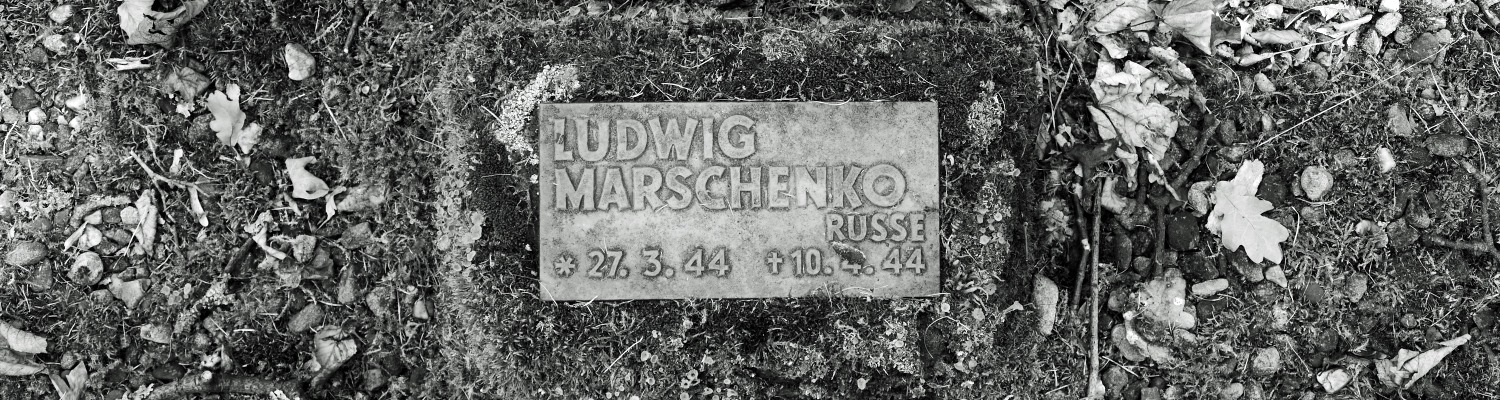
(Head picture: Gravestone of a Russian infant
at the German military cemetery Brandau/Odenwald, August 2025,
Translated inscription: Ludwig Marschenko, Russian, born 27/3/1944, died 10/04/1944)
If you wish to support my work, you can do so here. Many thanks!