
Mail Correspondence with Soldiers at War (“Feldpostbriefe”): Letter from German soldier Kurt Marlow, dated 1940, praising Hitler as “one of a kind” (Published on 25/08/2026)
I. From Hated Enemies to Celebrated Liberators
From today’s perspective, the statements made by German soldiers in the early days of World War II are particularly valuable because they often openly express the mindset with which many of them went to war – especially their conviction that their actions were right and that they were superior. Toward the end of the war, a great many Germans had quickly forgotten their original convictions, went out of their way to assert their supposedly long-standing rejection of National Socialism, and, in any case, now praised the Allies in the West as their “liberators”.
The disastrous German tendency to place oneself unconditionally at the service of whoever is currently in power, while shirking one’s own political responsibility, is particularly evident here.
II. Kurt Marlow reports from France
One such letter was written by the German soldier Kurt Marlow in July 1940 during the German advance out of France (source: Collection of Letters from Museumsstiftung Post und Telekommunikation Berlin, Kurt Marlow – 24 Letters – September 1939 to January 1945 – 3.2002.0884; also cf. Moutier, „Liebste Schwester, wir müssen hier sterben oder siegen“ – Briefe deutscher Wehrmachtssoldaten 1939-45 [“Dearest Sister, We Must Either Die or Triumph Here” – Letters from German Wehrmacht Soldiers, 1939-45], p. 95 ff.).
In it, he writes (translation from German language):
“Sunday, 21.7.40
Dear Mom!
Today we didn’t have to get up until 7 a.m. – it’s just wonderful when you can really sleep in for once. We have beds that look like coffins; you just dump some straw inside, throw a tent tarp over it, and the sleeping area is ready. I have three blankets to cover myself, so that’s plenty. We’re staying at a high school – a pretty nice building. Our town is actually quite nice; of course, you can’t expect too much. All the vehicles are parked in the schoolyard, so it’s not very far to go. When I’m not driving, I work on the car. You mentioned trouble with the engine – that only lasted 2-3 days; since then, it’s been running like a charm. Back then, some dirt must have gotten into the tank, which of course caused the engine to stall constantly while driving – it really drove me up the wall. The engine is usually so quiet that you can only tell it’s still running by the indicator light. I’ve had two flat tires so far – don’t laugh – during the train ride. I ran into Werner Degenkolb twice while passing through here; he lives in a neighboring town, about 16 km away. It’s a wild place – 90% Jewish, all shady figures, and only a few are nicely dressed. The houses are also in terrible shape; Degenkolb must be living in some kind of camp. In Silesia, I ran into a guy from the denture shop – the cyclist who bought my boat – and he sends his regards. I’m just amazed at how many people I know and all the different kinds of people you run into.
I received two packages from you – thank you very much; the cake tastes perfect, as do the cream candies. Is it just as hot where you are? Here, the sun is beating down on the country roads, and there’s so much dust on them that you can’t see the cars coming toward you, but work is underway everywhere. The road construction companies are all from Germany, mainly from Stuttgart, and the foreman is, of course, German as well. The Jews haven’t been put to work nearly enough yet; a large number of them are still loitering around in the streets. The fields are impeccably cultivated and in good condition; this is going to be a tremendous harvest. Yes, yes, Adolf certainly knew what he was doing; now we have plenty of grain and probably won’t need to import anything after the harvest. Alsace will likely become part of the Reich as well, and then we’ll simply have everything. Let’s just wait for the war to end – then Germany will grow so fast it’ll outpace even America. In any case, a man like Adolf Hitler is one of a kind – we’re lucky there isn’t another man like him in any other country. What do you think of the speech? We were speechless, anyway – especially about the peace offer; the English flatly rejected everything yesterday. It’ll probably start in the next few days; I just feel sorry for the innocent civilians, but this time there’ll be no mercy.
Yesterday I went to the movies; they were showing the newsreel about the capture of Paris, Verdun, and so on. By chance, I spotted a few members of my company in it. Then came the main feature, “Geheimzeichen LB 17”, starring Willy Birgel – it was pretty good. The movie theater is like the Rheinschloss back home – very nice, clean, and with a balcony.
The new vacation regulations are just coming into effect – two men will be leaving every day for three weeks, starting August 1. It’s a big deal. Our chief medical officer is okay; I’d say that’s safe to say.
Warm regards from
Your Kurt”
III. Biographical data
Kurt Marlow was born in Peenemünde in 1914. He was drafted in 1939 and served as a medic with the 68th Infantry Division in the campaigns against Poland, France, and Russia. Toward the end of the war, he served with the 719th Infantry Division, which fought in Belgium and the Netherlands following the Allied invasion of Normandy and was decimated during the retreat in March and April 1945 in the Palatinate.
Kurt Marlow has been listed as missing since late April 1945.
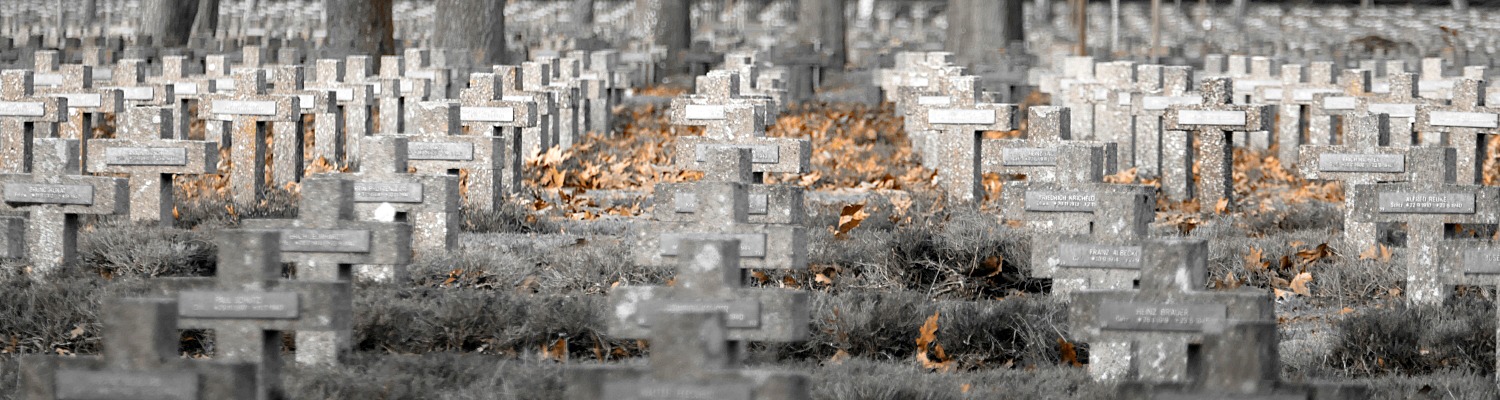
(Head picture: Grave crosses at the
German military cemetery Lommel/Belgium, December 2025)
If you wish to support my work on Julius Erasmus, you can do so here. Many thanks!