
“Modern Culture of Remembrance” in the Schenkenländchen Administrative District: The Removal of Thousands of Grave Candles from the Forest Cemetery Halbe in December 2024 and the Ban Imposed by the Cemetery Rules (Published on 27/07/2026)
Frequent readers of this blog will recall the so-called “flower ban” at the two military cemeteries in the Hürtgen Forest, which the Düren District Administration imposed there in the fall of 2022 through new cemetery rules.
At the Forest Cemetery Halbe – the former parish of Pastor Ernst Teichmann and, with more than 24,000 graves, one of the largest military cemeteries in Germany – a very similar situation has recently unfolded.
Commemoration of the war dead appears to be increasingly subject to state repression.
I. The ban on gatherings at military cemeteries in Brandenburg
As a background, it is important to note that in the state of Brandenburg, where the Forest Cemetery Halbe is located, public gatherings and processions at military cemeteries and in specifically designated areas in their immediate vicinity are generally prohibited under the dem „Gesetz über Versammlungen und Aufzüge an und auf Gräberstätten“ (“Act on Gatherings and Processions at and on Burial Sites”, “GräbVersammlG”) (cf. sec. 1(1) GräbVersammlG). Upon application, the competent authority may grant an exemption under the conditions set forth in sec. 1(2) GräbVersammlG.
II. The removal of thousands of grave candles from the Forest Cemetery Halbe in the presence of the police on December 27, 2024
According to a report in Märkische Allgemeine Zeitung (the local newspaper, “MAZ”) dated December 29, 2024, a private association placed approximately 5,000 LED grave lights on graves at the Forest Cemetery Halbe between December 22 and 25, 2024, as part of a Christmas memorial campaign. Similar grave lights were also set up at other military cemeteries, such as the one in Spremberg. The lights were purchased with donations and were to be removed again on December 29, 2024. The initiative was organized by a group of relatives who have been carrying out such campaigns at various military cemeteries in Brandenburg every Christmas for years to commemorate the victims of war – and there had apparently been no problems up to that point.
This time, however, the memorial event – known as the “Gräberleuchten” (~“Glowing Graves”) project – led to a police operation.
According to MAZ, “as part of routine patrols and based on tips from witnesses” (this and all subsequent citations are translated from German language), police were dispatched to the Forest Cemetery on Friday, December 27, 2024; several thousand grave candles were removed in their presence and “collected in a container”. The candles set up at the military cemetery in Spremberg were also removed. According to the Police Department South, which is responsible for the area, the police “assisted in enforcing the cemetery regulations”. MAZ noted that “right-wing extremists from across Germany” had repeatedly used the Forest Cemetery in the past for marches and propaganda purposes.
After a public outcry, the police backtracked shortly thereafter.
MAZ reported on December 30, 2024, that according to Maik Kettlitz, press spokesperson for Police Department South, the reason for the operation was a call by the far-right party “Die Heimat” to place candles at several military cemeteries to “honor fallen German soldiers in World War II”. During inspections in Halbe and Spremberg, an unusually large number of candles were found, and “flower arrangements with black, white, and red ribbons” had also been placed there. In light of the aforementioned call and the ban on gatherings at military cemeteries in Brandenburg, this was deemed an “illegal act” because “it is presumed that several individuals alone placed the many candles”. The police only learned later from MAZ about the private initiative to commemorate the war dead. The police operation was not directed against the private commemoration of the war dead, and they apologized “for having also removed the candles that had been placed there legitimately”. However, they asked for understanding, as it had not been possible to distinguish which candles belonged to the “unauthorized gathering”, which is why all of them had been removed. The candles – as was emphasized once again – had been “collected in a container”, and they intended to return them to the private initiative.
Many people refused to accept this and set up new grave lights at the Forest Cemetery Halbe on January 1, 2025, as reported by MAZ on January 2, 2025. According to police spokesperson Kettlitz, the police were once again on the scene, but “the commemoration” was deemed “permissible”.
In a follow-up report on January 9, 2025, MAZ reported that the police intended to return the confiscated grave candles – a total of 5,500 – and called on the organizers to come forward. The report also mentioned that the police had filed a criminal complaint with the Cottbus Public Prosecutor’s Office for a violation “of the Brandenburg Burial Sites Act.”
This article featured the first statement from Oliver Theel, the administrative director of the Schenkenländchen district – to which the municipality of Halbe belongs – who is apparently unaffiliated with any political party. He told MAZ that candles had been placed on all graves at Christmas for many years and made the following remarks:
“That is impressive and truly thought-provoking. I am committed to ensuring that this simple form of remembrance continues.”
He also considered the post-Christmas police operation – about which, according to him, neither the district administration, as the organizing body, nor the municipality of Halbe, as the property owner, had been informed – to be excessive; otherwise, he would have “put the brakes on it”.
Sandro Kracht, the honorary mayor of Halbe, also spoke in the report. He considerd the grave illumination a “wonderful gesture” and was pleased to see new candles placed on New Year’s Day.
III. The removal of the “Glowing Graves” in the Brandenburg State Parliament
These events led to a parliamentary aftermath in the state Parliament. Since the last state election in 2024, four political groups have been represented there: the SPD (Social Democratic Party), the AfD (Alternative for Germany), the BSW (Sara Wagenknecht Alliance), and the CDU (Christian Democrat Party) (in order of their share of the vote). The governing coalition initially formed by SPD and BSW collapsed in January 2026 and was replaced by a new coalition of SPD and CDU.
The AfD group in the Brandenburg State Parliament subsequently took up the issue of “Gräberleuchten” and repeatedly pressed the then-ruling coalition of the SPD and BSW in the Committees on Internal Affairs and Local Government (“AIK”) and on Law and Digitalization (“ARD”) to clarify the matter.
In the ARD, Dr. Benjamin Grimm (SPD), Brandenburg’s Minister of Justice and Digital Affairs, stated during the session on January 9, 2025, in response to a question from the AfD parliamentary group regarding the status of criminal proceedings that had been initiated and the legal basis for the removal of the candles, that the Cottbus Public Prosecutor’s Office was conducting a preliminary investigation “for a violation of the Assembly Act due to the large-scale placement of grave candles”. In light of the ongoing proceedings, he could only comment on the matter to a limited extent (cf. the minutes, p. 10).
At the AIK meeting on January 14, 2025, the AfD parliamentary group asked, among other things, who had actually provided “the impetus” for removing the candles. In addition to Katrin Lange (SPD), Minister of the Interior and Local Government, Oliver Stepien, Chief of Police for the State of Brandenburg, also commented on this matter. His statement was recorded in the minutes as follows (cf. the minutes, p. 15 ff.):
“Oliver Stepien (Chief of Police for the State of Brandenburg) explains that the responsible police department had identified a preliminary suspicion of a violation of the Assembly Act prior to January 1, 2025. It is important to note that the Federal Assembly Act continues to apply in Brandenburg, as the state does not have its own assembly law. In addition, it is supplemented by the Law on Assemblies at Cemeteries, which generally prohibits the holding of assemblies at cemeteries unless a special permit is granted. However, such a permit may not be granted if the assembly is associated with National Socialist ideology or symbolism.
The case had been discussed by the Legal Affairs Committee, though no further information could be provided due to the ongoing investigation.
The Act on the Protection of Burial Sites served a specific protective purpose, namely to safeguard burial sites from potential exploitation through associations with Nazi ideology. This contextualization was important for evaluating the police operation.
The scale of the grave lights – numbering approximately 5,000 in Halbe – had been extraordinary and unprecedented in this form of organized commemoration at a cemetery. Consequently, the legal and factual assessment of the incident had not been straightforward. On December 27, 2024, the police department had to conclude that this might have constituted an assembly, which justified the initial suspicion of a violation of the Assembly Act. In this context, it had been understandable that the grave lights were seized.
The final assessment of the facts of the case rests with the public prosecutor’s office, so no further comments were possible at this time. However, the operation on January 1, 2025, demonstrated that the police were by no means opposed to appropriate commemorations. The police commander on the scene had clearly outlined the parameters for a permissible commemoration, which had resulted in the event proceeding without incident. The question had rather been whether a line had been crossed that would constitute a criminal offense. A final statement could only be issued after the final internal review has been completed.”
At the AIK meeting on May 7, 2025, it emerged, among other things, that the grave candles removed from the Halbe Forest Cemetery – which had been “stored in a container” – had been destroyed as a result of improper storage, apparently outdoors in winter weather. The AfD caucus also pointed out that the repeatedly asked question of who specifically had given the order to remove the candles had not yet been answered. According to the minutes, Police Chief Stepien replied (cf. the minutes, p. 50; emphasis added),
“…that assemblies are subject to special protection. An initial suspicion had arisen among the on-site response teams and, to the best of their knowledge, had also been reviewed by the Legal Affairs Division. Subsequently, the usual follow-up measures were initiated – including by the security and shift services. There was no single person responsible; the action was taken as part of daily operations.”
Particularly noteworthy is the subsequent statement by Representative Ines Seiler (SPD), who felt compelled to comment (cf. the minutes, op. cit.),
“…that candles had been removed, but that there had been no disrespectful treatment of graves. The matter had been limited to the removal of the candles.”
At the ARD meeting on September 11, 2025, Minister Dr. Benjamin Grimm responded to a question from the AfD parliamentary group regarding the status of the matter (cf. the minutes, p. 33 ff.),
“…that the Cottbus Public Prosecutor’s Office had initiated a preliminary investigation against persons unknown at the end of December 2024 regarding a possible violation of Section 26 of the Assembly Act (VersammlG) in connection with the large-scale placement of grave candles, wreaths etc., at the Georgenberg, Spremberg, and Halbe military cemeteries. In the meantime, the case gad been dismissed pursuant to sec. 170(2) of the Code of Criminal Procedure (StPO) on factual grounds, as no perpetrator could be identified.”
As far as can be determined, the efforts in the Brandenburg State Parliament did not yield any further insights.
IV. The amendment of the cemetery rules for the Forest Cemetery Halbe in December 2025
As early as the beginning of 2025, the discussion about “Glowing Graves” had resumed.
In an interview with MAZ on January 29, 2025, Oliver Breithaupt, executive director of the Brandenburg regional chapter of Volksbund Deutsche Kriegsgräberfürsorge (the German War Graves Commission), pointed out that placing a candle on a grave should be understood primarily as a living person’s tribute to the deceased and not as an expression of solidarity with the political era in which that person lived, and he appealed, not to judge the dead.
In contrast, an “Aktionsbündnis gegen Heldengedenken und Naziaufmärsche“ (“Action Alliance Against Hero Worship and Nazi Marches”) called in MAZ on February 26, 2025, for a ban on activities such as “grave lighting” in order to “preserve the peace of the dead”. Placing thousands of grave lights was deemed inappropriate, as the peace of the dead had to bebe respected. “General commemoration” was impossible “due to the different fates” of the deceased. The alliance representative interviewed called for the cemetery rules to be amended so that “the mass placement of grave lights is no longer possible”. In response, district administrator Theel reiterated his commitment to “preserving the tradition of placing grave lights as a form of remembrance and a reminder”.
Nevertheless, the Schenkenländchen district administration complied with the demand to ban projects such as “Glowing Graves”.
In December 2025, just in time for the upcoming Christmas holiday, the Schenkenländchen district administration presented a revised version of the existing cemetery rules for the Forest Cemetery Halbe – which had been in effect since January 2, 1996.
Under the leadership of Jürgen Schladt, legal counsel for the Schenkenländchen district, a draft resolution was submitted to the Administrative Committee that specifically proposed supplementing the existing provisions on “General Conduct” at the Forest Cemetery in sec. 1 with a new paragraph 4 as follows:
“Placing and removing grave decorations (e.g., grave candles, wreaths, flowers, floral arrangements) for general remembrance are [sic!] permitted only at the memorial and the bell sculpture. Exceptions to this rule are memorial services held exclusively by family members.”
The draft provided the following rationale:
“Due to the incidents at the Forest Cemetery in connection with a police operation last year, a revision of the existing cemetery rules for the Forest Cemetery Halbe, which date back to 1995, made itself necessary. The general rules of conduct and prohibitions are now worded more clearly and provide government authorities with a better basis for intervention.”
The proposal was approved at the Administrative Committee meeting on December 9, 2025, by 11 of the 12 committee members present. The new cemetery rules adopted in this manner took effect on December 24, 2025 – just in time for Christmas.
Since the placement and setting of candles (among other items) – when not done solely as part of a “memorial service held exclusively by family members” – is now permitted only at two locations within the seven-hectare Forest Cemetery, namely at the memorial and at the bell sculpture, the inclusion of individual graves is no longer allowed. Since the cemetery rules provide for an exemption only for “memorial services” (see sec. 4) – which does not include the “Glowing Graves” project – and since placing grave candles on a large number of grave stones can hardly be considered a “memorial service held exclusively by family members”, the revised version of the cemetery rules effectively banned “Glowing Graves” at the Forest Cemetery Halbe.
MAZ reported on the ban on December 11, 2025. The “Glowing Graves” event, which had already been planned for Christmas 2025 at the Forest Cemetery, was subsequently canceled. Administrative Director Theel explained that the primary concern was not the grave lights themselves, but rather “maintaining general order at the cemetery”. Keeping the graves clean throughout the year was “a major undertaking,” he said, adding that they want “the cemetery to remain dignified”.
V. Assessment
The removal of the grave candles and subsequent developments – in particular, the revision of the cemetery rules for the Forest Cemetery – raise a number of questions.
1. The removal of the grave candles was “not directed against private commemoration”?
Police press spokesperson Kettlitz told MAZ that the removal was not “directed against private commemoration”, even though it appears that at the time it was carried out, the police did not even know who had placed the grave candles there. Did the police therefore not accept the possibility – which was later confirmed – that this might have been a private memorial project? The fact that they subsequently struggled desperately to justify their actions does nothing to change this, nor does their linguistically clumsy attempt to retroactively sell the removal and disposal of the candles to the outraged public as “collection in a container”.
2. Who ordered the removal of the grave candles? Who carried it out?
The question of who ordered the removal of the grave candles and who carried it out remains unanswered. According to a report in MAZ on December 29, 2024 (see above), the police merely “assisted in enforcing the cemetery rules”. It is unlikely that they carried out the removal of the candles themselves. So who collected the candles, and on whose orders?
Administrative director Theel told MAZ (see above) that neither the district administration nor the municipality of Halbe had been informed about the police operation. So does the responsibility lie solely with the police? The statements made by Brandenburg Police Chief Stepien before the Committee on Internal Affairs and Local Government of the Brandenburg State Parliament on May 7, 2025, might suggest as much: he said that “an initial suspicion” “had arisen among the onsite response teams”, and that an investigation was subsequently conducted by the “Legal Affairs Division” – presumably the “Legal Affairs Division” of the Southern Police Directorate (organizational chart)?
The statement made there by Mr. Stepien, the highest-ranking police official in the state of Brandenburg – that “there was no single person responsible” – speaks for itself and is unworthy of a state governed by the rule of law. If this is indeed the case, it raises the question of political accountability for a government agency in which it is apparently possible to initiate police action against citizens beyond legal accountability.
3. What is the legal basis for removing grave candles?
Equally unresolved is the question of the legal basis for removing the grave candles. State Minister of Justice Dr. Grimm, Police Chief Stepien, and the Police Department South cite an alleged violation of the Assembly Act due to the “large-scale placement of grave candles”. On May 7, 2025, Police Chief Stepien even went so far as to state before the Committee on Internal Affairs and Local Government of the Brandenburg State Parliament that authorities had to assume the possible (!) existence of an assembly, so that seizing the grave lights was “understandable”.
As an impartial observer, one wonders exactly how the placement of the grave candles was supposed to have taken place by means of (or during?) a gathering. In this regard, the statement by police spokesperson Kettlitz in MAZ on December 30, 2024 (see above) is already curious, as he claimed that authorities had assumed an “illegal act” because “it is presumed that several individuals alone placed the many candles”. So was there an unauthorized gathering? Or were the candles set up by “several individuals alone”? It’s hardly possible for both to be true at the same time. But let’s leave that aside for now.
Even if an unauthorized gathering had taken place: Why was it necessary to remove and dispose of the grave candles? Does a burning candle on the grave of a deceased person constitute a political statement? Does a burning candle on 5,000 graves of deceased people constitute a political statement? Or is a burning candle – especially on a grave in a military cemetery – not rather a deeply human sign of sympathy for the – without exception, violent – deaths of the soldiers, forced laborers, civilians, and children buried there? If the latter is the case – and from this perspective, there is little to nothing to argue against it –
Why not just let the candles continue to burn there, even if they were set up as part of an unauthorized gathering?
4. Dismissal of criminal proceedings because “no perpetrator could be identified”?
It is also telling that the Cottbus Public Prosecutor’s Office dismissed the criminal proceedings on the grounds that, allegedly, no perpetrator could be identified. Could this be because no crime was actually committed? This is a crude way of getting rid of the case without having to address the legal issues and, if necessary, admit to completely excessive government action.
5. The aim of the new cemetery rules: to prevent projects like “Glowing Graves” from happening in the first place in the future
In light of the statement made by District Administrator Theel in MAZ on January 9, 2025 (see above), in which he said the following about the “Gräberleuchten” project “That is impressive and truly thought-provoking. I am committed to ensuring that this simple form of remembrance continues,” the question arises as to how one should interpret the new cemetery rules, which are specifically designed to thwart such projects.
In the rationale for the revision provided by the district administration’s legal counsel, Jürgen Schladt, the strangely detached language stands out once again, stating that “a revision of the existing cemetery rules” had “made itself necessary” “due to the incidents … last year.” So, does this mean that the revision of the cemetery rules also became necessary on its own, much like the police’s removal of grave candles following a presumed “possible” gathering? Is there, once again, no “single person responsible” here either? It certainly sounds that way.
These so-called “incidents” – specifically, the placement of approximately 5,000 grave candles at the Forest Cemetery Halbe and their removal by the police – were the work of a private initiative, which even the police subsequently deemed permissible and went so far as to attempt to return the removed candles. Mr. Schladt must also be aware of this. To what extent, then, are these so-called “incidents” – that is, the unlawful removal of candles placed as part of a lawful memorial project – supposed to justify the drastic tightening of the cemetery rules that has been decided upon? The only apparent purpose is to completely prevent future memorial projects such as “Glowing Graves” and to create a legal basis for taking action against them. It is no coincidence that Mr. Schladt pointedly stated that the revised version provides “state authorities with a better basis for intervention”.
Above all, the higher-ranking law that precludes such intervention – in particular the Geneva Conventions, which, pursuant to Art. 25 of the German Grundgesetz (“GG”), are an integral part of federal law taking precedence over statutes, as well as the fundamental rights of citizens, in particular the freedom of religion and belief under Art. 4(1) GG and the general freedom of action under Art. 2(1) GG – which stand in the way of such intervention. He has hardly taken these into account to the extent required by constitutional law.
As a result, paying individual tribute at specific gravestones in the Forest Cemetery Halbe – by placing a grave candle or laying a flower there – is in many cases made impossible simply because so many of the war dead buried there are unidentified, making a memorial service held exclusively by family members impossible from the outset. This appears to have been precisely the intention of the Schenkenländchen district administration.
6. Government assessment of remembrance and reflection
As if it were a matter of course, the Schenkenländchen district administration presume to pass judgment on the way the living commemorate the dead and, ultimately, to categorize the ideas underlying such commemoration as “good” or “bad”. Such a state assessment of commemorations of the dead and the ideas (possibly) underlying them as “appropriate”, “justified” or even “permissible”, as was done, for example, by the police, is, however, impermissible per se, because the fundamental right to freedom of religion and belief (Art. 4(1) GG) protects every expression of religious or ideological life and prohibits the state, among other things, from interfering with the religious beliefs, practices, and expressions of individuals or religious communities.
In doing so, the state must not define standards that limit the protection afforded by Art. 4 GG to religions or worldviews with specific ideological content. This fundamental right is guaranteed without reservation and can only be restricted by so-called “conflicting constitutional law”. It is not clear what such conflicting constitutional law might be in the case of demonstrably commemorative events such as “Gräberleuchten”. In general, there is good reason to believe that in a liberal, democratic state governed by the rule of law – where all state action must comply not only with citizens’ fundamental rights but also with the principle of proportionality – it is difficult to conceive of such a thing as a prohibited or even criminal commemoration of the dead in the first place.
Thoughts are free, and they should remain so.
7. Are there options for taking legal action against the ban?
The legality of the new cemetery rules for the Forest Cemetery Halbe could be reviewed, for example, by means of a so-called specific application for judicial review pursuant to sec. 47(1) of the Administrative Court Procedure Act (“VwGO”) in conjunction with sec. 4(1) BbgVwGG; however, such an application would have to be filed no later than one year after publication (sec. 47(2)1 VwGO), meaning apparently by December 23, 2026.
Regardless of this, any administrative measure based on these cemetery rules is subject to what is known as incidental judicial review to determine its compatibility with the Grundgesetz, particularly with regard to fundamental rights.
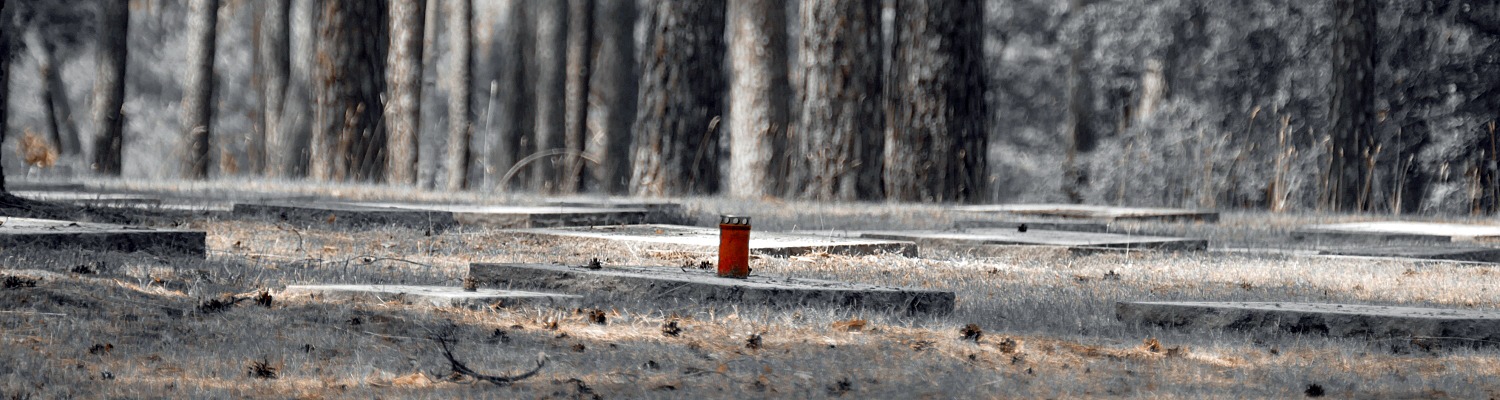
(Head picture: A candle on a grave stone
at the Forest Cemetery Halbe, June 2026)
If you wish to support my work on Julius Erasmus, you can do so here. Many thanks!