
Thoughts on war: National Remembrance Day in Germany on 15/11/2026 (Published on 15/11/2026)
Today is the German Remembrance Day. It is baffling to observe how Germany’s political leadership – albeit in small, but unmistakably clear steps – is once again preparing for military adventures. They are steadily pushing for the reintroduction of conscription, and even if the pace has recently slowed somewhat, the objective remains unchanged. In this context, it is always openly emphasized that they want to “bring more women into the armed forces” – the step towards conscription for women is not a large one, and any remaining legal obstacles should be easy to overcome. In July 2026, it was reported that Germany would acquire “Tomahawk” cruise missiles; these have a range of 2,500 kilometers and “could therefore fly from Germany far into Russian territory”. Just a few days ago, it was revealed that the German government, “against the backdrop of the conflict with Russia”, is considering to acquire a third of the nuclear technology company Urenco, one of the four largest companies involved in the enrichment of weapons-grade uranium.
Today’s Remembrance Day provides an opportunity to remember the catastrophes that German megalomania brought upon the country and the world, catastrophes that should never be repeated. The Remembrance Days observed in the immediate post-war period, still under the shadow of the Second World War, are particularly valuable in this regard. It was then that Germany’s special responsibility for peace and its preservation was clearly acknowledged and formulated as a guiding principle for political action. One would hope that the German people remembered this and set clear limits for their political class before it is too late and history repeats itself once again.
This may be supported, for instance, by the speech given by Bishop Dr. Dibelius on Remembrance Day 1955, which reads as follows (source: Volksbund Deutsche Kriegsgräberfürsorge e.V., Wir gedenken – Reden zum Volkstrauertag 1951 – 1995 [“We remember – Speeches on Remembrance Day 1951 – 1995”], p. 29 ff. [translation from German language]; emphasis added):
“Anyone who has ever stood in front of one of the military cemeteries that Kriegsgräberfürsorge [the German War Graves Commission] has created for us will have had difficulty getting rid of the thoughts that assailed them. There they lie, lined up in a row, who we thought still had their lives ahead of them, perhaps a meaningful life. During the war, they were all just small cogs in a tremendous machine, and yet each of them was a human being, a mother cried for each, almost each of them, and the wife and children had great heartbreak. A terrible harvest of blood for a war that no one who lives afterward dares to justify and which even our fallen soldiers only fought through to a very small extent with inner joy.
And today we are not only thinking of those who lie in military cemeteries. We are thinking of the many prisoners who never returned, those whom death overtook – no one knows where, no one knows how, and no one knows when. We are thinking of those who found their grave on the high seas or in the African desert, and we are truly thinking, not least, of all the men and women who fell victim to bombing raids in air-raid shelters or otherwise perished at the hands of the enemy in the heart of their homeland. A great harvest of death.
It has now been ten years since all of this came to an end. And Germany has made a new beginning, and much has stirred that aspires to be the start of a new, modest existence for the German people; but the question keeps arising: was all this new activity, this stirring within us, worth these enormous sacrifices, and did it truly have to be bought with such sacrifices? In the profound desolation that overcomes us, one is grateful for anything that can offer even a little relief.
Therefore, we are grateful for our military cemeteries, which at least allow a touch of dignity and faith to waft over our graves and which are meant to symbolize that the German people have not forgotten their dead. And we truly have not forgotten them. Not even in the immense upheaval of our times, not even in this overwhelming work on the new nothingness that surrounds us. We have not forgotten them, and we stand ready to learn from them what God intends us to learn.
There is a lot to learn there. I’ll just pick one out of the many. They all died with this great tension in their hearts between the obligation to do what they were told, not to ask about their own lives, but to be there for their comrades, or to help look after their neighbors in the air raid shelters, and yet not being able to affirm why it all happened, and yet not being able to understand the meaning that it all could have. And this tremendous tension between the opposites is what particularly gives us pause today.
Because God always sends times to his humanity in which they have to live in opposites and gain their strength from the tension between the opposites. Such a time is ours. I’ll just pick out a few things from these contrasts in which we have to live. We are children of our fatherland, and a day of national mourning calls us back to the fatherland. I know well that this word can only be uttered with reservation today because, for countless people, so much depends on it that should not and must not be again. But a person simply cannot thrive without a fatherland. And a people that only knows the state and no longer has the warm feeling of home that the word fatherland implies can have no future. And that is why we are committed to our fatherland at this time.
But our hearts are being carried far beyond the narrow confines of our fatherland these days, and the realization has become widespread among our people that it is not only about the fatherland, but that the responsibility we bear extends far beyond our borders. We stand by the idea of European unity, regardless of the daily course of this idea. We stand by the idea of a great community of the peoples of the world. And the word ‘humanity’, which just a few decades ago was an empty concept, is for us, and is becoming ever more so, a reality in which we live every day. And this tension exists between fatherland and humanity. But in the end it will be God’s will that we not only live in this tension, between these opposites, but also gain strength from it. That we gain the strength from this not to become cosmopolitans when thinking about humanity, not to become enthusiastic about irrelevant ideals, but rather that we let this thought of humanity become a reality on the way through our fatherland, and the strength that we do not become narrow-minded when thinking about our fatherland, not sink back into petty-bourgeois feeling and thinking, but that the fatherland should be a building block, marked with our marks, in the great building of humanity, that God wants to build.
We live by speaking the word ‘fatherland’, simultaneously with the certainty that we owe respect to those who serve to protect it. Even the smallest nation respects those who wear the soldier’s uniform and knows what it owes to those who embody the fact that the fatherland can demand commitment to the very end. And at the same time, we breathe and live with a fervent longing for peace. We know well how difficult it is to accept this today when one speaks of peace, because this word is so often associated with something entirely different. And we owe it to ourselves and to others to repeatedly profess this idea of peace before the whole world, to repeatedly declare that we have learned something from the past, that we now know that nothing good can ever come from war, never a solution to problems, never anything truly worth the destruction, and that we can only look forward to war in the age of nuclear weapons with horror. We live with this tension, and perhaps this tension is there so that we may gain the strength to reject peace out of fear and cowardice, a rejection that would offer no promise. And so that, on the other hand, we may commit ourselves to the fatherland – a commitment that is logically almost impossible to achieve, but which becomes reality precisely through the force of these opposing forces – only so that peace may endure, and so that humanity may become an organism in which one member serves another.
The German people have become far more mature since 1939 than they were before. We know anew how important it is that we forever renounce the ideal – which may be very convenient for the leaders of a state – that a select few should command and everyone else should simply obey, but rather that what matters is that each individual, man and woman, within the limits of their own abilities, forms their own judgment on the major issues of public life, no longer prepared to follow any slogans – whether they come from a leader or a party – but to examine these slogans independently and decide before their conscience where the right path may lie. At the same time, we face the great necessity that, in times of particular tasks, particular needs, and particular responsibility, all differences of opinion must be silenced and converge into a great commonality of responsibility. These are contradictions, but perhaps we will gain strength from living amidst them. On the one hand, we must live up to our responsibility in such a way that we don’t want to impose our judgment on anyone, that our aim is not to overwhelm others, but to persuade them and help them arrive at the right judgment. And on the other hand, we must prevent this individual opinion from degenerating into stubbornness and self-absorption, but rather ensure that the right solution is found in the interplay of these opposing viewpoints.
And above all these opposites and above all the call to gain strength from the tension between the opposites stands the cross that stands on our war graves. Yes, what is this cross but the greatest global tension between opposites? Someone suffered death and enjoyed death to its last depths and went through death to life and took those who believe in him with him into life. Then he made it certain to us on the cross that the trouble that God sends should change into its opposite, namely into blessing, and that if you experience the trouble in depth, you will also receive the blessing in its depth. There is the cross that allows us no illusions about the external and internal hardship in which we all face one another, but that tears us out of hopelessness into a hope that exists for life and for death. We vow to this cross even in this hour. We pledge ourselves to him in a time that does not allow us to have illusions, in a time in which heavy worries weigh on our fatherland, in a time in which the living God truly does not make things easy for his human children in the German fatherland.
(…) But the cross stands above the hopeless present and calls us into a hope that we know will last forever. We vow to this hope – this is how we greet our dead!”
May these words continue to inspire reflection and corresponding action even more than 70 years later.
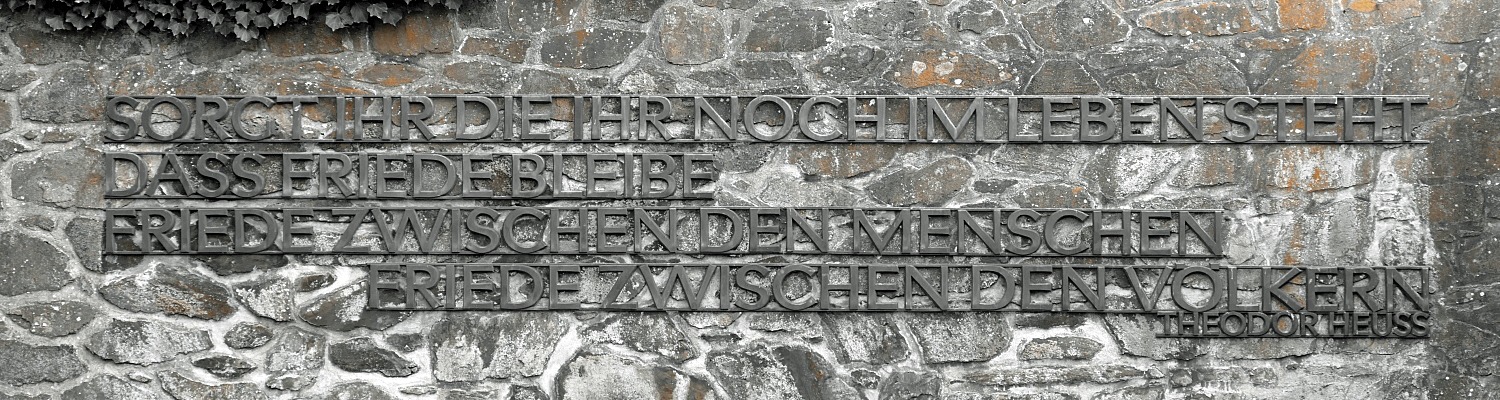
(Head picture: Inscription at the war victims’ cemetery Runkel, October 2026;
translation:
“May you who are still alive, ensure that peace remains,
peace among people, peace among nations”
(German Federal President Theodor Heuss at the opening of the
Hürtgen military cemetery on August 17, 1952))
If you wish to support my work, you can do so here. Many thanks!