
Thoughts on war: Field Mail Inspection Report on the Last Letters from Stalingrad, January 1943 (Published on 06/11/2026)
I. Censorship of German field mail by the Field Mail Inspection Office [Feldpostprüfstellen, FPP]
The German field post service began operations on September 3, 1939. During World War II, an estimated total of more than 40 billion field post letters were sent between home and the front, with civilian letters – accounting for 76 percent – far outnumbering military ones. The field post was subject to censorship, carried out by so-called Field Mail Inspection Office (“FPPs”).
The FPPs conducted random checks of field post mail for “classified” or “subversive” content. The inspection staff opened letters by cutting them open with scissors and then resealed them with adhesive tape bearing the imprint “Opened – Field Mail Inspection Office”. Field postcards were cleared with a stamp bearing the inscription “Inspected – Field Post Inspection Office”. This allowed the recipient to immediately recognize that the contents had been inspected. The very existence of postal censorship was intended to deter every soldier from sending messages with prohibited content.
The inspection of field mail was also intended to provide the German military leadership with an unbiased picture of the morale of the troops and the home front; corresponding reports on the inspection activities had to be submitted to the High Command of the Wehrmacht (“OKW”) by the 1st of each month (for further details on all of this, see Buchbender/Sterz, Das andere Gesicht des Krieges – Deutsche Feldpostbriefe 1939–1945 (2nd ed., 1983), p. 13 ff.).
These reports provide insightful snapshots of the mood surrounding developments in various theaters of war.
II. Field Mail Inspection Report from January 1943 on the Last Letters from Stalingrad
Such report also exists regarding the last letters from Stalingrad, and it candidly reflects the prevailing mood, particularly among the German soldiers.
The report reads as follows (source: Buchbender/Sterz, Das andere Gesicht des Krieges – Deutsche Feldpostbriefe 1939–1945 (2nd ed., 1983), p. 16 ff. (= BArch RW 4/v. 264); translation from German language):
3rd Interim Report of the Field Mail Inspection Office at the German 4th Army Armored Command
on 11,237 field post items sent from the front to home from Dec. 30, 1942, to Jan. 16, 1943,
during the inspection period from Jan. 12 to Jan. 17, 1943
All the horrors of the Russian winter, all the hardships and sufferings of war – both physical and mental – caused by hunger, cold during icy storms, and constant exposure to the enemy will continue to be endured with iron-willed heroism, for: “We will not lose heart, but place our trust in the words the Führer has radioed to us” (Captain, letter dated Dec. 31). Loyalty, faith, and trust in the Führer have been put to a test by those who are surrounded – a test that could not be imagined to be any harder, yet also any more glorious: “We all have the firm hope that the Führer will not abandon us and will certainly know what to do, just as he has always known what to do” (Private First Class, letter dated Jan. 2), or “We stand in firm trust in the Führer, unshakable until final victory” (Non-commissioned Officer, letter dated Jan. 1).
The majority is full of hope and now takes it for granted that the ring will be broken soon. “That is why we are holding out steadfastly; that is as certain as 2 × 2 = 4” (Lance Corporal, FPNr. 25438 D, letter dated Jan. 16). Dutifully and heroically, relief is awaited and they “still hold fast to what has been entrusted to us. We must hold our position for another four weeks at all costs (my guess); if we succeed, our currently dire situation will be transformed into a great victory. We will hold our ground!” (Private, FPNr. 21 221, Jan. 1). All hardships and suffering are endured with tenacious determination, and the hunger continues: “My dear parents, if possible, please send me food. As much as I hate to write this, the hunger is intense” (Private First Class, FPNr. 00432, letter dated Dec. 29). Worn down and exhausted, they await relief with increasingly anxious anticipation. But there is still no prospect of liberation, and many are beginning to doubt whether such a prospect even exists anymore.
The letters from the first week of January reveal a significant decline in morale. There is an increasing number of last wills and farewell letters. “If you could see me and all the other comrades, you might think death was standing right before you” (Private,. FPNr. 22951 D on Jan. 3). Another private, FPNr. 30103, wrote as early as New Year’s Eve: “Of the 380 men who marched out so proudly, only about 100 skeletal frames of skin and bones remain. We survivors can barely walk anymore from hunger and weakness.” Consequently, an assistant physician, FPNr. 00701 A, wrote as early as December 30: “Slowly, our brave warriors are beginning to grow alarmingly frail; it is high time for relief to arrive –” and goes on to report on a thigh amputation performed with scissors, without anesthesia, by flashlight in a cramped earthen bunker, concluding: “One becomes numb to everything and thinks only of food.”
One of the many examples of the worsening physical condition: “Today, a soldier sent to fetch food collapsed from exhaustion after 50 steps, and by the time we got him to the bunker, he was already dead.” “If this keeps up,” writes a soldier, FPNr. 17240 C, on January 13, “then we’ll all starve to death. We’re all at the point where they can do whatever they want with us.” A junior doctor, FPNr. 04096, wrote to his wife as early as January 3: “Russia can be compared to an iron, cold coffin whose lid hasn’t yet been soldered shut, because from time to time we have the opportunity to open it a little –” and calculates the remaining days of life based on the insufficient daily caloric intake compared to the calories necessary for survival. He concludes: “Can one really blame the boys for the fact that everything is slowly lurching along in a stupor? Despair is also a great enemy of the troops, but enemy No. 1 is and always will be hunger! –”, “It hurts so much that we search the dead Russians for bread and often find pea flour on them as well, which we naturally cook in water without salt – now you can imagine how great the hunger is” (Private, FPNr. 24400 to his wife on January 5).
A general shortage of salt! Some have a radio and are happy to find amusing entertainment and distraction through it. As recently as January 16, a noncommissioned officer (FPNr. 34020) wrote to his parents: “We don’t want to keep writing about it, but once it’s all over, the outside world should also learn what German soldiers have endured and sacrificed here. This heroism and perseverance are unparalleled and will be rewarded with a great victory.” And there is a deep tragedy in the fact that some can scarcely contain their joy because they think they hear the thunder of artillery from the south – the reserve armies of Manstein and Kleist – when in reality it is the cannons of Stalin’s Red Executioners.
Thus, every rumor circulating about liberation is joyfully passed along and believed with hope. Every “Ju” [Ju-52 airplane] is gratefully welcomed, and at the same time, word spreads that four Condor aircraft are now flying in with ammunition. In recent days, however, the flights have become increasingly sparse and infrequent, despite supposedly good landing conditions. – A private first class, FPNr. 02375, writes to his wife on January 5: “Some time ago, word went around that we were to receive a 5-kg package here as a special token of the Führer’s appreciation. And that seems to be coming true, because the first packages have arrived.” “Otherwise, the mail is our biggest headache, and we’ve now completely given up hope – we’ll just have to wait until the fighting on the Don is over – patience is all there is; there’s nothing else we can do or say.” (Private 37764 to his wife on January 11). The lack and delay of mail takes up a large portion of the letters.
The letters dated January 16 are very gloomy, and most of them are gradually becoming hopeless, especially since the Soviets are attacking with great ferocity and a massive deployment of artillery, ammunition, and bombers. Moreover, with an icy northeast wind, the temperature has dropped to -35° C. As a result of enemy incursions, positions that had been partially fortified had to be abandoned, and the troops are now exposed on the open steppe, as there are insufficient forces to dig in. Increasingly, many have – especially in the last few days (January 13–16) – sealed their unprecedented display of loyalty and heroism with their deaths due to the effects of hunger and cold. A non-commissioned officer, FPNr. 17428, wrote to his wife on January 6: “I must tell you quite honestly, I would much rather have a quick and sudden end than a slow, certain wasting away, to put it another way.” – As early as January 1, an OGefr. FPN No. 32579 C wrote to his wife: “Things look very bleak here, and our spirits have sunk to rock bottom.” There are also one or two – but no more – who, in their despair, voice their dissatisfaction, such as an OGefr. FPN 39820, who wrote to his mother on January 11: “No one can imagine this kind of life. We don’t deserve this, and that’s why we had to come to the Reich.” Similarly, a private, FPN No. 06897, wrote to his wife on January 1: “Our situation is getting harder and harder. We’re simply at the end of our rope. If something doesn’t happen soon, we’ll all perish. We’re already losing heart. Because we were promised help from outside, but fate has other plans. –”
Illnesses are on the rise. The sick and wounded must return to their units as soon as they are reasonably fit for duty after brief treatment. There are constant complaints about infestations of vermin: lice, fleas, and, above all, mice. Fuel shortages are also beginning to take their toll, as many units were unable to pick up rations on the 16th for this reason. At the same time, it was reported that only a few of the many supply bombs dropped were actually found. As a result, morale and hope continue to plummet, and many – perhaps even most – have given up on life entirely: “We must all expect our end at any moment.”
But precisely at the height of the danger, everyone seems to be aware of their duty and responsibility, and on January 16, a First Lieutenant (FPNr. 28 320) writes to a Second Lieutenant Dr. X in Berlin: “The infantry, of course, is once again in the worst position, since there were no fortified positions, but it is exemplary as always.” In moving words, however, the glorious loyalty of German soldiers is attested to by a Major (FPNr. 17275 A) in a letter to his wife on January 16: “The relentless battle continues; God helps the brave! Whatever Providence may decree, we ask for only one thing: the strength to persevere! May it one day be said of us that the German Army fought at Stalingrad as no soldiers in the world have ever fought before. It is up to the mothers to pass this spirit on to our children. –”
The Mail Home – Frontline covers the period from November 26, 1942, to January 3, 1943. It is at times confident, hopeful, and conscientious in the face of all the demands of the fourth year of the war, while fully recognizing the gravity of the situation; at other times, however, it is very gloomy, and in places even quite desperate, without ever descending into malice. – For example, someone from Halle a.S. writes to a lieutenant: “If one is a staunch supporter of the Führer, then every duty becomes a matter of course.” A letter from Siegmar-Schönau (Sa.) dated November 26: “We are all doing our duty; I myself must perform tasks today that are not my responsibility, but which simply must be done,” or from Karlsruhe dated December 16: “The homeland wants to be strong and worthy of you.” –
Stalingrad and the Caucasus, however, have been a source of growing concern back home since the turn of the year, because news of the gravity of the situation has seeped out everywhere: “I know for certain that I would never hear the truth from you, no matter how bad things might be for you. But people have ears, after all, and I get goosebumps when I listen to them talk about the war – especially about Stalingrad.” From Bautzen/Sat., Dec. 31: “It’s worrisome to hear how many are trapped at Stalingrad. The news is slowly seeping out. And lately I’ve had such painful concerns, because I haven’t heard from you since Nov. 13.” From Bernburg, Nov. 26, to the paymaster: “Yesterday and today people are saying that breakthroughs are happening on your front?!” From Vienna, Dec. 11: “It’s enough to drive one to despair; I no longer know what to think or what might happen – my nerves are on edge.The silence in radio reports about certain battle zones also contributes to our overwhelming despair.” From Bremen, Dec. 29: “We’ve now gone four weeks without a letter from you. We’re all so unhappy and talk about you all day long – if only this terrible war would finally end.” From Munich on January 3: “I’m very worried about you, because we’re hearing nothing good at all from the Caucasus Front, especially from Stalingrad. The enemy is said to have broken through again as far as Rostov.” Also from Munich on January 3: “Will this bloodshed never end? It’s enough to drive one to despair! Is there any hope left at all? Over there in Stalingrad, it never ends, and back home, the cities are being pounded with the heaviest bombs.” From Brandenburg, January 3: “The mood here is gloomy everywhere, and everyone is joyless. If only this misery were over – what happy people we would be.”
It should also be noted that, in light of the situation in Stalingrad and the fact that many of the letters are the last ones written – and some are outright farewell letters – the FPP/4th Army Armored Command is exercising its authority very leniently. Passages with content that is demoralizing or likely to cause great alarm at home are therefore merely rendered illegible using ink, pencil, or an eraser (depending on the writing method), and in such an inconspicuous manner that the redaction could appear to have been made by the letter writer himself. Unfortunately, the usual troop support provided by the FPP had to be suspended during the encirclement – partly because the transmission of messages was too delayed, and partly because the full extent of the hardships is well known to higher authorities in every respect. –
Count Zettwitz
[handwritten in the original]
Cavalry Captain and Head of
Unit d.F.P. 36819
F.P.P.
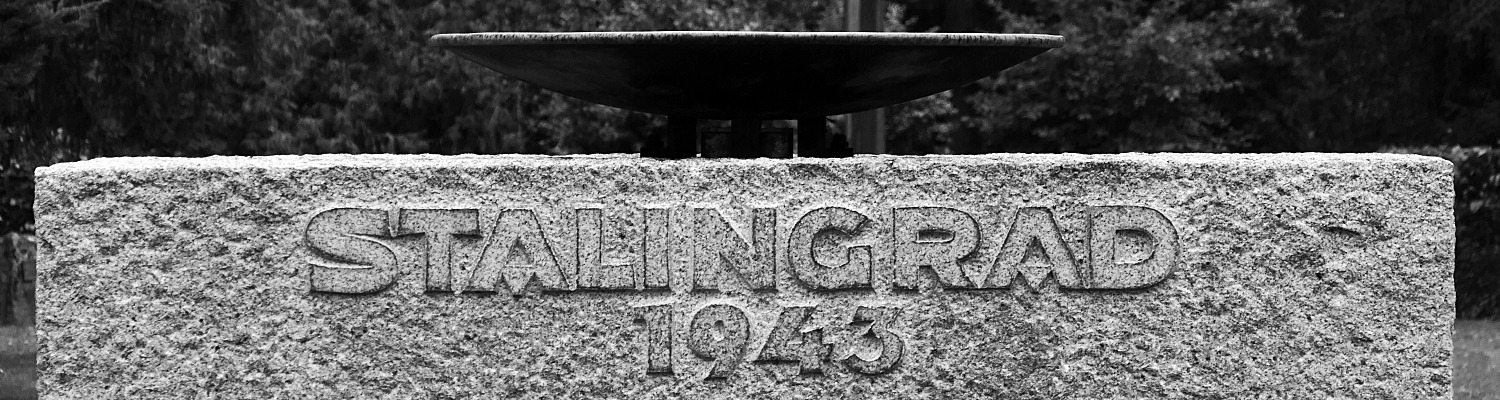
(Head picture: Stalingrad Memorial Stone at the Limburg Main Cemetery,
November 2026)
If you wish to support my work, you can do so here. Many thanks!