
Mail Correspondence with Soldiers at War (“Feldpostbriefe”): “Who is still with us?” – A letter from an unknown German soldier in Stalingrad, December 1942 (Published on 18/10/2026)
I. The Battle of Stalingrad
The significance of the Battle of Stalingrad as a turning point in World War II and as a national symbol – a warning sign for the Germans, a promise for the Russians – has been discussed here on several occasions; see, for example, the September 1988 speech by former German soldier Johannes Uhr on the importance of commemorating the victims of Stalingrad.
II. Commemorating the Victims of the Battle of Stalingrad
Today, the town of Rossoshka in the Volgograd region of Russia plays a central role in both German and Russian commemorations of the victims of the Battle of Stalingrad. There is both a memorial and resting place for the German soldiers who fell or went missing – in Rossoshka itself, in the area from Volgograd to Rostov-on-Don, and between the Volga and Don rivers – as well as a Russian military cemetery; the two sites are separated only by a narrow country road. According to Volksbund Deutsche Kriegsgräberfürsorge e.V. (“Volksbund”, the “German War Graves Commission”), the German cemetery was dedicated in 1999, and in September 2006, granite blocks bearing the names of nearly 120,000 missing and deceased soldiers were installed. The Volksbund currently lists the total number of those buried there as 71,427.
In 2007, the Volksbund published a highly recommended book titled “Namen für Rossoschka – Schicksale aus Stalingrad” (“Names for Rossoshka—Fates from Stalingrad”), which gives a voice to German eyewitnesses for whom – as the editors note in the foreword – Stalingrad became a matter of fate, and which is intended to serve as an example of the suffering caused by war and the grief of the bereaved.
III. A Letter from an Unknown German Soldier About the War Against Russia
This book contains the following letter from an unknown German soldier dated the turn of the year 1942–1943, in which he describes the fighting at that time in vivid terms as follows (see Volksbund, Namen für Rossoschka, 2nd ed. (2007), p. 128 ff. [translation from German language]):
“Russia, December 31, 1942
Dear Gretel!
Another year is coming to an end, and my thoughts drift far away, back to home. It’s time to pause, reflect on the path I’ve traveled, and linger on those memories. Why condemn a year just because it caused me days and months of torment and left my nerves in constant turmoil? I console myself with the thought that it could be even worse. I think of the many comrades who walked part of the way with us, who left us by giving their all. They all entered the new year of 1942 with the same strong hearts – and yet: they’re gone. Who’s still with us from the old guard in France? Don’t ask how many hands I need for that.
I let the year pass before my eyes, very slowly, and lo and behold: there were some bright spots, too. It started with a vacation. I was with you and the kids. Then came the days of convalescence in Bautzen. With light duty and trips to the movies, they still offered plenty of variety. Then it was off to the marching battalion, and that strange aftertaste was back. Eleven days of train travel followed, and before we headed to our old company, some general had to give us a speech that went something like this: »Dear old comrades! I want to tell you that the Russian is no longer the fighter from Kaneff. Their training is inadequate, not to mention their armament. The first wave may still be armed, but the second is already coming with scythes, and the third wave will have to scavenge for the weapons of the fallen.« Today we could talk about it and at least note that we saw neither Russians with scythes nor Russians scavenging for weapons. Usually, everyone had plenty of both.
I think back to life in the bunker that spring, to standing guard in the merciless cold and storm. I think of one day in particular. We returned to the village after eight days on duty. There was a lot of snow, but the sun had already melted quite a bit of it, and deep puddles of water had formed beneath the snow. We made our way back in the dark. We sank into the snow and our boots filled with slush. We grumbled, but what did it matter? We had three days of rest, after all. It froze again overnight. A few hours later, the alarm sounded: The Russians had overrun one of our outposts. There were dead and wounded. Where was our rest? Back into our wet boots and out we went. We’re moving forward again. Where there were puddles, there’s now ice. It cracks under our feet. The Russians have withdrawn again after taking everything they needed. Without relief, we stood or lay at our posts until dawn. Our socks were frozen inside our boots, and our legs were almost numb.
I keep thinking back to a night when our little village became a playground for the pilots. There may have been 70 bombs – some say they counted 100 – huge ones. We sat in our mud huts, keeping our fingers crossed. We hadn’t made it to the bunker yet. We took over from one unit after another, but they forgot about us. Then came the advance. It started off very hard. We marched and marched. The casualties? What good are numbers? We can remain silent.
When we were in Voroshilovgrad, we thought it was all over for us. Far from it. It went on and on. Across the Donets and across the Don, and then to the Sal – and that’s when I think back to August 1, 1942. It was near Martynovka. A reconnaissance patrol had set out and just wouldn’t come back. Finally, the rest of the patrol arrived. Then came the report: rugged terrain, tall underbrush all around, no sign of the Russians. Suddenly, fire came from all sides. Those who could retreated. Some were missing. We had to do something for them – we couldn’t just leave them… The medic crawled forward once more. The others waited for hours. No one else came. The next day, after the area had been cleared, we searched for them. We found them, dead, robbed, and stripped of their clothes as far as possible. It was a very confusing time overall. You never knew whether the Russians were ahead of us, to our left or right, or whether we also had to expect Russians behind us. On one such day, nearly the entire supply train of two of our companies was nearly wiped out.
And on we go. I think of the march across the steppe, in the scorching heat, day after day shrouded in clouds of dust and with no water. If there was any, it was salty. Have you ever drunk coffee that tastes salty? You lose the urge to drink, even when you’re very thirsty. I think of August 20, when things really heated up, and of one of the last days of August, when a barrel organ played for the column – and then comes Stalingrad. What is there to write or say about it? One should remain silent about it, if only out of gratitude for so much self-sacrifice, courage, determination, self-denial, and hope. One should only think about it – especially back home. We’re sick of what we read about it in the newspaper. We don’t want to see pictures of comrades eating their breakfast with a caption below saying: »during a lull in the fighting« or »on standby«. You know how these things are. After all, everything has to make sense. Perhaps people will once again be very happy to remain silent about Stalingrad.
The last day of the year: What would you do at home? Maybe you’d have gone to the movies or the theater. Music plays on the radio. The traditional herring salad is on the table, along with sausages and maybe even some aspic. Punch or grog is served. The ice cream is ready, and then you wait, listening for the ringing of the many bells. When tiredness washes over you from head to toe, it’s time to head to bed.
It’s the same here. We, too, live by the hundreds in a village. The name doesn’t matter. You’re familiar with the area. In peacetime, the village might have had four houses. Three are currently uninhabitable, and Russians are living in the fourth. We have no movie theater and no radio. We worked during the day because we have to get things done. There’s no alcohol left either, and festive lighting has been missing for a long time. Everyone is writing, and I think today’s letters are very different from the everyday ones. They’re hardly likely to be cheerful. One by one, we take turns going on guard duty. Our bells ring a little differently than those back home. For us, the rumble of the Ju 52s and Heinkel 111s – flying back and forth day and night – is like the ringing of bells. Our festive lighting consists of the many flares that light up no matter which way you turn. The front is everywhere, everywhere. When the year is over, my service will be finished too, and then I’ll think of you for a little while – a quarter of an hour or half an hour.
The New Year: I’m not expecting much, and I plan to accept anything that exceeds my expectations as a gift. In any case, I wish you good health once again – keep your chin up and hang in there. And if the year has been bearable, you’ll get another letter like this from me at the end of it. If it’s been wonderful, then I’ll be home, and we’ll throw a big party with minimal effort.
So, good luck, best wishes, a kiss, and an airmail stamp from your Hubertus.”
IV. The Value of Memory
Reinhard Führer, then president of Volksbund, described the significance of the Battle of Stalingrad in the foreword to “Namen für Rossoschka” as follows (ibid., pp. 8, 10 [translation from German language]):
“The Battle of Stalingrad – now known as Volgograd – is one of the most horrific and tragic events of World War II. The people endured unspeakable suffering, and countless lives were lost. Deep grief filled the families of the victims on both sides. Stalingrad has become a symbol that reminds us of how precious peace is. (…) The Rossoshka War Cemetery, with its German and Russian cemeteries and the memorial to the missing, shows that grief is indivisible. It need not divide people; it can bring them together – for it is profoundly human. Peace, too, is indivisible. There is no such thing as peace that benefits only one side. Peace unites. That is why all our efforts are dedicated to promoting understanding and reconciliation between former enemies. They are dedicated to preserving the memory of the dead. And they are dedicated to peace.”
One might hope – not least in light of, among other things, the joint production of a so-called “dance theater” performance set set atop war graves – that these words will be kept in mind and followed by appropriate actions, not only by political leaders but also, and not least, by Volksbund itself.
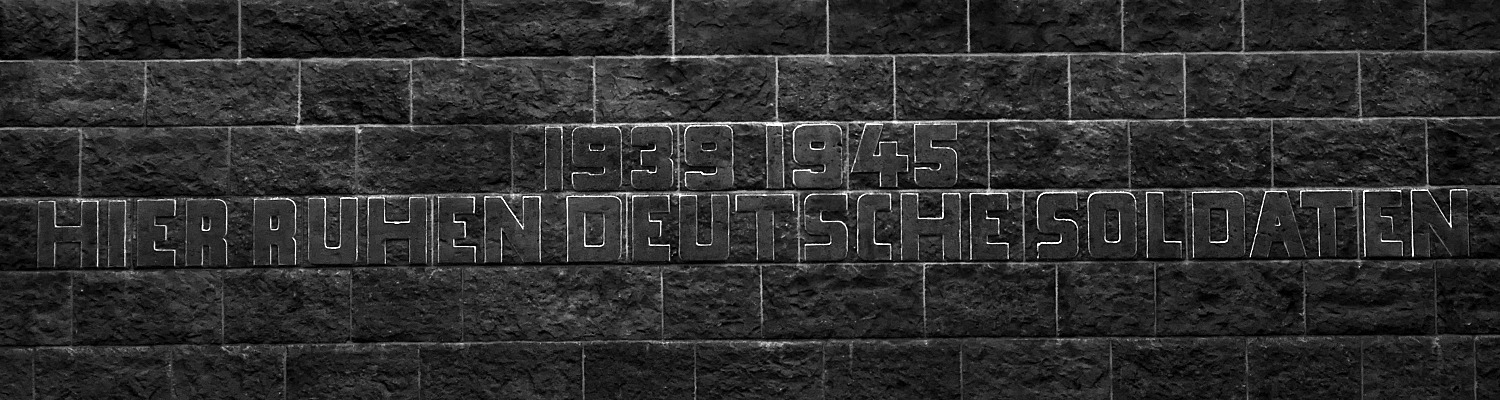
(Head picture: Entrance to the
German military cemetery Lommel/Belgium, December 2025,
inscription: “1939-1945 Hier ruhen deutsche Soldaten”
[“1939-1945 German soldiers are buried here”])
If you wish to support my work on Julius Erasmus, you can do so here. Many thanks!