
Julius Erasmus: The Severe Fires in the Hürtgen Forest After the End of World War II (Published on 18/09/2026)
I. The Fires in the Hürtgen Forest in August 2026
In August 2026, the Hürtgenwald forest burned. Amid nationwide and international press and media coverage, prominent German politicians rushed to the affected district of Hürtgenwald-Gey to spend days there making a spectacle of themselves while fighting what State Minister President Wüst described (Archive) as the “largest forest fire in the history of the state of North Rhine-Westphalia” (this and all subsequent citations translated from German language). According to the latest figures from the state government, the forest area damaged by this fire amounts to “around 300 to 400 hectares” (Archive).
As regrettable as the events in Gey were for those affected: Anyone familiar with the postwar history of the Hürtgen Forest in more detail could not help but be astonished by the spin given to these events by the political protagonists involved. The state of North Rhine-Westphalia was founded on August 23, 1946, and as early as the years 1945 through 1948, severe forest fires repeatedly ravaged the Hürtgen Forest.
II. The Fires in the Hürtgen Forest After the End of World War II
These fires were also of great importance for the recovery of the war dead from the Battle of the Hürtgen Forest, as many of these bodies still lay in field graves or were even unburied in the vast forest areas that had been severely ravaged by the fighting, where Julius Erasmus and his helpers searched for them.
Baptist Palm, a participant in the battles in the Hürtgen Forest and later mayor of Vossenack, writes about this in his 1953 book “Hürtgenwald – Das Verdun des Zweiten Weltkriegs” [“Hürtgenwald – The Verdun of the Second World War”] (ibid., p. 108):
“The late summer of 1945 came. Everywhere in the woods was the unbearable smell of decay. Nevertheless, nothing was done by higher authorities to bury the soldiers. Then came the terrible thing for the countless survivors who were looking for their dead who lay unburied here: the forests burned! Yes, some circumstance, perhaps it was the piles of ammunition lying around, perhaps it was phosphorus ignited by the heat, had started this fire. Hundreds of acres of forest between Vossenack and Hürtgen were burning. Piles of ammunition of all kinds went up in the air and rekindled the fire again and again. The many hundreds of bodies (no one knows the number) burned and charred. Black bone remains lay scattered wildly on the black, burnt forest floor. Only the black, charred tree stumps rose to the sky, complaining to the world.”
1. The Forest Fires of the Summer of 1945
Despite postwar restrictions, the forest service agencies responsible documented the fires of that time in great detail; some of these records are available at the State Archives of North Rhine-Westphalia and were reviewed some time ago as part of the research on Julius Erasmus conducted here.
These files contain, for example, information about a fire in the Hürtgen Forest in the summer of 1945, before the state of North Rhine-Westphalia was established. A report dated August 2, 1945, indicates that this single forest fire on July 26, 1945 – which affected the areas of Kleinhau, Großhau, Vossenack, and Raffelsbrand – burned 420 hectares of forest (see State Archives of North Rhine-Westphalia, File BR 1132 No. 116).
2. The Forest Fires of 1947
According to these records, the forest fires were even more severe in the exceptionally hot year of 1947, the year after the state of North Rhine-Westphalia was founded.
For example, the records document a total of 58 (!) fires in the jurisdiction of the Hürtgen Forestry Office alone during the period from March 26 to September 20, 1947, which damaged a total of 2,222 hectares (!) of forest land (see State Archives of North Rhine-Westphalia, File BR 1132 No. 124).
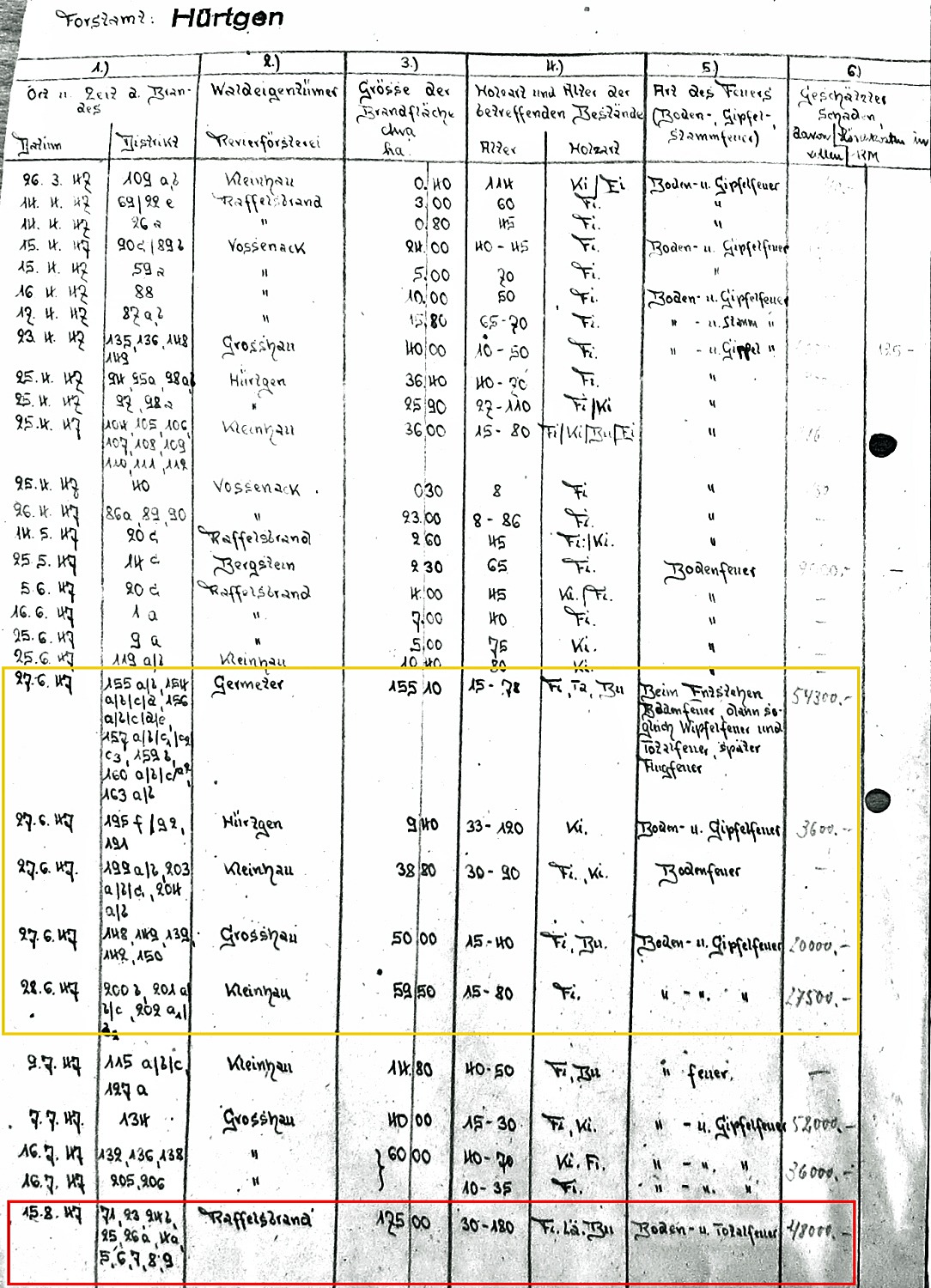
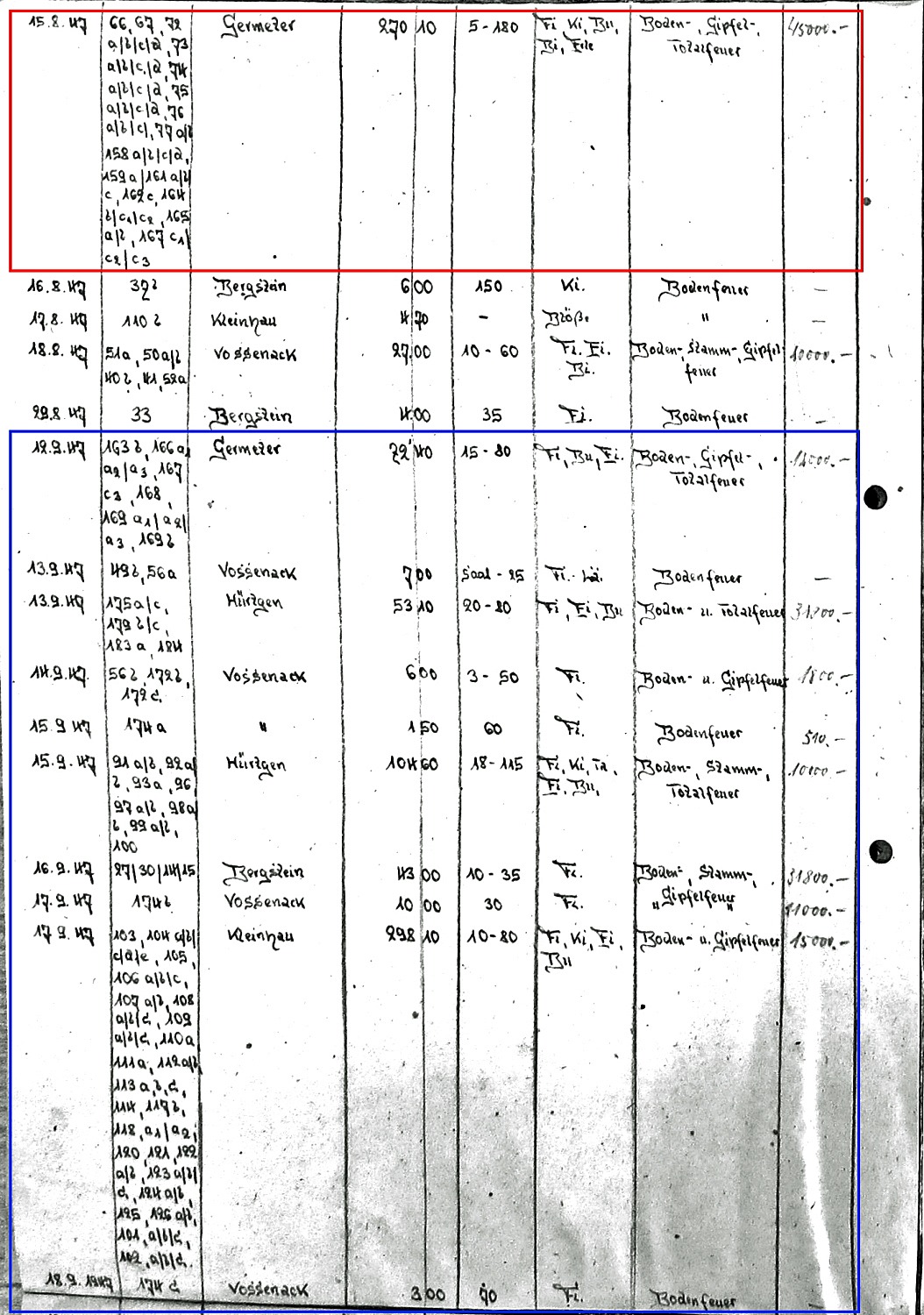
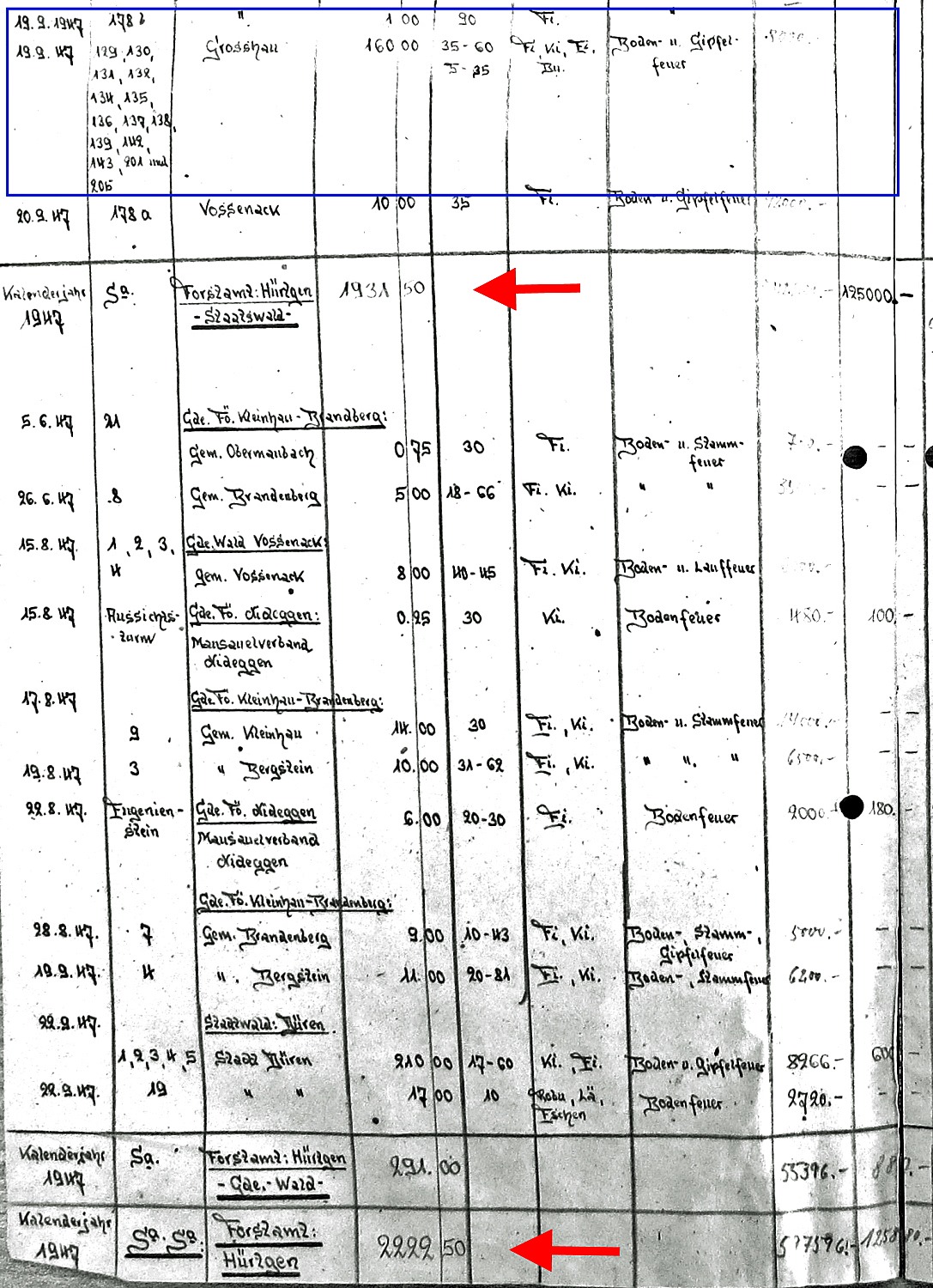
The relevant report does not appear to include two additional major fires that occurred this year in Germeter (October 1947, area affected: 185 hectares) and Raffelsbrand (September 1947, area affected: 95 hectares), which would bring the total area of forest damaged by fire for the year to approximately 2,500 hectares.
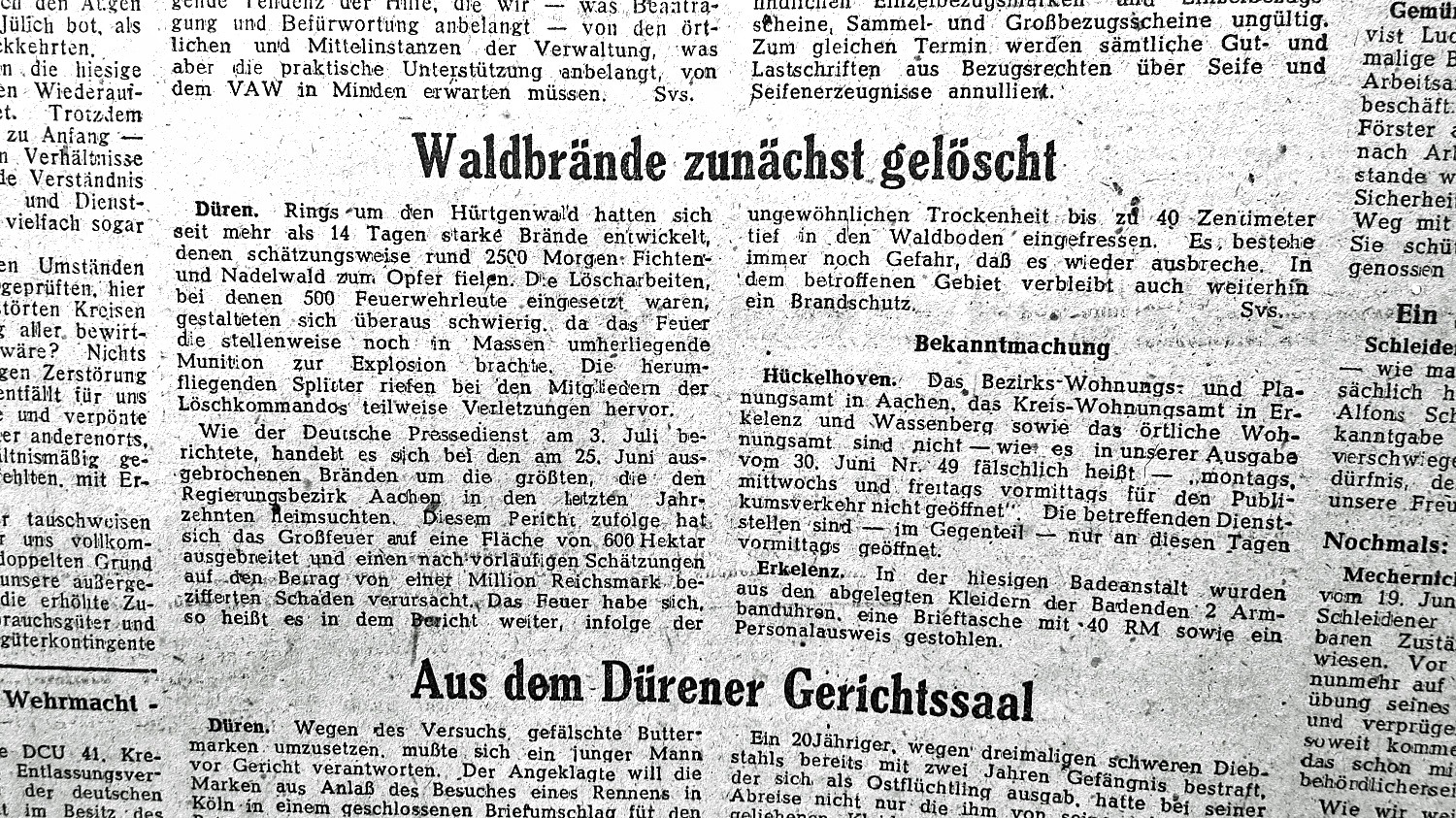
According to the reports, three fires were particularly severe: those on June 27-28, 1947, and August 15, 1947, as well as a fire that raged for over a week, from September 12 to 19, 1947. The first affected the forest parts of Germeter, Hürtgen, Kleinhau, and Großhau, burning an area of approximately 313 hectares. The second affected Raffelsbrand and Germeter, with 395 hectares damaged. The last, affecting Germeter, Vossenack, Hürtgen, Bergstein, Kleinhau, and Großhau, damaged an area of approximately 757 hectares (source in each case: State Archives of North Rhine-Westphalia, ibid.).
There is also a report on the first fire mentioned above in the local press – which was still quite sparse at the time – from the newspaper “Volksstimme” dated July 7, 1947:
III. The Impact of the Fires on the War Dead in the Hürtgen Forest
These massive fires, which in many cases broke out in the midst of former combat positions – often caused by the spontaneous combustion of unexploded ordnance, particularly phosphorus, in the unusually hot summer weather at the time – made the recovery of the war dead considerably more difficult.
As a result, only bones remained of the unburied dead lying there, making it nearly impossible to classify and identify them – a process for which remnants of uniforms and equipment, which were otherwise often present, provided valuable clues. Field graves in these forested areas – usually marked by a hastily constructed wooden cross topped with the victim’s steel helmet – were no longer easily distinguishable due to the effects of the fire. Burial mounds were scorched and covered with ash, and grave crosses burned, thus eliminating them as points of reference.
It is in no small part due to these massive forest fires that many of the dead buried in the military cemeteries in Vossenack and Hürtgen have remained unidentified to this day.
In his book (op. cit., pp. 108-109), Baptist Palm commented (ibid., p. 108/109):
“And if, back then, numerous families received the news: »The son, the father, the brother, killed in action or missing in the Hürtgen Forest«, and still do not know today where he has found his final resting place (…), then he is among those for whom nature has dug a grave (…). Their loved ones will never be able to visit the graves of their fallen relatives. They know only this: Somewhere in the Hürtgen Forest he fell; somewhere in this “Forest of the Dead” he was burned unburied, carried off by wild animals – the forest is his grave.”
However, today the remains of war dead are still occasionally recovered and identified even in the areas formerly affected by forest fires; prime examples include U.S. soldier Robert Cahow in 2001 and German soldier Benno Schott in 2011, both of whom were found in the Raffelsbrand area.
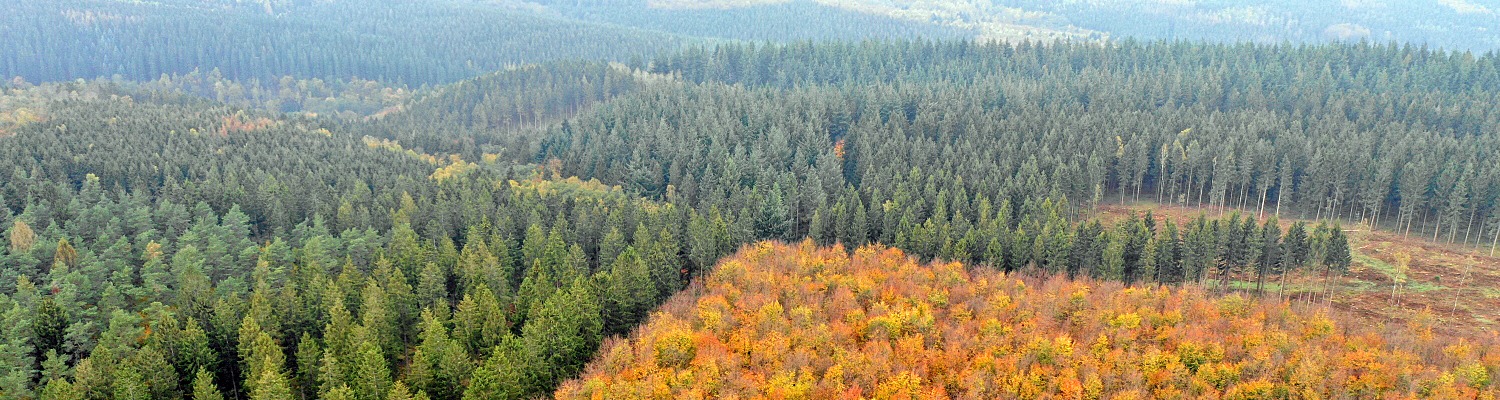
(Head picture: Hürtgen Forest near Hürtgen in autumn,
October 2019)
If you wish to support my work, you can do so here. Many thanks!