
Mail Correspondence with Soldiers at War (“Feldpostbriefe”): Letters from the German soldier Günter von Scheven on the Eastern Front 1941/42 (Published on 12/06/2026)
I. Sculptor
Günter von Scheven, born on 17/04/1908, in Krefeld, was a prominent German sculptor. He created mostly figurative sculptures and statues strongly inspired by Greek classical art, particularly sports motifs. He was drafted in 1940 and served in World War II as a member of the 466th Infantry Regiment with the German 257th Infantry Division.
II. With the 257th Infantry Division in Russia
With this division, he was deployed from June 22/06/1941 through March 1942 during the German invasion of the Soviet Union and advanced toward Lviv with Army Group South. From 12/07/ to 08/08/1941, the division fought in the encirclement battle near Uman, in which the Wehrmacht, together with Hungarian and Romanian units, destroyed 20 divisions of the Red Army. From November 1941, it was stationed on the Donets River north of Sloviansk and successfully defended the area from 18/01/ to 07/04/1942, against the Soviet winter offensive.
After serving on the French coast beginning in August 1942 and returning to the Eastern Front in April 1943, the 257th Infantry Division was ultimately surrounded on 23/08/1944, during Operation Jassy-Kishinev, and was destroyed by 29/08/1944.
III. Letters from the Front
In numerous letters sent from the front between July 1941 and March 1942, Günter von Scheven wrote home about these missions. His letters go far beyond mere accounts of his experiences. In addition to describing the war’s impact on his emotional world, he reflects on the significance of war as a means of transforming the world, thereby offering a personal yet timeless perspective on the theme of humanity in war (source: Bähr, Die Stimme des Menschen – Briefe und Aufzeichnungen aus der ganzen Welt 1939 – 1945, p. 153 ff. [all translated from German language]).
He wrote from Russia on 25/06/1941 (ibid., p. 153):
“The war is rolling eastward, its cruel path resembling a Day of Judgment come to life. Yesterday we took Tulchin, 450 kilometers east of the old border, in conjunction with Hungarian tanks and Romanian troops.
We covered immense distances. The struggle against nature – against the mountains, the rivers, the poor roads, the dust, and the scorching heat – just as fierce as the battle against the Russian units, who are putting up a stubborn defense in favorable terrain. And so we press on amid the stench of death on the advance routes. Who still knows sleep and rest? I fell asleep amid the artillery fire after we had been on the move for 48 hours, overcome by rain and the cold of the night.”
On 03/08/1941, he reported (ibid., p. 153/154):
“I can only assure you that all these experiences, however unfamiliar they may be, strengthen and confirm my resolve, which, above all the chaos, serves human purposes. One must walk through the night in order to perceive the light anew and as something divine. For the few who are not bound by material things, this struggle is a purification. Nowhere does one experience humanity as more profound, cruel, ugly, and divine than under the hammerblows of fate.
In my experience, when I am exhausted, my imagination works wonders. Certain images come to life – such as Michelangelo’s Last Judgment and the agonized face of Christ himself; even Dante’s world-weary features appear before my inner eye. I see war as humanity’s self-judgment, a judgment that can serve to rouse the souls until a new upsurge becomes possible from the darkness.”
In a letter dated 05/08/1941, Günter von Scheven stated (ibid., p. 154):
“Yesterday our battalion repelled an enemy breakthrough attempt, taking 2,000 prisoners and other spoils. We are lying in a wheat field, having gathered the sheaves together for shelter from the merciless sun. Perhaps mail is coming as well; that is always an uplifting moment, a reward for many hardships. This Russia – as a country and a character – has not yet been able to move me significantly. Only the vastness is compelling, though it dissolves any personal character. Between day and night, between sweat and hunger, one does not have the chance to delve deeper into such impressions. They are backdrops against which the spectacle of war unfolds. My feelings are manifold, while the impressions flood over me in an overwhelming tide. I must agree with your conviction that only a complete defeat of Bolshevism will make the sacrifices worthwhile. It also seems to me that the war with the Soviet Union has become the war into which all others will flow or from which new ones will begin.”
On 16/08/1941, he wrote (ibid., p. 154):
“In moments of reflection, I feel an indescribable longing for you, for the Rhine, for the small and great things that bind us together. As long as the starry sky remains familiar to me, as long as I can find my way up there, nothing can harm me. These nights, which we always spend outdoors, are a reward, where above the vast plain the eternal stars shine majestically over our bloody strife. The sight of the eternal strengthens more than physical nourishment. Tasso’s words, which you wrote to me, are truth to me. One’s own sphere cannot be destroyed.“
On 02/09/1941, he reported (ibid., p. 155):
“We covered more than 2,000 kilometers. The final stretch on foot: from the battlefields south of Uman to the Dnieper Bend, in forced marches, only at night, on impossible roads where everything got stuck. The experience of death is overwhelming; it is like a new baptism. In the breakneck pace of events, it grants us moments of clear spiritual insight. There are also beautiful experiences in this untouched, magnificent landscape, where the broad waters of the Dnieper carve their way according to their own laws, wild and untamed. This primitive existence fosters a new union with nature; one is constantly exposed to the wind, the sun, and all kinds of weather. Do not be alarmed by what I have said; for those who have experienced it, it is simple.”
On 29/10/1941, he stated (ibid., p. 155):
“We can go no further; clay and mud weigh down our feet like lead, the vehicles are sinking up to their axles, and eventually even human and animal strength fails. The rain pours down without ceasing. The bridges have been blown up, the farmsteads burned to the ground, the livestock scattered, our clothes and shoes worn out, and the company, after heavy fighting, has dwindled to less than a third of its original size. After the last assault on a fiercely contested railway embankment, only a single boy remained of my group. Many comrades lie bleeding and dying on this unspeakably sorrowful earth. Since October 6, the start of the offensive, battle has followed battle, combined with marches day and night, attacks by tanks and low-flying aircraft, and every hellish means of destruction. Setting out from Konstantinograd, we crossed the Orel and now, following the fall of Kharkiv, stand west of Izyum.”
On 06/11/1941, Günter von Scheven wrote the following home (ibid., p. 155/156):
“We march another 50 kilometers into the Donets Basin to take up winter quarters there – for now, the destination of our long, war-torn trek across a thousand plains and over countless rivers. In our sector, the front has stalled. The general direction of the advance is southeast toward Rostov and the Sea of Azov. As a sergeant, I now hold a position that affords me greater personal freedom, hard-won through the recent battles. I have many friends and greater responsibility.
I don’t expect much from the joys of this world. I have distanced myself greatly from what usually fulfills people. It is not yet time to speak of this. Horror and death are still too close. First I must escape this gloomy atmosphere. Dear Mother, I am happy to be able to write to you, even though the fatigue of the marches and the thought of our people’s fate cast a shadow over my spirits. But believe me, I am closer to all that is divine than ever before. The mystery of light is greater than that of darkness.”
In letters dated 08/ and 15/11/1941, he offered a glimpse into his innermost feelings (ibid., p. 156/157):
“It seems to me that we are no longer on Earth; a treeless landscape, devoid of cultivated fields, barren meadows stretching out in endless monotony. Above it all, a gray mist that chokes off the light, so that twilight reigns all day long – an atmosphere illuminated only by the pulse of one’s own life and the thoughts that pierce the heart. One is entirely dependent on oneself, on one’s own resources. The whole situation worries me: the course of the war, which is becoming ever more excessive; the relationship between our strength and the outcome of these immense efforts. We, who are cut off from the outside world, lack the big picture. Dark behind the clouds stands the glow of the world’s conflagration.
The cold has set in with a vengeance. The frozen mud looks like lava rolling right through the middle of the village. From the north and east, the winds roar with elemental force across the vast plains. Now the mud huts we live in are proving their worth. Our hosts are not communists; the icon in the niche tells us so. They cook us Russian soup, toast bread, and haul wood. There is no overt hostility here like there was on the Dnieper. It is time to reflect on everything we have experienced, and the silence by the lamp at the table at night feels unfamiliar – no orders, no gunfire, no enemy; only the wind rattling the shutters, yet it does not break the silence, which I find deeply comforting within. One is grateful for the fragment of life that has been saved from the hell of death. The smallest beauty is a revelation, a ray of sunshine, the frost flowers on the window.”
On the second Sunday of Advent in 1941, he wrote home (ibid., p. 157):
“One need not stand in the midst of a hail of shells to witness the turning point of our time. The earthquake-like tremors continue unseen and are perceptible to those who are attuned to the course of world history. For this reason, your stance at home is of just as crucial importance as ours at the front. Our aim is to overcome this chaotic transition and to preserve human dignity, purified through pain and sacrifice. That is why your existence – unscathed by the turmoil of war – is so important to us, for we see in it the necessary foundations for the inner constitution that will help shape the future. We are not fighting for political disputes, but in the belief that what is noble and best must prove itself anew in the struggle against the hideous specter of materialism. I see the entire nation in a process of transformation, in a torrent of suffering and blood that will enable it to reach new heights.”
On 07/12/1941, Günter von Scheven wrote the following from the Donets (ibid., p. 157/158):
“Just as the Dnieper did three months ago, the Donets now holds us back. Rivers have, after all, played a decisive role in the course of war since time immemorial. Here, for the time being, they serve as borders; on both sides, forces are being organized and gathered. How often have I witnessed this before, first on the San. It is almost impossible for the organizing mind to untangle the rush of these experiences. One lives amid contradictions and yet unites them, without even realizing it. Before, the ground beneath one’s feet glowed in the summer’s swelter; now tiny ice crystals shimmer in the moonlight of the winter night. Snow, endless, as if it had always been there. And who knows the true enemy! Is it Bolshevism alone? Is it not the expression of an illness that concerns us all? What is brewing in the upheavals that transform the victor just as much as the vanquished? Today, no one recognizes it yet.”
In a letter dated 09/12/1941, he also reported on partisan attacks during the harsh Russian winter (ibid., p. 158):
“In these turbulent days, when Russian partisans are trying to set our villages and outposts ablaze, we bear a heavy burden of responsibility. Added to this are the harshness of winter in a form unlike anything seen in Europe – with snowstorms and long, perilous nights in which bullets whistle and artillery on both sides engages in battle. Our small band has positioned itself as advantageously as possible for defense. Winter has offered us respite, and that suits our exhaustion well, for we would not have made it much further after the battles of October, which demanded the utmost. December is a grim, dark month. By a single dim light, we wait through the nights in the cramped space of a hut for news of the trains. Something is always happening somewhere. For hours on end, we lie on alert. Fires light up the sky.”
At the turn of the year on 31/12/1941, he wrote (idib., p. 158):
“With a shudder, we stand on the threshold of new, fateful events. I have felt all your love and the loyalty of our homeland, which are a reward for all our hardships. We are gladly willing to risk everything for this homeland.”
On 14/02/1942, he reported from Sloviansk (ibid., p. 158/159):
“It is impossible to put into words the haunting weeks of the defensive battle. Defense is bloodier and harder than attack. For the first time, the Russians attacked, well-prepared and with ten times our strength. We held Majaki. The horrors we have endured pound in our temples. Whoever survives this winter war may face old age and death with confidence. I do not believe there is anything left on God’s earth that could instill fear in him. We must now be silent with the dead, until our tongues are loosened again by sun and light. The soul becomes infinitely vast, stretching between life and death to its very limits.”
On 06/03/1942 he reported home (ibid., p. 159):
“Russia and this endless, eerie war are throwing the deepest layers of existence into turmoil. We are all shaken by the realization that a tremendous turning point in the world is upon us. Along the upper Donets, the fighting has subsided over the past three days. Perhaps both sides are exhausted. Now that it has been snowing for days, nature has, with gentle force, laid the purest white over the bloody traces of battle in a conciliatory gesture, and it suddenly seems as though the fighting belongs to a legendary, dark tale. Graves are covered in snow, the names no longer legible; shell craters have been leveled. Where there was once a path, an endless expanse now stretches out. In Russia’s immense expanse, there is no stopping. Deeds and individual fates fade into the boundless; a painful yet soothing experience. May the time come when I can bear witness to what humanity has suffered. Dear Father, I do not believe that any artistic achievement in Germany today can compare to the feat of a simple soldier who holds his position under a barrage of fire in a hopeless situation. This unknown soldier strides once more across the battlefields in nameless grandeur, as in the days of the First World War. Unnamed, seen by only a few comrades, in silence, he dies the loneliest of deaths, passing into the unreachable; the East takes his bones into its abyss, as if nothing had happened. Let us remain faithfully united. It is still uncertain when we will see each other again. Comfort our dear, good mother. Let us maintain our trust in God and our confidence.”
In a letter dated 09/03/1942, he wrote about his fallen comrades (ibid., p. 159):
“Images of fallen comrades flash before my eyes, their bodies bearing terrible wounds. Covered by gray coats, frozen stiff by the cold before their time, they lie there silent and lifeless, their faces ravaged by frost and their eyes devoid of light. Rarely could the smile of deliverance still touch the corners of their mouths; a merciless, harsh death. After many days of battle, long rows lay side by side. Every hour was filled with the twilight of death. Let us never forget the faces of these dead and living. What we see here is the face of the Russian war, and perhaps the final, unattainable expression of our time.”
Günter von Scheven’s last letter was written on the day of his death, 21/03/1942 (idib., p. 160):
“After a march through the snowy wasteland, we reached the small mud huts once again. The frost remains relentless; the temperature hovers around 20 degrees with the constant east winds, and long snowdrifts and deep, fine fresh snow envelop us. Ice crystals swirl in the air; the universe seems to be falling into a state of paralysis. We are sheltered and have also grown hard. Your last greetings came to me like a stream of warmth and light, carrying familiar and beloved images from home. Michelangelo’s two heads have shaken me to the core. This prophetic spirit also blows in the higher spheres of the present. What compels Jeremiah’s gaze down to earth – the guilt of the world and the judgment – we can fathom today. We strive ourselves to view the tragedy of our time from such a height…”
IV. Death in March 1942
Günter von Scheven was killed in action on 21/03/1942, during the fighting for Karpovka in the Krasnograd area.
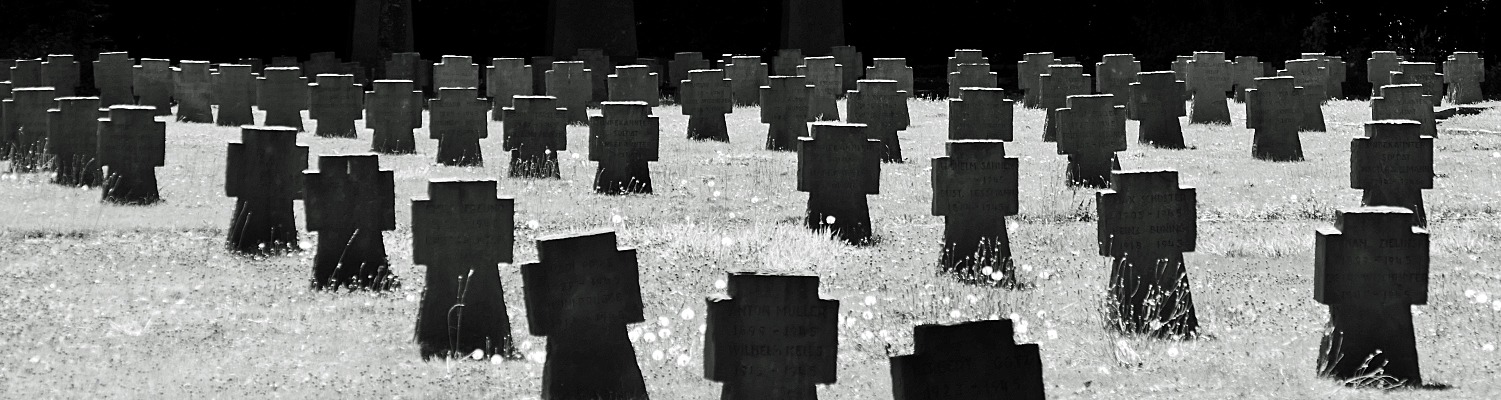
(Head picture: Grave crosses at the German military cemetery Ittenbach,
August 2025)
If you wish to support my work on Julius Erasmus, you can do so here. Many thanks!