
Mail Correspondence with Soldiers at War (“Feldpostbriefe”): US soldier William Lee Preston on a column of German prisoners of war marching after the end of the war (Published on 01/04/2026)
I. The 65th US Infantry Division in World War II
The 65th US Infantry Division (“Battle-Axe Division”) was formed on 16/08/1943, at Camp Shelby, Mississippi, USA. It landed in France in January 1945 and was transferred to the Western Front in March 1945 to join the 26th U.S. Infantry Division, where both fought in the Saar region part of the Siegfried Line. After crossing the Rhine in March 1945 near Oppenheim, the division advanced into southern Germany, where it captured Regensburg and Passau, among other cities. In May 1945, it crossed the border into Austria and occupied the city of Linz, where numerous German soldiers, including approximately 10,000 men from the 12th SS Panzer Division “Hitlerjugend”, surrendered, presumably to avoid capture by Russian troops. On 09/05/1945, soldiers of the division met up with soldiers of the Soviet 4th Guards Army near Erlauf.
II. Letter from US soldier William Lee Preston to his brother shortly after the end of the war
William Lee Preston also served in the 65th US Infantry Division. Shortly after the end of World War II, he watched a parade of German prisoners of war – including teenage soldiers from the 12th SS Panzer Division – and shared his thoughts in a letter to his brother in the United States.
He wrote to him on 10/05/1945 (source: Carroll, War letters, p. 279 ff.):
“Dear John,
The war is over. The war in Europe is over. I can hardly believe it, for it seems only yesterday we were seeing our first action in the Siegfried line.
Two nights ago, John, I sat by an open window on the second story of the building my platoon occupies, and listened and watched for over an hour as German prisoners, thousands, passed below me on their way to a prisoner of war enclosure. I listened to the tromp, tromp, of Nazi boots, no longer in cadence, no longer marching proudly, a beaten, tired mob of German soldiers – surrendered.
I recalled the many pictures and newsreels I had seen of the German Wehrmacht on parade, while thousands of cheering civilians watched the spectacle before Adolf Hitler. The super race they were – the world’s best soldiers then. I looked at them now – hungry, shoulders stooped by the heavy equipment on their backs, uniforms dirty, and a haggard expression on their faces. Hitler’s soldiers on parade before the Yanks, and the G.I.s watched intently. Then I recalled the scene I had witnessed of those same soldiers – they had left a string of dead and dying from Cherbourg to the Siegfried line – from the Rhine to Austria, in retreat. I had seen them lying in roads, streets, ditches, fields, wherever we went – sometimes with G.I.s near them. And still they came on the street below me, marching four abreast.
Two afternoons ago I saw another group, a column of Hitler’s SS troops who had surrendered. I watched as M.P’s took them to a prison camp. They still wore their insignia, the skull and cross bones, but they were no longer arrogant, their pride had gone with surrender. Hitler’s crack troops with the insignia that had meant terror and torture to the people of Europe for years. And not only to Europeans, but terror and torture to American soldiers surrendered. And now I saw them stop for a rest, and was amazed to see them begging G.I.’s for a smoke, a cigarette butt. We felt like spitting on them. The terror of Europe – begging for a smoke. How things change. The M.P’s moved them off again. They walked with shoulders stooped, heads bowed looking at the ground – beaten. I was glad to see them so. We didn’t mock them as they passed, for our hatred was deeper than mocking.
Another column of German soldiers came by. I was amazed. Can you imagine Kent Lawrence, Jo, and men dad’s age fighting the war for America? Most of them were 14, 15, 16, years of age, with an old man here and there in the column. The youngsters were the Hitler youth, fanatical boys fighting for der Fuhrer. In America, kids the same age are reading Superman and going to junior high school, I hope. Yet these German boys were old soldiers, prisoners of war. A shame, I agree, but indicative of the desperate measures the Nazi leaders took in a last ditch fight against us.
Yes, the war in Europe is over. I don’t know what the reaction was in the states on a whole. Over a patched up radio we heard that ticker tape and paper floated down from New York buildings. We heard that there were wild celebrations in the streets in London by civilians, English and American soldiers. But, John, the front line troops didn’t celebrate. Most of the men merely read the story of victory from the division bulletin sent to the troops, said something like “I’m glad,” and walked away. Perhaps it was a different story in their hearts, or perhaps they were too tired, or thinking of home too much, or thinking of their buddies who didn’t live to see the victory, to do much celebrating or merry making. But I’m sure of one thing – the troops were glad they wouldn’t have to fight anymore – I was.
What our future is we don’t know, but everyone is sweating out the South Pacific troop movement.
My love to Eleanor and Troy.
Your brother,
Bill
PS. Some boys who left Camp Shelby with me didn’t get to see V- E day. Others are in hospitals in the U.S., England and France who used to be in my company. I’m thankful John, to be sitting here writing to you, and I’m still a very lucky fellow. Yes, I’m thankful.”
III. Biographical data
William Lee Preston, born on 11/08/1922, in Monroe, Walton County, Georgia, USA, died there on 19/04/1995.
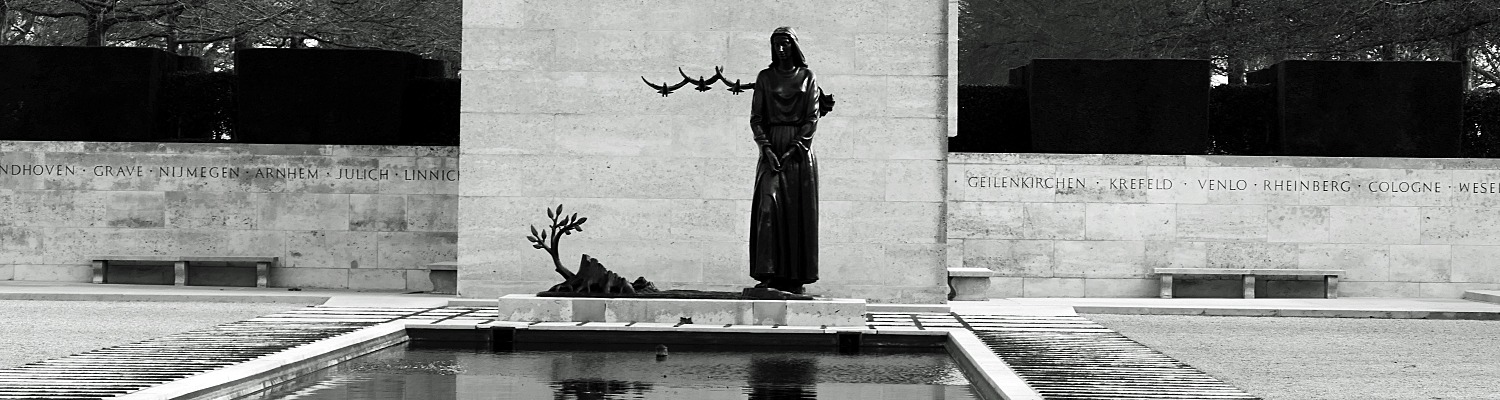
(Head picture: US military cemetery Margraten/Netherlands,
November 2025)
If you wish to support my work, you can do so here. Many thanks!