
Thoughts on war: Reinhard Mey, soldier “Kai” and the “damned field of honor” (Published on 12/03/2026)
I. Reinhard Mey and the horror of war
I have repeatedly referred to Reinhard Mey’s work and his songs against war on this blog (see, for example, here and here). Particularly moving is his account of the last days in the life of his father-in-law, who as a young man had to fight in Russia during World War II and who, in the face of his approaching death, was no longer able to suppress the horror of his experiences there, which he had carefully hidden throughout his life.
During a live concert in 2008, Reinhard Mey reported on this as follows:
“My father-in-law was a wonderful, fun-loving, witty, humorous man. And only in the last days of his life was he disturbed, confused, fearful, and jumpy, trying to free himself from his sickbed. He tried to escape because he thought he was back in the war. He imagined himself surrounded, encircled, attacked. And so, in the last hours of his life, he was once again shaken by the fears he had suppressed for 60 years.
In the last hours of his life, he suddenly once again became the boy who, at the age of 20, had been given a rifle and sent to war in Russia. The war had destroyed him. We hadn’t realized this because he knew how to hide it behind his wit and humor. Only when his strength waned and he could no longer fight off the images that tormented him did we realize the extent of it.
War destroys all people. Even those who seem to come home unscathed. Those who come home with their bones intact, because war destroys people’s souls. And every war does that. So does the war they are currently trying to sell us as inevitable, as right, as important and just. The ladies and gentlemen who never have to go there themselves. Who never lie in the dirt themselves, who are never shot at themselves, who never have to violate the commandment »Thou shalt not kill!« with their own hands. Who send our soldiers into war, into conflict, and then stand there and cry crocodile tears when they come home in zinc coffins.
War destroys everyone. Only the bigwigs return home unscathed.”
Words that give pause for thought even in 2026, when Germany is once again arming itself and promoting participation in wars that are being sold to the public by political protagonists – as so often – as “unavoidable, right, important, and just”, as if World War II and the lessons (supposedly) learned from it had never happened. But if history repeats itself once again, so too will the consequences for the people.
II. When families lose a member in war
Reinhard Mey describes these consequences directly after his remarks about the oppressive aftermath of war in his dying father-in-law in his song “Kai” (from 1:50 in the recording) from 2007 about the life and death of an air force soldier shot down during a relief mission and the thoughts of his surviving relatives. A complete collection of Reinhard Mey’s song lyrics is available on his website; the lyrics to “Kai” can be found on p. 501 (afterwards translated from German language).
Reinhard Mey – Kai
A letter written in sensitive, clear words,
A gentleman from the ministry delivered it.
They shouldn’t find about it on the radio,
The news will be on the morning news at eight.
Suddenly, nothing is the same anymore in the quiet terraced house.
The Minister expresses his deepest sympathy!
Kai was on that flight,
along with three comrades.
Four bullet holes in the nose,
loaded with relief supplies.
Silent, introverted, withdrawn,
shot down from the bright blue sky.
Kai was on that flight.
They have received the message in their darkest fears
Many times before and always suppressed it.
But now that it is here, their actions seem
Strangely composed, as if guided by someone else.
What will they bring home from the foreign land under the flag,
More than an identification tag from an impact fire?
Kai was on that flight,
along with three comrades.
Four bullet holes in the nose,
loaded with relief supplies.
Unarmed in friendly fire,
first officer at the controls.
Kai was on that flight.
Photos in frames all over the house,
With his school bag on his first day of school,
On a school trip, flying a kite,
And in his uniform at his swearing-in ceremony.
If only she had just spanked him and simply locked him up in the bathroom.
Just like back then when he stole the crayons from Woolworth’s!
Kai was on that flight,
along with three comrades.
Four bullet holes in the nose,
loaded with relief supplies.
Suddenly disappeared from the radar.
What happened in those seconds?
Kai was on that flight.
And living people in a secure parliament
Send another contingent of troops.
With words like assistance that seem noble,
Like “peace mission”, but mean nothing else
Than: We are sending young people to a country
Where they are not welcome, their service not recognized,
Their sacrifice not respected, their uniform hated –
You poor children, do you know what you are being sent to die for?
Violence will breed new violence,
Terror will feed new terror.
And once again, mothers learn no lesson from this,
And once again, fathers give their sons toy guns –
It does not lie fallow, it does not dry up, the damned field of honor!
Kai was on that flight,
along with three comrades.
Four bullet holes in the nose,
loaded with relief supplies.
At the end of the world,
crashed in a poppy field.
III. A lesson? Or emptiness?
Also this song by Reinhard Mey accurately sums up the mechanisms of war and its consequences for the soldiers affected and their families in an almost universal form. For those involved, the supposed “field of honor” means little more than death, suffering, and destruction; even the survivors remain scarred for the rest of their lives. Next time will be no different. Then, again, no one in Germany in particular will be able to say that they “knew nothing” and “did not want this.”
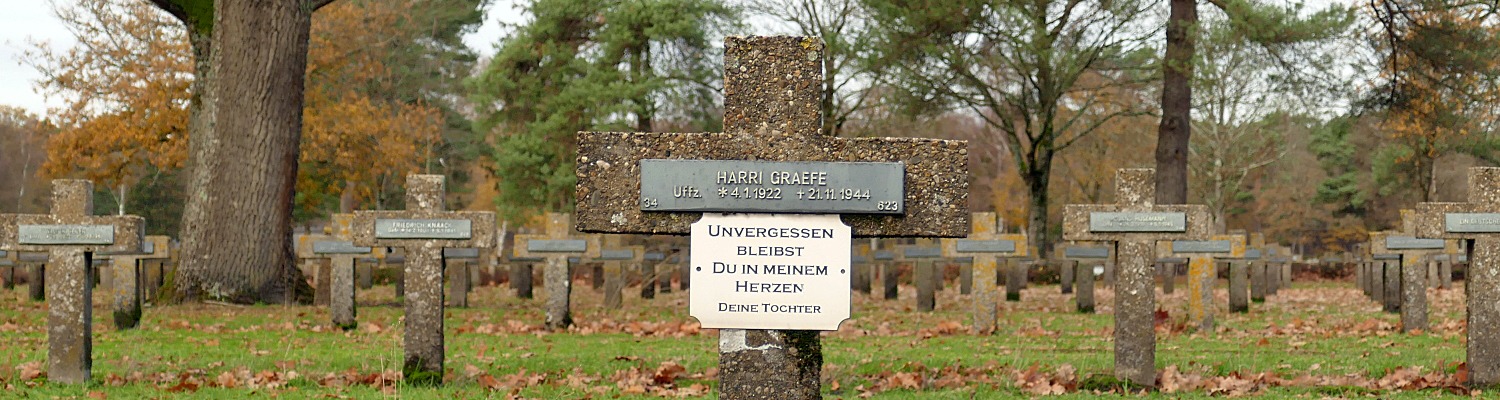
(Head picture: Grave cross at a foreign German military cemetery,
marked with a plaque reading “Unvergessen bleibst Du in meinem Herzen. Deine Tochter.”
[“You remain unforgotten in my heart. Your daughter.”],
December 2025)
If you wish to support my work, you can do so here. Many thanks!