
War diaries: The memories of German nurse Elfriede Schade-Bartkowiak of her time in German military hospitals on the Eastern Front between 1941 and 1945 – The soldier without a jaw and arms (Published on 12/12/2025)
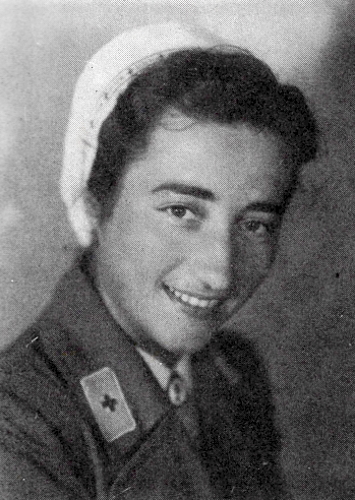
Doctors and nurses who worked in military hospitals during World War II can give particularly vivid accounts of the consequences of war. In addition to the report by Lilo Weinsheimer, which was reproduced here some time ago, Elfriede Schade-Bartkowiak, a Red Cross nurse at the time, vividly describes the horror of war in her 1989 book “Sag mir, wo die Blumen sind…” (“Where have all the flowers gone…”), which she experienced in military hospitals on the Eastern Front and wrote down.
The background of Mrs Schade-Bartkowiak, her path to becoming a nurse, and her initial experiences have already been described. Particularly memorable is her description of a young soldier who, in addition to a severe head injury, had also lost both arms in battle.
She writes (source: Schade-Bartkowiak, Sag mir, wo die Blumen sind, p. 28 ff.; translated from German language):
“One day I arrived at the station when the corporal from the office gave me a letter..
» For you, sister! The field post is working great!«
A letter! Ah – a letter. Yes, of course, you could receive mail. I turned it over in my hand, read the sender, from Mom, I sighed – from Mom.
But then sister Hedwig arrived with the orders for the night:
»I’m with the belly in room 8. We have to tie him down, he’s too violent and Wanda can’t cope with him. Please check on him more often. He’s an expert at unwrapping himself, he’s already torn off his bandages five times today… «
The letter went into my pocket with my notepad, and I began my rounds. There was so much to do that I completely forgot about the letter.
A large hospital train had arrived from the Stalingrad sector, and the stretchers with the new arrivals were piling up downstairs in front of the delousing station. Afterwards, they had to be freshly bandaged in the operating room or on the wards. All the rooms and halls were already full, and it was almost impossible to get through the stairwell and corridors. The Russian stretcher bearers dragged in additional straw sacks, and more and more sankras [short for »Sanitätskraftwagen«, ~ ambulance vehicle] spewed out their sad cargo. The operating rooms were the only ones lit up brightly by the glow of the dynamo lamps. None of the doctors and nurses could hope to get any sleep that night.
This time, it was mainly jaw and head shots that were unloaded. On the ground floor, the convalescent company from across the street had set up even more bunk beds the day before.
Soon the rooms were filled with rattling breaths and inarticulate sounds, as almost none of the wounded could speak properly, even though they were otherwise not so helpless.
I lent a hand wherever it was needed. I helped the men off the stretchers and into their beds, secured the mosquito nets against the flies, and stowed their belongings under their pillows. I ran to the operating room to receive patients who had just undergone surgery, fetched rubber tubes and tea to quench the thirsty … dawn was almost breaking when the influx finally began to subside.
The jaw ward presented an eerie sight: the bunk beds and mosquito nets above them made the rooms seem even gloomier and more desolate than usual. The air was stifling, breathing was labored, and beneath the nets lay figures that sometimes bore no resemblance to human beings. Huge, misshapen head bandages glowed ghostly in the darkness.
Now, finally, as I took their temperatures, I was able to concentrate on each individual. I pulled back the mosquito net of a lower bed to insert the thermometer and feel their pulse…
But – oh my God! There was nothing there! There was a body and a huge head bandage, and two smaller bandages on the sides, where a person’s arms would be.
The curtain fell from my hand, and I stood there for a moment, paralyzed. A guttural sound reached my ear, questioning, urgent. I took the rubber tube and the cup of tea, lifted the curtain, and inserted the tube into the hole in the middle of the head bandage. The cup was emptied halfway with a gurgling sound. Then the bandage turned toward me, and the sounds reached me again.
»What else does he want?« I thought. »My God, what can I do?«
At a loss, my fingers fiddled with the notepad and pencil I had brought with me for those who couldn’t speak.
But it was pointless! How could someone with two amputated arm stumps write? The gurgling sounds were incomprehensible. Suddenly – I breathed a sigh of relief – my brain seemed to be working again. I did have a mouth, after all, and could ask:
»Are you still thirsty?« Shakes head.
»Does the bandage hurt – are you in pain?«
»Do you need the syringe, the bottle?« Shakes head again.
»Are you uncomfortable?«
The eerie creature reacted to everything with an almost imperceptible but increasingly impatient shake of its head. At a loss, I lowered the mosquito net again, which was met with an immoderately disappointed snort and gurgle.
As I continued my work – taking temperatures, checking pulses, giving drinks, fulfilling requests scribbled on my notepad – I racked my brains: what does he want, what could this person want? A human being, this creature without a face, without a voice, without arms, and this creature wants something from me, has a wish. What can a person wish for who no longer has a voice, eyes, or arms?
As if by chance, my hand touched the letter in my pocket – the letter from my mother…
The letter! That was it!
I ran back, between the beds, and lifted the curtain:
»Would you like me to write a letter for you?«
Yes – yes! The answer – a vigorous nod. »… I am alive and on my way home.«
And once again, I had to learn a lesson in the book of life: withdrawing into myself and isolating myself, suppressing my feelings, switching them on and off as needed like a light switch – for my own peace of mind, as a form of protection – was not sufficient out here.
My own problems – I suddenly realized – my fears, my shame about them, my self-pity, and my grief over lost ideals – it was all so unimportant, so small, so insignificant. These people here didn’t just need a professional, the efforts of a night watchman – they needed me with all my heart and soul, but above all they needed my participation in their feelings, their thinking and their suffering.
It was not an easy learning process, and the strain did not lessen. From then on, I spent a lot of time after work writing letters home for the wounded, looking at pictures of their relatives, and listening to their worries and needs. I heard about women who were expecting a child at home while their husbands were fighting in Stalingrad. I recognized the helpless longing for home in a very young infantryman and learned of the lieutenant’s impatience to recover quickly and be with his men.
The highs and lows of military life lay before me like an open book. Homesickness and longing, fear and despair, courage and bravery, recklessness and fatalism, love and anger – the whole range of human and male emotions. And where words were not enough, I learned to read their eyes.
It may be true, as some say, that eyes alone cannot express feelings. But together with the faces, they spoke to me. The eyes fascinated me, the blue, brown, cloudy, feverish, light and dark, young and old. The enchantment of the language of the eyes will stay with me for the rest of my life.”
When Germany once again seeks to restore its “war readiness,” testimonials such as that of Elfriede Schade-Bartkowiak are invaluable in reminding us what war means.
May people remember this and say “No!” this time.
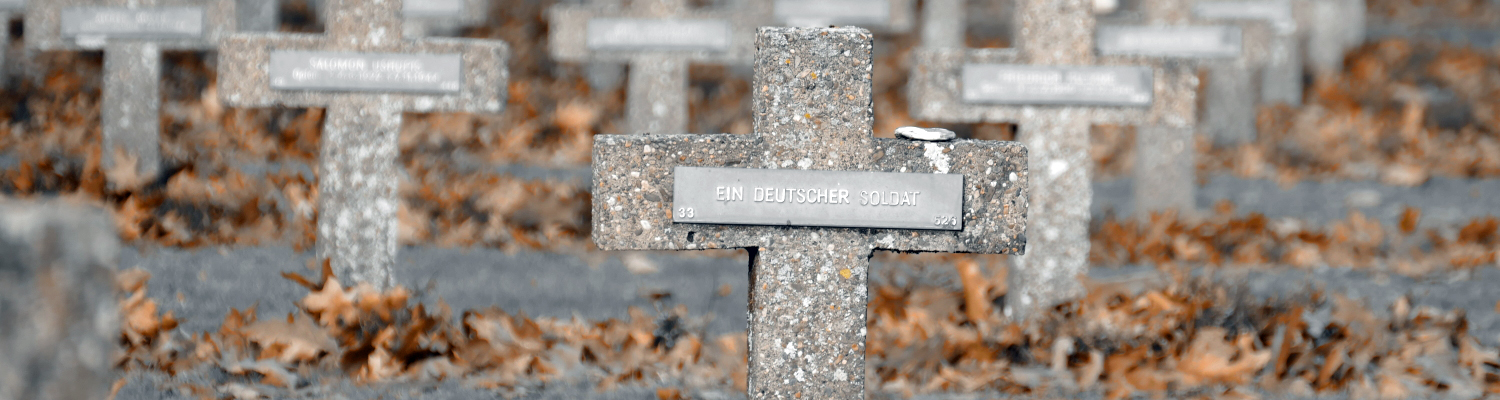
(Head picture: Grave cross at the German military cemetery in Lommel/Belgium,
inscribed “A German Soldier”, December 2025)
If you wish to support my work, you can do so here. Many thanks!